Garage Door Opener Repair vs Replace: When to Fix and When to Buy New
Your garage door opener isn't working—now what? This guide breaks down repair costs, replacement costs, and exactly when each option makes financial sense.
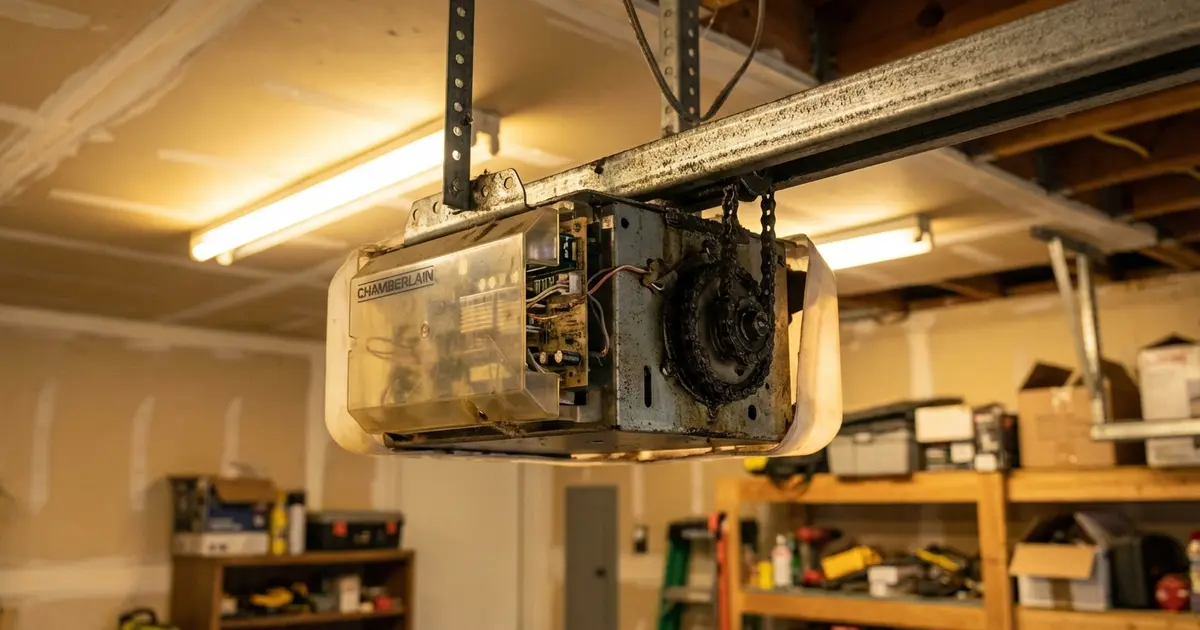
Quick Answer: Repair or Replace?
For most homeowners, the decision comes down to three factors: age of the unit, cost of the repair relative to replacement, and whether modern safety features are missing. Here's the short version:
| Situation | Recommendation |
|---|---|
| Opener under 7 years old, first repair | Repair — likely cost-effective |
| Opener 7–12 years old, one repair needed | Repair if quote is under 50% of replacement cost |
| Opener 12+ years old, any major repair | Replace — unit is near end of life |
| Second repair visit in 12 months | Replace — pattern of failure |
| Parts are discontinued | Replace — can't fix what you can't source |
| No auto-reverse or safety sensors | Replace — safety risk, likely pre-1993 |
Garage Door Opener Repair Costs by Problem Type
Repair costs vary widely depending on what failed. Simple fixes like sensor alignment or remote reprogramming cost very little. Major component failures—logic boards, motors, stripped gears—can approach the cost of a new unit. Use this table to benchmark what you're quoted.
| Problem | DIY Cost | Pro Cost (Parts + Labor) | Notes |
|---|---|---|---|
| Remote/keypad not working | $5–$30 (batteries/new remote) | $50–$100 | Often just batteries or a sync issue |
| Safety sensor misalignment | $0 (adjust yourself) | $50–$100 | Check alignment before calling anyone |
| Drive gear stripped | $20–$60 (parts only) | $100–$200 | Common on chain-drive units after 5+ years |
| Logic / circuit board | $50–$150 (part only) | $130–$280 | Boards vary by brand; verify availability |
| Capacitor / start capacitor | $10–$30 | $90–$160 | Motor hums but won't start = likely capacitor |
| Trolley / carriage replacement | $30–$80 | $110–$220 | Door moves but opener doesn't push/pull |
| Motor replacement | N/A | $200–$400 | Motor-only replacement rarely makes financial sense on older units |
| Travel / force limit adjustment | $0 (owner's manual) | $50–$100 | Door reverses before closing = try limit adjustment first |
| Wiring repair | Not recommended | $80–$180 | Exposed or chewed wiring, loose connections |
| Full tune-up + safety check | — | $60–$130 | Good preventive investment on units 5+ years old |
Regional Labor Variation
Labor rates for opener work vary by market. Expect the high end of ranges in coastal metros (Los Angeles, New York, Seattle, Boston) and the low end in mid-size Midwest or Southern cities. Emergency or same-day service typically adds $50–$150 to any repair quote.
| Region | Typical Labor Rate (per hour) | Standard Service Call Fee |
|---|---|---|
| Northeast (NYC, Boston, Philly) | $90–$130 | $75–$120 |
| West Coast (LA, SF, Seattle) | $85–$125 | $70–$110 |
| Southeast (Atlanta, Charlotte, Orlando) | $65–$95 | $55–$85 |
| Midwest (Chicago, Columbus, Kansas City) | $65–$100 | $55–$90 |
| Southwest (Phoenix, Dallas, San Antonio) | $65–$95 | $55–$85 |
Garage Door Opener Replacement Costs
When replacement is the right call, you have meaningful choices in price and capability. The total installed cost includes the unit, installation labor (typically 2–3 hours), disposal of the old unit, and basic programming of remotes and keypads.
| Opener Tier | Unit Cost | Installed Cost | Best For |
|---|---|---|---|
| Budget chain-drive | $100–$180 | $220–$350 | Detached garages, low use, price-sensitive buyers |
| Mid-range belt-drive | $180–$280 | $330–$500 | Attached garages, quieter operation needed |
| Smart opener (Wi-Fi + app) | $220–$380 | $380–$600 | Most new installs — remote monitoring, alerts |
| Smart opener + battery backup | $280–$450 | $420–$700 | Areas with frequent power outages, attached garages |
| Premium / direct-drive | $350–$600 | $500–$900 | Heavy or oversized doors, ultra-quiet, long service life |
Installation labor alone typically runs $100–$200 for a standard residential opener swap. If new wiring, drywall anchoring, or a custom ceiling bracket is needed, add $50–$150.
The Decision Framework: The 60% Rule (and When to Ignore It)
A common rule of thumb in appliance repair: if the repair exceeds 50–60% of replacement cost, replace instead. For garage door openers specifically, here's how to apply it:
- Get a written repair quote with parts and labor itemized.
- Get or estimate a replacement quote for an equivalent-quality unit installed.
- Calculate: repair cost ÷ replacement cost = repair ratio
- If ratio is below 0.5 and the unit is under 10 years old: repair.
- If ratio is 0.5–0.7 and unit is 10–13 years: judgment call based on condition and features.
- If ratio exceeds 0.7 OR unit is 13+ years old: replace almost always wins.
Example Calculation
Your 11-year-old chain-drive opener needs a logic board: $180 repair quote. A new mid-range belt-drive opener installed: $420. Ratio: 180/420 = 0.43. On the formula, repair wins—but at 11 years, the unit has limited life left. In this case, a smart upgrade to a belt-drive with Wi-Fi likely makes sense for a $240 premium, especially if the attached garage is your main entry.
The Age Factor (Override Rule)
Age modifies the formula. Even a "cheap" repair on a 15-year-old opener is often a false economy—you're resetting the repair clock on a unit that will likely need another service call within 1–2 years. Past 12–13 years, lean heavily toward replacement unless the repair is minor (under $100) and the unit is low-use.
Signs It's Time to Replace Your Garage Door Opener
- It's 12–15+ years old: Most major components are near end of life. You're one part away from another repair visit.
- No safety auto-reverse: Any opener installed before 1993 lacks federally required auto-reverse sensors. This is a safety hazard for children and pets—replace immediately.
- No rolling code technology: Older fixed-code openers are vulnerable to code-grabbing theft. Smart criminals can clone the signal. Modern openers use rolling codes that change every use.
- Second repair in 12 months: Two service calls in a year signals systemic failure, not isolated part failure.
- Parts are discontinued: If the technician can't source OEM parts, the repair relies on workarounds that may not last.
- Extremely loud operation: Chain-drive units get noisier as the chain and sprocket wear. If vibration is disturbing living spaces, a belt or direct-drive replacement solves it permanently.
- No smartphone control (and you want it): If you're tired of keeping track of remotes or want to let in delivery drivers remotely, upgrading to a smart opener is a lifestyle improvement that a repair won't deliver.
- No battery backup (and you need it): If power outages trap your car in the garage, a new unit with battery backup ends that problem.
Signs a Repair Makes More Sense
- Unit is under 7 years old: Even mid-range repairs are typically cost-effective on a relatively new opener.
- Problem is clearly isolated: A single failed component (stripped gear, bad sensor, dead remote) on an otherwise healthy unit is a good repair candidate.
- The repair is minor: Anything under $100–$120 is almost always worth fixing regardless of age.
- You just replaced the door: If your door and springs are new, keeping a functional opener for another few years avoids unnecessary spend.
- The unit already has features you want: If it's already a smart opener with battery backup, a $150 logic board repair is obvious math.
Opener Types: What You're Choosing Between at Replacement
If you decide to replace, understanding the drive types helps you buy right the first time.
| Drive Type | Noise Level | Cost | Lifespan | Best For |
|---|---|---|---|---|
| Chain drive | Loud | Lowest | 10–15 years | Detached garages, budget-focused buyers |
| Belt drive | Quiet | Mid-range | 10–15 years | Attached garages with living space above/beside |
| Screw drive | Moderate | Mid-range | 8–12 years | Single-car garages, minimal maintenance preference |
| Direct drive | Very quiet | Higher | 15–20+ years | Attached garages, heavy doors, long-term value seekers |
| Jackshaft / wall-mount | Very quiet | Highest | 15–20+ years | High-lift or low-headroom applications |
For most attached-garage homeowners, a mid-range belt-drive smart opener with battery backup delivers the best balance of noise, reliability, features, and total cost over 10+ years.
Smart Opener Features Worth Paying For
Not all add-ons are worth the premium. Here's an honest breakdown of what's genuinely useful versus what's marketing fluff.
| Feature | Typical Upcharge | Worth It? | Why |
|---|---|---|---|
| Wi-Fi / smartphone app | $40–$80 | ✅ Yes, for most | Open/close remotely, monitor status, get alerts |
| Battery backup | $60–$120 | ✅ Yes (attached garage) | Power outages no longer trap your car inside |
| Auto-close timer | Included on most smart units | ✅ Yes | Closes automatically if left open—prevents weather and security issues |
| Integrated camera | $80–$150 | ⚠️ Maybe | Useful for security, but standalone cameras often offer better value |
| Built-in LED lighting | Minimal | ✅ Yes | Better coverage, longer life than incandescent |
| Keypad + 2 remotes included | Included in package | ✅ Yes | Saves $60–$100 vs buying separately |
| Ultra-quiet drive upgrade | $100–$200 | ✅ For attached garages | Reduces vibration into living space significantly |
DIY vs Hiring a Pro: What You Can Safely Do Yourself
Opener work ranges from simple 5-minute tasks to moderately complex electrical and mechanical repairs. Here's what's safe to attempt and what isn't.
Safe DIY tasks
- Replacing remote batteries or buying a new compatible remote ($15–$40)
- Reprogramming a remote or keypad (see opener manual or YouTube for your model)
- Adjusting safety sensor alignment (loosen wing nut, aim lights at each other, retighten)
- Adjusting travel limits and force settings (clearly documented in most manuals)
- Replacing the trolley release rope/cord
- Cleaning the rail and applying light lubrication to the drive mechanism
Tasks worth hiring a pro for
- Logic board / circuit board replacement (risk of incorrect part + electrostatic damage)
- Motor or capacitor replacement (electrical safety, warranty implications)
- Drive gear replacement (mechanical disassembly, alignment)
- Full replacement installation (wiring, mounting, programming, safety testing)
- Any work near the torsion spring system (springs under extreme tension—separate risk)
Find trusted garage door pros in Phoenix, Atlanta, Chicago, Seattle, and Miami.
How to Troubleshoot Before Calling Anyone
Before spending money on a service call, run through this checklist. Many opener issues have free or near-free fixes:
- Check the power: Is the outlet working? Try plugging in a lamp. Check the circuit breaker. Reset the GFCI outlet if there is one near the garage.
- Check the remote batteries: Replace them. Even "new-ish" batteries can be weak. Try the wall button instead—if the wall button works and the remote doesn't, the remote is the issue.
- Check the safety sensors: Look at the small sensors near the floor on each side of the door. Each should show a steady light (not blinking). If one is blinking, gently realign it until both lights are solid.
- Check if the manual release was pulled: A red cord hanging from the trolley disconnects the door from the drive. If it's been pulled, reconnect it by pulling the cord toward the motor until you hear a click.
- Check travel limits: If the door reverses immediately after starting to close, the limit settings may be off. Consult your manual for adjustment screws.
- Check for obstructions: Sweep the floor threshold. Even a small pebble can trigger the sensor reverse.
If none of these fix it, you've narrowed down the problem meaningfully before calling a technician—which helps you evaluate quotes more effectively.
What a Good Opener Repair Quote Looks Like
A professional, transparent quote should include:
- Line items for parts and labor (not a single blended number)
- The specific part name and, ideally, the part number
- Labor warranty (minimum 30–90 days on the work performed)
- Parts warranty (OEM parts typically carry 90-day to 1-year warranties)
- Total price before you authorize work
Be cautious of quotes that list only a lump sum with no breakdown, or technicians who insist on "seeing it in person before quoting" but then pressure-sell a replacement on-site. A good company can give you a ballpark range over the phone based on the symptoms you describe.
How to Hire a Garage Door Opener Technician
- Get 2–3 quotes: For any repair over $150, it's worth a quick second opinion—even by phone.
- Ask about truck-stock parts: Companies that stock common opener parts on their trucks can complete the job in one visit. Companies that have to order parts add delay and often a second service call fee.
- Verify licensing in your state: Many states require garage door contractors to carry a specialty license. Ask if they're licensed and insured.
- Check reviews for opener-specific work: Search "[company name] + opener repair" on Google Maps to see if reviews mention opener work specifically—not just spring or cable jobs.
- Ask about same-day availability: If your garage is your primary entry, getting it working today matters. Premium for same-day is usually worth it.
Find trusted garage door pros in Nashville, Charlotte, Orlando, San Antonio, and Portland.
How Long Does Opener Replacement Take?
A straightforward opener swap on an existing properly-working door takes 1.5–3 hours for an experienced technician. The job involves removing the old unit, mounting the new rail and motor head, connecting wiring, installing sensors, programming remotes and keypad, testing all safety features, and adjusting force/travel limits.
If the old opener left behind damaged wiring, a non-standard mount, or the door itself needs adjustments, add 30–60 minutes. Complex situations (jackshaft installs, high-lift conversions, low-headroom brackets) can take 3–5 hours.
Brand Considerations When Replacing
The opener market is dominated by a handful of major brands. Here's what to know:
- LiftMaster / Chamberlain: The most-used brands in the US. Excellent parts availability, strong dealer network, myQ smart platform is mature. Best choice for most homeowners.
- Genie: Strong mid-market option. Intellicode security, good customer support. Slightly less dealer presence than LiftMaster.
- Craftsman: Solid budget-to-mid option, widely available at hardware stores. Newer units use the AssureLink platform.
- Ryobi: Direct-drive units sold at Home Depot. Good quiet performance and app control at mid-range prices.
- Overhead Door: Premium commercial and residential brand. Excellent build quality; higher price point.
For most homeowners, choosing LiftMaster or Genie maximizes the chance your local technician stocks parts and is familiar with the platform.
Find Garage Door Opener Pros Near You
Find trusted garage door pros in Phoenix · Atlanta · Chicago · Seattle · Miami
Related Guides
FAQs
How much does it cost to repair a garage door opener?
Most garage door opener repairs run $75–$350 depending on what failed. Common fixes include logic board replacement ($100–$200), drive gear replacement ($80–$150), and circuit board or capacitor repairs ($90–$180). Labor typically adds $50–$100 per visit.
How much does it cost to replace a garage door opener?
A new garage door opener professionally installed costs $250–$600 for most homes. Budget units start around $150 installed; smart openers with battery backup and Wi-Fi can reach $700–$900 installed. Unit cost alone ranges from $100–$400+.
When should I replace instead of repair my garage door opener?
Replace when: the unit is 10–15+ years old, you've had two or more repair visits in one year, parts are discontinued, the repair quote exceeds 60% of replacement cost, or you want modern safety features (auto-reverse, battery backup, smartphone control).
Can I repair a garage door opener myself?
Minor tasks like reprogramming remotes, replacing batteries, and adjusting force/travel limits are safe DIY jobs. Logic board replacement and drive gear repairs require moderate mechanical skill. Spring-related work and anything involving the motor wiring should be left to professionals.
What are the most common garage door opener problems?
The five most common issues are: (1) remote or keypad not working—usually batteries or signal issues, (2) door reverses before closing—often a sensor misalignment or travel limit issue, (3) opener runs but door doesn't move—likely a stripped drive gear, (4) opener is very loud—worn trolley or drive mechanism, (5) door won't open at all—could be logic board, power issue, or disengaged trolley.
How long do garage door openers last?
Most garage door openers last 10–15 years with normal use. High-quality units from brands like LiftMaster can reach 15–20 years. Factors that shorten lifespan include frequent use (4+ cycles/day), poor spring balance (the motor works harder), and lack of periodic maintenance.