Garage Door Cable Repair: Signs, Costs, and Safety Warnings
Garage door cables are under tremendous tension and quietly do one of the hardest jobs in your home. When they fail — and they do fail — the consequences can be sudden and dangerous.
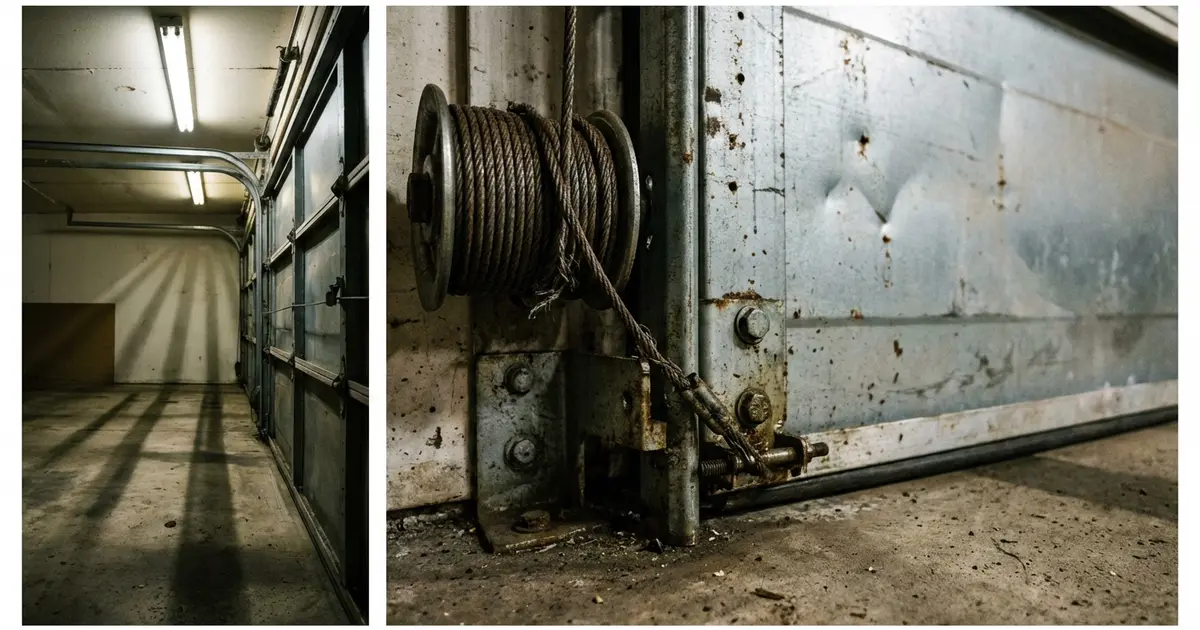
How Garage Door Cables Work
Your garage door looks like a simple piece of equipment — but it's a precisely balanced mechanical system. Cables are the critical tension-transfer component that makes it work safely.
When the garage door is closed, the springs (either torsion springs above the door or extension springs along the tracks) are wound under tension. When the door opens, that spring tension is released — and the cables transfer that energy to lift the door's weight. Without functioning cables, the springs have no way to transmit force to the door.
A standard residential garage door weighs 130–350 lbs. The cables, working together with the springs, make it possible to lift that weight smoothly with a modest opener motor — or even by hand. This is why cable failure is so disruptive: the door instantly becomes a dangerous, unsupported dead weight.
Garage Door Cable Types
There are two types of cables in a garage door system, and both serve critical safety functions:
Lift Cables (Primary Load-Bearing)
These are the cables you most often hear about. They wrap around a drum at the top of the door and connect to the bottom bracket on each side of the door. They transfer spring energy to lift the door and control its descent.
- Attach at the bottom corner of the door on each side
- Wind around a cable drum when the door opens
- Work in tandem with torsion springs (most modern doors) or extension springs
Safety Cables (Extension Spring Systems)
Doors with extension springs (the springs that run along the horizontal track) also use safety cables — a second cable that threads through the center of the spring. If the spring snaps, this safety cable prevents the broken spring from becoming a projectile.
- Required on all extension spring doors for safe operation
- Should be inspected at every service visit
- If missing on your extension spring door, add them immediately
| Cable Type | Function | Spring System |
|---|---|---|
| Lift cables | Transfer spring energy to lift door | Torsion and extension doors |
| Safety cables | Contain broken spring, prevent projectile | Extension spring doors only |
Warning Signs Your Garage Door Cable Is Failing
Cables don't always fail without warning. Knowing the early signs can help you address wear before a sudden, dangerous failure occurs.
Visual Signs
- Fraying or unraveling: Look at the cables where they attach to the bottom bracket. If you can see individual wire strands separating from the main cable, it's fraying. This is a pre-failure condition — the cable is near the end of its life.
- Rust or corrosion: Surface rust weakens the cable's tensile strength. In humid or coastal climates, cables can corrode faster than average. Rust that penetrates into the cable strands indicates replacement is due.
- Cable slack or piling up: If a cable has come off its drum, you may see it lying coiled on the garage floor or hanging loosely near the door frame. This is an active failure requiring immediate attention.
- Visible damage near the drum: Inspect the cable drum (the spool at the top of each side of the door). If cable wraps look uneven, overlapping, or jammed, the cable may have slipped its track.
Operational Signs
- Door hangs crooked or opens unevenly: If one side rises faster than the other, a cable may have slipped or failed on one side.
- Door feels heavier than usual: Cables that are fraying may slip slightly under load, reducing the effective spring-assist.
- Grinding or scraping noise: A cable that has jumped off its drum can scrape against the track or other hardware.
- Opener straining or reversing: Many modern openers detect unusual resistance. If the opener reverses when the door is only partway down, cable issues (among other problems) may be the cause.
- Door drops fast on one side: A sure sign of cable failure on that side. Stop using the door immediately.
What Happens When a Cable Breaks
A cable failure is not a gentle event. When a lift cable snaps or comes off its drum while the door is in motion:
- The door loses balanced support immediately and can drop suddenly on one side
- If the door is open or partially open, it can fall rapidly — creating a crush hazard for anyone or anything beneath it
- The opener may continue running, torquing the door rails and potentially bending the track or stripping gears
- The remaining cable takes full load on one side, putting it at higher failure risk
What to do immediately: Do not try to open or close the door manually. Do not run the opener. If the door is stuck open, call a 24-hour garage door company to secure it safely. If it's shut (even crookedly), leave it shut until a technician arrives.
For related troubleshooting, see our garage door won't open guide and off-track repair guide.
Garage Door Cable Repair Cost in 2026
Cable repair is one of the more affordable garage door services — the parts are inexpensive, and labor time is typically 1–2 hours. Most homeowners pay $100–$400 for cable service, with the wide range explained by whether springs need adjustment, how many cables are replaced, and local market rates.
| Service | Typical Cost |
|---|---|
| Cable reattachment (came off drum, no break) | $75–$175 |
| Single cable replacement | $100–$200 |
| Both cables replaced (recommended) | $150–$300 |
| Cables + spring adjustment | $200–$400 |
| Safety cables added (extension spring door) | $50–$100 |
| Emergency / after-hours service | +$50–$150 |
Cable costs themselves are low ($15–$40 per cable for standard residential lift cables). The majority of the bill is labor — and the expertise to safely work around the spring system. Upgrading to galvanized cables (better corrosion resistance) usually costs $10–$20 more per cable and is worth it in humid or coastal areas.
✅ Key Takeaway: Always replace both cables at once — the second is always near the same failure point. The extra cost is minimal compared to a second service call.
When Cables and Springs Fail Together
Cable failures and spring failures are closely related. A broken torsion spring releases uncontrolled tension that can yank cables off their drums. Conversely, a cable that comes off its drum can put asymmetric load on a spring and cause premature failure. Many cable service calls include a spring inspection — and sometimes a combined repair. See our spring replacement cost guide for full pricing on that side of the repair.
Regional Cost Breakdown
Labor rates for garage door service vary meaningfully across the US. These estimates are for a standard two-cable replacement on a residential sectional door (no spring work included):
| Region | Estimated Cost (Both Cables) |
|---|---|
| Southeast (TX, GA, FL, SC) | $130–$250 |
| Midwest (IL, OH, MN, MI) | $140–$270 |
| Mountain West (CO, AZ, NV, UT) | $150–$280 |
| Northeast (NY, MA, CT, NJ) | $180–$350 |
| West Coast (CA, OR, WA) | $200–$380 |
Rural areas and small markets may have fewer competitive options. In those areas, a single provider quote can run at the high end. Getting at least two quotes — even by phone — helps establish a reasonable market rate in your area.
DIY vs Professional: The Safety Case
Garage door cable repair is one of the clearest cases where professional service is strongly recommended, even for mechanically capable homeowners. Here's why:
The Core Risk: Spring Tension
Cables are physically simple — braided wire. The danger comes from what they're connected to. Torsion springs are wound under hundreds of pounds of force. Extension springs stretch to bear the door's weight. Any mistake while working with cables — a slip, an unexpected release, or a tool that catches — can cause the spring energy to release violently.
ER data and insurance reports consistently list garage door spring and cable injuries as serious. Broken wrists, fractured hands, and eye injuries are common outcomes of DIY spring/cable mishaps.
⚠️ Warning: Cables work in tandem with springs under hundreds of pounds of tension. Never attempt DIY cable replacement — the spring system must be safely unwound first by a trained technician.
What DIY Is and Isn't Appropriate For
| Task | DIY Safety | Notes |
|---|---|---|
| Visually inspect cables for fraying | ✅ Safe | Do this regularly, door closed, opener unplugged |
| Lubricate cable drum area | ✅ Safe | With door closed, spring tension engaged |
| Re-seat cable that came off drum (no spring work) | ⚠️ Risky | Only if fully confident; spring must be safely managed |
| Replace broken lift cable | ❌ Pro only | Requires spring winding/unwinding; high injury risk |
| Add safety cables to extension spring | ⚠️ Moderate risk | Springs must be unloaded; DIY possible with experience |
| Cable replacement + spring adjustment | ❌ Pro only | Combined scope significantly increases risk |
The Cost Argument for DIY Doesn't Hold
Cable parts cost $15–$40. A professional charges $100–$300 for the job. The savings aren't significant enough to justify the risk — especially when you factor in the cost of an ER visit if something goes wrong. This is one area where the professional's value is clear.
What to Expect During Professional Cable Replacement
Understanding the process helps you verify that the technician is doing the job correctly — not cutting corners.
- Door locked and secured: The technician will disconnect the opener and lock the door in place to prevent movement during work.
- Spring tension released (if needed): For torsion spring systems, the spring must be unwound before cables can be safely replaced. This requires calibrated winding bars and experience.
- Old cables removed: Both cables should be replaced simultaneously. A technician replacing only one cable when both are worn is cutting corners.
- New cables installed and routed: Cables thread through specific paths along the door and wrap around the drum in a precise pattern. Improper drum winding creates uneven tension and premature failure.
- Spring re-tensioned and door balanced: After cables are seated, the spring is re-tensioned to the correct turns-per-inch spec for the door's weight. The door is then balanced — it should stay at mid-height without drifting.
- Full safety test: The technician tests opener force settings, auto-reverse, and safety sensor function before leaving.
A cable replacement with spring adjustment takes approximately 1–2 hours for most residential doors.
How to Extend Your Garage Door Cable Life
Cables don't require much maintenance, but a few simple habits meaningfully extend their lifespan and reduce the chance of a sudden failure:
Regular Visual Inspection
Once or twice a year, open the garage door fully and look at the cables. With the door open and the spring tension engaged in the drum, the cables should look smooth, evenly wound, and free of fraying, rust, or kinks. Check where the cable attaches to the bottom bracket — this is where wear most often starts.
Lubrication
Cables themselves don't need direct lubrication (it can attract dirt and cause buildup). However, keeping the cable drums and bottom brackets lightly lubricated reduces friction and wear. Use a garage-door-specific lubricant — not WD-40, which evaporates quickly and leaves residue.
Avoid Overloading the System
Cables and springs are sized for the door's specific weight. Adding heavy insulation panels, switching from a single-layer to a triple-layer door without replacing the spring system, or installing extra hardware without adjusting cable tension can accelerate wear.
Address Door Balance Issues Promptly
An off-balance door puts uneven stress on cables. If the door drifts or one side feels heavier, get it balanced before the uneven load damages cables or springs.
Annual Tune-Up
An annual professional tune-up (typically $80–$150) includes cable and spring inspection, lubrication, and hardware tightening — and often catches fraying cables before they fail. It's the single best investment in preventing an emergency call.
Hiring a Cable Repair Pro: What to Ask
Not all garage door service companies are equal. Before booking, ask these questions:
- "Will you replace both cables or just the broken one?" — Both should be replaced. A company that only replaces the broken one is setting you up for a repeat call.
- "What type of cable will you install?" — Ask if they carry galvanized cables. In humid climates especially, the small upgrade in corrosion resistance is worth it.
- "Does the quote include spring adjustment and door balancing?" — It should. Replacing cables without re-tensioning and balancing is incomplete work.
- "What is your labor warranty?" — Reputable companies offer 90 days to 1 year on parts and labor.
- "Is there a dispatch or service call fee separate from repair cost?" — Know what you're paying before the technician arrives.
Also see our guide on how to choose a reliable garage door repair company for a full vetting checklist — including how to spot red flags in pricing and upselling behavior.
For a complete look at what you might pay across all garage door repairs, see our garage door repair cost guide.
Find Cable Repair Pros Near You
Find trusted garage door pros in Los Angeles · Find trusted garage door pros in Miami · Find trusted garage door pros in Seattle · Find trusted garage door pros in Minneapolis · Find trusted garage door pros in Atlanta
Frequently Asked Questions
How much does garage door cable repair cost?
Garage door cable repair typically costs $100–$400, including parts and labor. A simple cable reattachment may cost $75–$150, while full cable replacement on both sides (recommended when one breaks) usually runs $150–$300. Emergency or after-hours service adds $50–$150 to the total.
Can I fix a broken garage door cable myself?
Cable replacement is not recommended as a DIY task for most homeowners. Garage door cables work in tandem with the spring system, which is under extreme tension. Improperly handling cables while the spring is loaded can result in sudden, violent release of energy and serious injury. Even experienced mechanics should use caution. Call a licensed technician.
What happens if a garage door cable breaks?
When a cable breaks, the door loses balanced support on one side. This typically causes the door to become crooked, drop suddenly on the broken cable side, or become completely inoperable. In some cases the opener will detect the resistance and stop — but in others, the door can drop fast enough to cause injury or property damage. Stop using the door immediately.
Should I replace both cables at the same time?
Yes. Both cables experience the same number of cycles and the same wear. If one has failed, the other is nearing the same failure point. Replacing both at the same time costs only marginally more than replacing one — and avoids a second service call (and second emergency) weeks later.
How long do garage door cables last?
Cables typically last 7–15 years, depending on use frequency, material quality, and environmental conditions. Cables in humid or coastal environments can corrode faster. Galvanized cables offer better corrosion resistance and are worth requesting if you're in a high-moisture area.
How do I know if my cable is frayed vs broken?
A broken cable will usually be visibly loose or coiled on the floor of the garage, and the door will hang crooked. A frayed cable may still be intact but shows unraveled wire strands — this is a warning sign of imminent failure. Both conditions warrant immediate professional inspection. Do not continue using the door.