How to Fix a Garage Door Off Track: Step-by-Step Guide
A garage door that has jumped off its track is one of the more alarming garage problems—but it's also one of the more common ones. Here's exactly what to do, what it costs, and when to call in a professional.
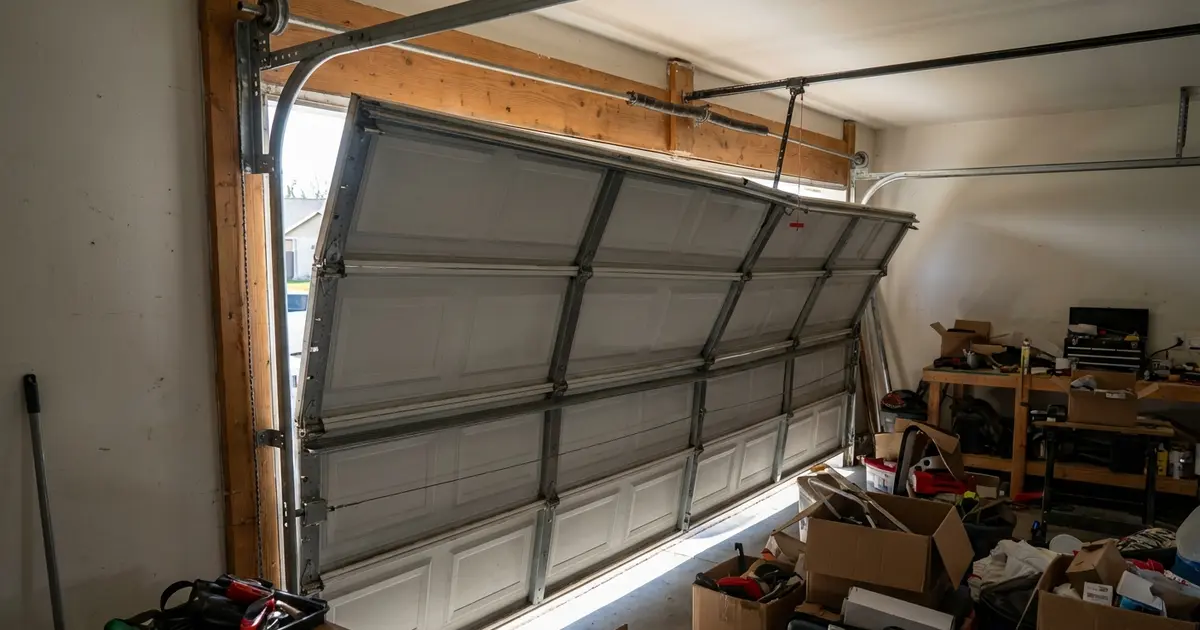
What Does "Off Track" Actually Mean?
A garage door runs on two vertical tracks on either side of the opening, plus horizontal tracks that extend into the garage ceiling. Steel rollers—attached to the door's hinges—roll inside these tracks as the door opens and closes.
When a door "goes off track," one or more rollers have popped out of the track channel. The severity ranges from a single roller barely misaligned (easy fix) to the entire door having collapsed out of both tracks (structural repair).
Understanding which situation you're dealing with is the first step. The visual inspection below will tell you quickly.
| Severity | What You See | Typical Fix |
|---|---|---|
| Minor | One roller slightly out, door stuck but upright | DIY or simple pro re-track ($125–$175) |
| Moderate | Multiple rollers out, door sagging or tilted | Pro re-track + cable check ($175–$350) |
| Severe | Door fully derailed, track bent, panels buckled | Pro repair + parts replacement ($300–$700+) |
| Critical | Door has fallen, spring or cable snapped | Emergency professional service (call immediately) |
Immediate Safety Steps (Do These First)
Before assessing damage or attempting any repair, take these steps in order:
- Stop using the opener. Pull the red emergency release cord (hangs from the trolley) to disconnect the opener from the door. This prevents the motor from running against a stuck door and burning out or causing the door to move unpredictably.
- Do not try to force the door open or closed. A derailed door can fall suddenly with significant force. A standard two-car garage door weighs 150–300 lbs. Do not stand under it.
- Secure the door where it is. If the door is partially open, use locking pliers (Vise-Grips) clamped to the track below a roller to prevent it from sliding down. Use two clamps, one on each side.
- Keep people and pets out of the area. Treat the space under the door as a fall zone until it's secured.
- Check for broken springs or cables before touching anything else. If you see a cable hanging loose or a visible gap in a spring coil, stop and call a pro—the door's weight is no longer being managed safely.
What Causes a Garage Door to Go Off Track?
Understanding the cause matters because it tells you whether this was a one-time event or something likely to recur.
1. Impact — Vehicle or Object Strike
The single most common cause. A car bumper clipping the door, a ladder falling against a panel, or a child's bike hitting the track are all enough to knock rollers out of alignment. Impact often bends the track locally, which requires repair beyond just re-seating the rollers.
2. Worn or Broken Rollers
Nylon rollers can crack, and steel rollers can rust or flatten over time. A damaged roller can't stay in the track channel under load, especially on the way up or down. This is a wear-and-tear failure that worsens gradually before causing a full derailment.
3. Cable Failure
Garage door cables run along either side of the door and connect the spring system to the bottom of the door. If one cable snaps or slips off the drum, the door loses balanced support on that side and can torque out of the tracks as it moves.
4. Track Misalignment (Gradual)
Track bolts can loosen over years of vibration and use. If a track section shifts out of plumb or gets knocked inward, rollers eventually can't navigate the bend and pop out. This is a progressive failure you may first notice as grinding or a hitch in the door's movement.
5. Obstructions at the Bottom
A rock, frozen snow, or debris caught under the door as it closes can stop the door suddenly while the opener continues to push. This can pop rollers out at the base and stress the bottom section brackets.
6. Door Forced When Disengaged
If someone manually lifted the door after pulling the emergency release but lifted unevenly or too forcefully, panels can shift and rollers can derail.
7. Ice and Cold Weather
In cold climates, the door can freeze to the floor seal. Running the opener when the door is frozen can cause sudden strain that pops the bottom rollers out and can damage the bottom panel brackets.
How to Assess the Damage Before Doing Anything
With the door secured and the opener disconnected, do a careful visual inspection from outside the fall zone. You're looking for:
- Roller location: Can you see which rollers are out of the track? Are they on one side or both?
- Track condition: Is the track straight, or is there a visible bend, kink, or gap in the brackets?
- Cable condition: Look at each side of the door where the cables run. Are they taut and on the drum, or hanging loose?
- Spring condition: Look at the horizontal spring assembly above the door (torsion) or along the horizontal tracks (extension). Is there a visible gap or break?
- Panel condition: Are any door panels bent, buckled, or separated at the seams?
- Bottom brackets: The metal brackets at the door's bottom corners hold the cable and bottom rollers. Are they intact and flat against the door?
If everything looks intact except one or two rollers that are clearly just out of the track channel—and you can see the track is straight with no bends—you're dealing with a minor derailment. Continue to the DIY section. If anything else looks wrong, stop here and call a professional.
Step-by-Step DIY Fix: Minor Roller Misalignment
This procedure applies only to minor cases where a single roller (or two adjacent rollers on the same side) has slipped out of a straight, undamaged track. All springs and cables must be intact and under tension.
Tools You Need
- Locking pliers / Vise-Grips (2 pairs)
- Rubber mallet
- Needle-nose pliers
- Work gloves
- Safety glasses
- Optional: flathead screwdriver, WD-40 or garage door lubricant
Step 1: Secure the Door
Clamp one pair of locking pliers on each track just below the lowest roller that's still seated in the track. This prevents the door from dropping while you work. Do not work under an unsecured door.
Step 2: Widen the Track Opening
Using your pliers, gently bend the track lip outward at the section just below where the roller came out. You only need to open the gap by about 1/4 inch—just enough to allow the roller to re-enter. Work slowly; over-bending the track creates a new alignment problem.
Step 3: Re-Seat the Roller
Align the roller stem with the track opening you widened. Holding the door steady with one hand, guide the roller back into the track with your other hand. A rubber mallet can help tap it into position if needed. Do not use metal tools to hammer rollers—you'll damage the roller or track.
Step 4: Squeeze the Track Back
Once the roller is seated, use your pliers to gently squeeze the track lip back to its original position. The roller should move freely along the track when tested by hand—it should roll smoothly without catching.
Step 5: Repeat for Additional Derailed Rollers
Work from the bottom up, securing each roller in sequence. Remove locking pliers from the lower clamp point only after the roller above it is seated and confirmed.
Step 6: Manually Test the Door
With the opener still disconnected, manually lift the door slowly through its full range of motion. It should feel balanced and move without catching. If it catches, jerks, or requires significant force, stop—there's an underlying issue requiring professional attention.
Step 7: Reconnect the Opener and Test
Re-engage the opener trolley (pull the release cord toward the door while lifting until you hear a click). Run the opener through one open and one close cycle while watching carefully. Listen for unusual sounds and watch that the door travels evenly on both sides.
Step 8: Lubricate and Inspect
Apply a garage-door-safe lubricant (not WD-40, which attracts dirt) to the rollers, tracks, and hinges. Inspect all roller bolts for tightness. Check track mounting brackets. If anything looks loose or worn, now is the time to address it.
When to Stop and Call a Professional
The DIY path above is only appropriate for a specific, narrow set of conditions. Stop and call a professional if any of the following are true:
- 🚫 A cable is loose, hanging, or visibly snapped
- 🚫 A spring has a visible gap or you heard a loud bang before the door stopped working
- 🚫 The track is bent, kinked, or has a damaged mounting bracket
- 🚫 Multiple rollers on both sides are out of the tracks
- 🚫 A door panel is buckled, cracked, or separated at the seam
- 🚫 The door is fully down and you can't determine where it derailed
- 🚫 You feel any resistance, imbalance, or catching during the manual test
- 🚫 The bottom corner bracket is bent or cracked
- 🚫 The door came off track after a vehicle impact
None of these situations are judgment calls—they're professional territory. The risk of injury from a mishandled door is too high to rationalize DIY in these cases.
Find trusted garage door pros in Denver, Houston, Dallas, Las Vegas, and Austin.
Off-Track Repair Costs in 2026
The cost of an off-track repair depends on severity, the parts needed, and your location. Here's a realistic breakdown of what repairs actually cost across the US.
| Repair Type | Average Cost | Cost Range |
|---|---|---|
| Simple re-track (1–2 rollers, no damage) | $150 | $125–$200 |
| Re-track + roller replacement (set) | $200 | $160–$280 |
| Re-track + cable re-seating or replacement | $250 | $200–$350 |
| Track realignment (no replacement) | $175 | $140–$250 |
| Single track section replacement | $300 | $200–$450 |
| Full track replacement (both sides) | $500 | $350–$700 |
| Panel replacement (if buckled by derail) | $400 | $250–$600+ |
| Emergency same-day service add-on | +$100 | +$50–$150 |
Regional Cost Variation
| Region | Simple Re-Track | Re-Track + Rollers | Track Replacement |
|---|---|---|---|
| Northeast (NY, Boston, DC) | $175–$250 | $225–$350 | $450–$750 |
| West Coast (LA, SF, Seattle) | $160–$240 | $210–$330 | $420–$700 |
| Southeast (Atlanta, Miami, Charlotte) | $125–$200 | $175–$280 | $320–$600 |
| Midwest (Chicago, Columbus, Detroit) | $130–$210 | $180–$290 | $330–$580 |
| Southwest (Phoenix, Dallas, San Antonio) | $125–$195 | $175–$275 | $320–$560 |
What Drives the Cost Up
- Number of derailed rollers: More rollers out = more labor time
- Track damage: A bent track that needs replacement is a significant parts and labor cost
- Cable or spring involvement: If the derailment damaged or was caused by cable/spring failure, those need repair too
- Emergency dispatch: Same-day or after-hours calls add $50–$150
- Door weight: Heavy wood or insulated steel doors are harder to work with safely
- Age of hardware: Older tracks and rollers may not accept simple repair—they may need full replacement
Garage Door Track Types and What Can Go Wrong
Not all garage door tracks are the same. The type affects how repairs are done and what parts cost.
| Track Type | Roller Size | Common On | Common Issue |
|---|---|---|---|
| Standard lift | 2" rollers | Most residential doors | Bracket loosening, roller wear |
| High lift | 2" or 3" rollers | Garages with high ceilings | More complex alignment, bracket stress |
| Vertical lift | 3" rollers | Commercial, very high ceilings | Requires specialist for repair |
| Low headroom | Custom brackets | Garages with limited ceiling space | Complex bracket system, limited DIY options |
Most residential repairs involve standard-lift tracks. If your garage has a custom configuration (high-lift, low-headroom), tell the technician before they arrive—some situations require special brackets or experience.
Bent Track: Repair vs Replace
A track with a minor kink from an impact can sometimes be straightened using a rubber mallet and careful work. But bent tracks rarely return to perfectly true alignment, and a misaligned track causes ongoing roller wear and increases the chance of recurrence.
If the bent section is at a bracket point or near the vertical-to-horizontal curve, replacement is almost always the better option. A proper track runs $50–$120 per side in parts; the labor to replace one side runs $80–$200. For both sides, total replacement cost is typically $350–$600.
How to Prevent Your Garage Door from Going Off Track
Most off-track events are preventable. These steps address the root causes:
1. Keep Rollers Maintained
Inspect rollers twice a year. Nylon rollers should be smooth with no visible cracks. Steel rollers should be rust-free and spin freely. Replace worn rollers before they fail mid-cycle. A full set of rollers (10–12 per door) costs $30–$80 in parts; most technicians install them during a tune-up for under $150 total.
2. Lubricate Regularly
Dry rollers and stiff hinges create resistance that stresses the entire system. Apply a lithium-based garage door lubricant to rollers, hinges, and springs every 6 months. Avoid WD-40—it evaporates quickly and attracts grit.
3. Check Track Brackets Annually
Walk the track line twice a year and check that every wall bracket is tight and that the track is plumb and parallel. Loose brackets are easy to tighten with a socket set before they cause a real problem.
4. Keep the Track Clear
Don't store items in the garage that can fall against the track. Bikes, rakes, ladders, and boxes that encroach on the track are common culprits. Mark the track zone with floor tape as a visual reminder.
5. Address Unusual Sounds Early
A grinding or skipping sound when the door moves is your early warning system. Don't ignore it—investigate or call for a tune-up before the minor issue becomes a full derailment.
6. Be Careful with Vehicles
Tight garages and low bumpers are a bad combination. Add a parking guide (a hanging tennis ball works) and mark the door opening to prevent accidental contact. The most common cause of bent tracks is a vehicle clip.
7. Prevent Icing
In cold climates, avoid letting the door seal freeze to the floor. Apply a rubber seal lubricant to the bottom seal before winter. If the door is frozen, melt the ice with warm water—never force it with the opener.
What Happens When the Tech Arrives
Here's what a professional off-track repair visit typically looks like so you know what to expect:
- Assessment (10–15 min): The technician will check all four sides of the system—tracks, rollers, cables, springs, and panels. They'll identify every issue and quote accordingly before touching anything.
- Disconnect and secure: They'll disconnect the opener and secure the door if you haven't already.
- Re-seat or replace rollers: Derailed rollers are re-seated. Worn rollers are flagged for replacement.
- Realign tracks: Any track sections that have shifted are realigned to plumb. Loose brackets are tightened or replaced.
- Address secondary issues: If a cable is involved, it will be re-seated on the drum or replaced. If spring tension is off, it will be adjusted.
- Balance test: The door is tested in manual mode at mid-height. A properly balanced door should stay at mid-height without drifting.
- Reconnect and test with opener: Full cycle test with the opener, including safety reversal check.
- Lubricate: Rollers, hinges, and tracks are lubricated as part of standard service.
A clean, simple re-track on a standard door typically takes 45–90 minutes. More complex repairs run 2–4 hours.
How to Hire the Right Technician for an Off-Track Repair
Off-track repairs are common jobs that most qualified garage door companies handle routinely. Here's how to choose well:
- Get a same-day or next-day commitment: An off-track door shouldn't be left unsecured overnight if avoidable. Most garage door companies offer same-day or next-day service for this type of repair.
- Ask for an on-site assessment before committing: The severity isn't always clear from a phone description. A good company will send a tech to assess and quote before doing work.
- Request an itemized quote: You want to see parts and labor broken out. A lump-sum quote makes it hard to evaluate fairness.
- Ask if they stock common roller and cable parts on the truck: This lets them complete the job in one visit rather than ordering parts and coming back.
- Verify licensing and insurance: In most states, garage door contractors must be licensed. Ask. Unlicensed contractors are harder to hold accountable if something goes wrong.
- Check Google reviews specifically for repair quality: Look for reviews that mention the tech showed up on time, explained the problem clearly, and didn't oversell.
Find trusted garage door pros in Phoenix, Charlotte, Nashville, Orlando, and San Antonio.
Related Guides
Find Off-Track Repair Pros Near You
Find trusted garage door pros in Denver · Houston · Dallas · Las Vegas · Austin
FAQs
How much does it cost to fix a garage door off track?
Most off-track repairs cost $125–$400 for professional service. Minor track adjustments and re-seating a door run $125–$200. If the track is bent or the cables are damaged, expect $200–$400. Severely damaged tracks that need replacement can reach $400–$700+.
Can I put a garage door back on track myself?
A small misalignment on a single panel where the roller has slipped out can sometimes be corrected as a DIY task. However, if the door came off track due to cable failure, spring breakage, impact, or the track is visibly bent, professional repair is strongly recommended. Working under an improperly supported door is dangerous.
What causes a garage door to come off track?
The most common causes are: a vehicle or object hitting the door or track, a broken or slipped cable creating uneven tension, a worn or broken roller that derailed, a track that has shifted out of alignment over time, or the door being forced when the trolley was disengaged. Ice accumulation in cold climates is also a common culprit.
Is it safe to use a garage door that came off track?
No. Do not operate the door with the opener or attempt to use it manually until it is repaired. An off-track door can fall suddenly, damage the opener motor, bend the door panels, and cause serious injury. Secure the door in position and call a technician.
How long does it take to fix a garage door off track?
A simple re-track job with no component damage takes 1–2 hours. If rollers need replacement, cables need re-seating, or the track needs realignment, expect 2–3 hours. Track replacement or structural repairs can take 3–5 hours.
Can an off-track garage door damage the opener?
Yes. If you run the opener when the door is off track, the motor can strain hard enough to strip the drive gear, burn out the motor, or bend the rail. Always disconnect the opener immediately when you discover the door is off track.