Garage Door Opener Types: Chain vs Belt vs Screw vs Direct Drive
Walk into any home improvement store or browse Amazon for garage door openers and you'll immediately face a wall of choices — chain drive, belt drive, screw drive, direct drive, wall-mount, 1/2 HP, 3/4 HP, with Wi-Fi, without. The marketing language is designed to confuse more than clarify.
This guide cuts through the noise. There are four primary drive mechanisms used in residential garage door openers, plus an increasingly popular wall-mount (jackshaft) design. Each has genuine trade-offs in noise, cost, maintenance, and longevity. Once you understand those trade-offs, the right choice for your specific garage becomes obvious.
Bottom line up front: For attached garages adjacent to living space, buy a belt drive or direct drive. For detached garages where noise doesn't matter, a chain drive is a perfectly good and cheaper option. Screw drives are a middle ground that has mostly been displaced by improved belt and direct drive options.
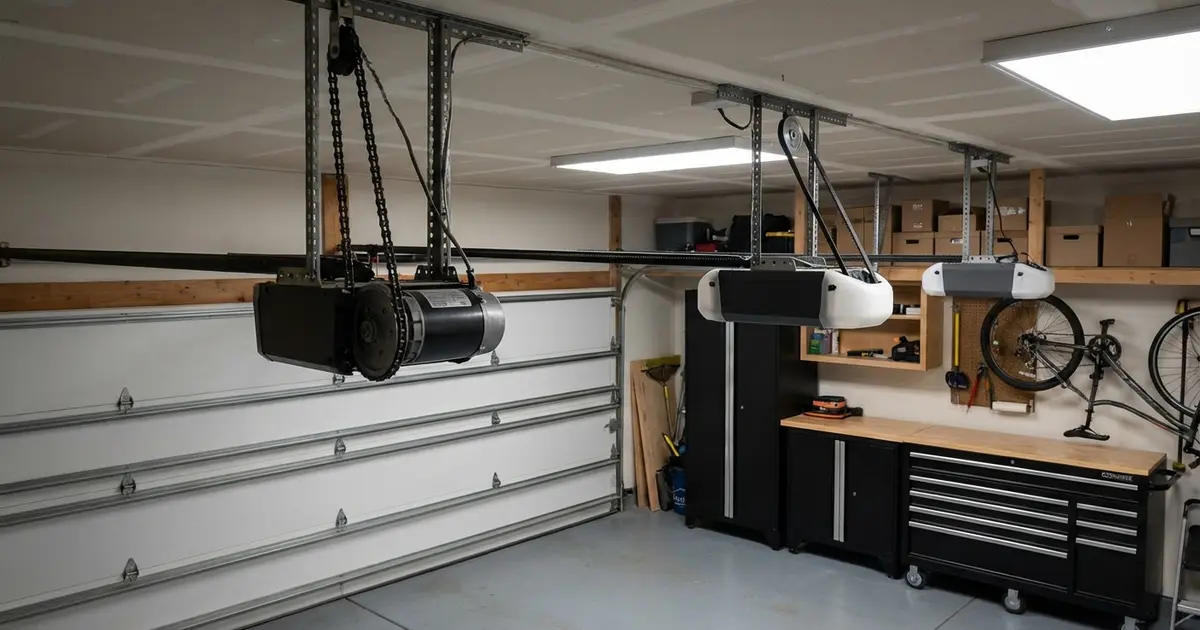
How Garage Door Openers Work
Before comparing drive types, it helps to understand what all garage door openers have in common. Every standard ceiling-mounted opener consists of:
- The motor unit — the main housing that contains the motor, circuit board, light, and Wi-Fi/radio receiver. It mounts to the ceiling above the door.
- The rail (track) — a horizontal rail that extends from the motor unit to a mounting point above the center of the door. The trolley travels along this rail.
- The trolley — a sliding carriage on the rail that connects to the door via a curved arm. When the trolley moves toward or away from the motor, the door opens or closes.
- The drive mechanism — what moves the trolley. This is where chain, belt, screw, and direct drive differ.
- The emergency release — a red-handled cord that disconnects the trolley from the drive, allowing manual operation during power outages.
The drive mechanism is the only significant structural difference between opener types. Everything else — the motor, the sensors, the smart features, the remotes — is essentially the same technology regardless of whether you buy chain drive or belt drive from the same manufacturer.
💡 Pro Tip: If your garage is attached and adjacent to a bedroom, choose a belt drive opener — they're 60–70% quieter than chain drives and worth the extra $50–$100.
Chain Drive Openers
Chain drive openers work exactly like a bicycle: a metal chain wraps around a sprocket gear on the motor shaft and connects to the trolley. When the motor turns, the chain moves the trolley along the rail.
How They Work
The chain loops over the sprocket and runs along a channel in the rail, pulling the trolley back and forth. Slack in the chain is managed by a tension mechanism; if the chain becomes too loose (common after years of use), it sags and produces a pronounced slapping or rattling sound during operation. Regular chain lubrication (every 3–6 months with white lithium grease or a dedicated chain lubricant) keeps the mechanism running smoothly and extends chain life.
Chain Drive Pros
- Lowest purchase cost. Chain drive openers are the most affordable type available. You can find a solid 1/2 HP chain drive from Chamberlain or Genie for $130–$180 at a hardware store, versus $200–$280 for a comparable belt drive.
- Proven reliability. Metal chain on metal sprocket is simple, robust, and time-tested. There's nothing to crack or degrade from UV exposure (like rubber belts can). In a well-maintained chain drive, the mechanism itself can outlast the motor electronics.
- Available in high-lift configurations. Chain drives are commonly available in configurations for doors taller than standard 7–8 feet, making them practical for custom or commercial applications where belt-drive alternatives may not be available.
- Easy to service. Chains are inspectable, lubricatable, and replaceable. Any garage door technician can service a chain drive opener without specialized tools or parts.
Chain Drive Cons
- Noise. This is the chain drive's primary disadvantage. The metal chain engaging the sprocket creates a characteristic rattle and vibration during every cycle. The trolley movement also creates a clicking/clanking sound. In an attached garage, this noise transmits through the ceiling and walls into the house. For a bedroom above the garage or a home office adjacent to the garage wall, chain drive noise is genuinely disruptive at 6am or late at night.
- Vibration transfer. Beyond the sound itself, chain drives transmit more vibration to the motor unit and the mounting hardware than belt or direct drive systems. Over years, this can loosen mounting bolts and create additional noise sources.
- Maintenance requirement. Chains need lubrication every 3–6 months; belts and direct drives need much less maintenance. In practice, most homeowners skip this maintenance, leading to noisier operation and faster wear.
Who Should Choose Chain Drive
Chain drive is the right choice for: detached garages where noise doesn't affect anyone's sleep, budget-conscious installations where cost is the primary factor, garages that are used very infrequently (cabin, workshop, rarely-used storage), and situations where simplicity and serviceability matter more than noise.
Popular Chain Drive Models (2026)
- Chamberlain B503: 3/4 HP, Wi-Fi, built-in camera — ~$200
- Genie ChainLift 900: 1/2 HP, solid basic unit — ~$130
- LiftMaster 8365-267: 1/2 HP, MyQ compatible — ~$180
✅ Key Takeaway: Belt drive is the best all-around choice for attached garages. Quieter than chain drive, more reliable than screw drive, and competitively priced. Spend the extra $50–$100 over chain drive if noise matters.
Belt Drive Openers
Belt drive openers replace the metal chain with a rubber (or fiberglass-reinforced rubber) belt. The belt performs the same function as the chain — moving the trolley along the rail — but rubber against plastic or rubber-coated components produces dramatically less noise and vibration.
How They Work
The belt wraps around a drive sprocket on the motor and runs along the rail to a tension pulley at the far end. The trolley connects to the belt, and as the motor turns the sprocket, the belt pulls the trolley toward or away from the motor unit. Belt tension is maintained by the pulley system; most modern belts are made from steel-reinforced rubber or polyurethane with a fiberglass or Kevlar core for strength and durability.
Belt Drive Pros
- Quiet operation. Belt drives are the standard recommendation for attached garages. The difference in noise between a chain drive and a belt drive in the same garage is immediately noticeable — the belt drive sounds like a smooth hum rather than a mechanical clatter. If you're replacing a chain drive in an attached garage and wondering if the upgrade is worth the $60–$80 difference, it almost always is.
- Low vibration. Belt materials absorb vibration rather than transmitting it, meaning the motor housing shakes less and the structural noise transmitted into the house is reduced.
- Low maintenance. Modern reinforced rubber belts don't need lubrication. Unlike chains, there's no metal-on-metal friction to manage. Inspection (looking for cracks or fraying) is the primary maintenance task, and most belts last 10+ years without intervention.
- Widely available in smart configurations. The most popular smart garage door openers (with Wi-Fi, cameras, and app control) are predominantly belt drive models. If smart features matter to you, your belt drive choices are extensive.
Belt Drive Cons
- Higher cost than chain drive. A comparable belt drive opener costs $60–$100 more than a chain drive equivalent. This is the only significant trade-off — belt drives don't have meaningful disadvantages compared to chain drives in attached-garage applications.
- Belt can crack in extreme cold. Standard rubber belts can become brittle in garages that regularly experience -20°F or colder temperatures. If you're in the northern US or Canada with an unheated garage in a harsh winter climate, look for a belt drive marketed as "cold-weather rated" or consider a chain drive, which handles extreme cold better.
- Belt replacement when it wears out. Replacing a worn or cracked belt requires a service call or careful DIY work. The belt itself is inexpensive ($20–$40), but the labor to replace it runs $75–$150.
Who Should Choose Belt Drive
Belt drive is the right choice for: any attached garage adjacent to living space, anyone who values quiet operation, garages where the opener runs frequently (families with multiple drivers), and homeowners who want smart features since the most feature-rich openers are predominantly belt drive.
Popular Belt Drive Models (2026)
- Chamberlain B4643T: 1-1/4 HP, built-in camera, Wi-Fi, MyQ — ~$280
- LiftMaster 87504-267: 3/4 HP, camera, Wi-Fi — ~$300
- Genie SilentMax 750: 3/4 HP, quiet operation — ~$190
Screw Drive Openers
Screw drive openers use a long threaded steel rod (resembling a giant screw or lead screw) instead of a chain or belt. The motor turns this rod, and a carriage with a threaded interior nut rides along the rod — converting the rotation into linear trolley motion.
How They Work
The drive rod runs the full length of the rail from the motor unit to the far end. A plastic carriage (the trolley) threads onto the rod; as the rod rotates, the threaded carriage is driven forward or backward along the rod's length. The design eliminates the need for a chain or belt entirely, reducing the number of moving parts to essentially two: the motor and the rod.
Screw Drive Pros
- Fewer moving parts than chain or belt. With no chain to stretch, no belt to crack, and no sprocket teeth to wear, screw drive mechanisms are theoretically simpler. The drive rod itself is virtually maintenance-free.
- Good for heavy doors. Screw drives handle heavier doors well because the threaded rod provides positive mechanical engagement — there's no belt slippage under load as can occasionally occur with lighter belts on very heavy doors.
- Generally faster operation. Screw drive openers tend to open and close the door slightly faster than equivalent chain or belt models, which some homeowners prefer.
Screw Drive Cons
- Temperature sensitivity. This is the screw drive's Achilles heel. The plastic carriage that rides on the threaded rod expands and contracts with temperature changes. In climates with significant temperature swings (cold winters, hot summers), the carriage can bind on the rod, causing jerky operation or stalling. Some manufacturers address this with improved carriage materials, but temperature sensitivity is an inherent limitation of the mechanism.
- Noise level. Screw drives are louder than belt drives and roughly comparable to chain drives (though with a different sound — more of a mechanical grinding hum than a chain rattle).
- Fewer smart model choices. As belt and direct drive models have taken over the premium segment of the market, screw drive options have become limited. If you want advanced smart features (camera, full app control, HomeKit integration), your screw drive choices are narrower.
- Maintenance. The threaded rod needs periodic lubrication with a non-drip grease to prevent binding and noise. Skipping this maintenance accelerates carriage wear.
Who Should Choose Screw Drive
Screw drive is increasingly hard to recommend over belt drive for most homeowners. The main remaining use case is mild, stable climates (consistently above freezing, not extremely hot) where temperature sensitivity is less of a concern, heavy doors, and situations where the price premium over chain drive is acceptable but the full cost of a belt drive isn't. In cold northern states, screw drive is generally not recommended.
Popular Screw Drive Models (2026)
- Genie ScrewLift 600: 1/2 HP, basic model — ~$160
- LiftMaster 3245 series: 3/4 HP — ~$220
Direct Drive Openers
Direct drive openers (sometimes called "DC motor" openers, though that term also applies to some belt drives) flip the traditional opener concept: instead of a stationary motor moving a trolley along a rail, the motor unit itself travels along a stationary chain embedded in the rail. The motor is the trolley.
How They Work
A single, sturdy chain is permanently fixed in the center of the rail. The motor unit engages this stationary chain and drives itself along it. A connecting arm on the moving motor attaches to the door. When the motor activates, it drives itself forward along the chain (moving toward the door, which opens it) or backward (moving away from the door, which closes it). Because the motor itself is the only moving part — and it rides on the fixed chain rather than pulling a separate trolley — there are dramatically fewer wear points than in any other opener type.
Direct Drive Pros
- Extremely quiet and smooth. Direct drive openers are among the quietest available. The motor glides along the stationary chain with minimal vibration. Sommer, the German manufacturer that popularized direct drive openers in the US, claims their models are the quietest available. This is roughly comparable to belt drive in practice, with some direct drive models edging out even the quietest belt drives.
- Lowest maintenance of any type. One moving part — the motor unit — means almost nothing to maintain. There's no chain to lubricate (the stationary chain receives light lubrication at installation and rarely needs attention), no belt to inspect for cracking, no carriage to wear out.
- Longest claimed lifespan. Sommer and other direct drive manufacturers often claim 20+ year lifespans for well-maintained units. With fewer wear parts, this claim has more merit than similar claims from manufacturers of more complex systems. The motor electronics are more likely to fail before the drive mechanism does.
- Excellent for cold climates. Unlike screw drives (which are sensitive to temperature-driven expansion/contraction of the plastic carriage) and rubber belts (which can crack in extreme cold), the direct drive mechanism is largely unaffected by temperature extremes.
Direct Drive Cons
- Higher upfront cost. Direct drive openers typically cost $50–$100 more than comparable belt drives and $100–$150 more than chain drives. This is the primary barrier.
- Fewer brand options. Sommer is the most prominent direct drive specialist in the US market. Craftsman and a few other brands offer direct drive models, but the selection is narrower than chain or belt drive options.
- Less DIY-familiar. Because direct drive openers work differently than the traditional trolley-on-rail design, some homeowners and even some technicians are less familiar with them. Installation is straightforward, but the different visual design can be disorienting if you're used to standard rail-based openers.
Who Should Choose Direct Drive
Direct drive is an excellent choice for homeowners who want the quietest possible operation, the lowest long-term maintenance, and the best performance in cold climates, and who are willing to pay a modest premium for those benefits. It's particularly well-suited for attached garages where noise is a concern, northern climates with harsh winters, and homeowners who want to "set it and forget it" without regular maintenance tasks.
Popular Direct Drive Models (2026)
- Sommer Direct Drive 1042V001: 3/4 HP, the benchmark direct drive model — ~$250
- Sommer Direct Drive Pro: Wi-Fi enabled — ~$320
- Craftsman CMXEOCG471 (Direct Drive): 3/4 HP — ~$200
Jackshaft / Wall-Mount Openers
Jackshaft openers (also called side-mount or wall-mount openers) are fundamentally different from the four ceiling-mounted types above. Instead of mounting on the ceiling with a rail extending toward the door, a jackshaft opener mounts on the wall beside the door and drives the torsion spring shaft directly.
How They Work
The jackshaft motor connects to the torsion spring shaft via a drive mechanism, turning the shaft to open and close the door — the same shaft your torsion springs are wound on. Because there's no overhead rail or trolley, the entire ceiling above the garage door is completely clear. The motor unit hangs on the wall like a control panel, with just a short motor-to-shaft connection rather than a 10-foot ceiling-mounted rail assembly.
Jackshaft Pros
- Full ceiling clearance. The most compelling advantage: zero ceiling obstruction above the door. This matters for: garages with very low ceilings (under 11 feet) where a ceiling rail would be impractical; garages used for RV or boat storage where height is critical; garages with ceiling storage systems (racks, hoists, bike lifts) in the overhead door zone; and homes where the garage has high ceilings and an overhead rail would look awkward or obstruct planned storage.
- Compatible with high-lift door systems. Standard ceiling-mounted openers don't work with high-lift tracks (used when cars or vehicles need extra vertical clearance before the door goes horizontal). Jackshaft openers work fine with high-lift track configurations.
- Very quiet. Jackshaft openers drive the torsion shaft directly, with no trolley clattering along a rail. LiftMaster's 8500W (a premium jackshaft model) is consistently cited as one of the quietest openers on the market.
- Sleek appearance. A wall-mounted motor unit with no overhead rail is visually cleaner than a ceiling rail assembly — relevant if aesthetics matter in the garage space.
Jackshaft Cons
- Requires torsion springs. Jackshaft openers only work with torsion spring systems, not extension springs. If your garage has extension springs, you'd need to convert to torsion first — adding $200–$400 to the total project cost.
- Higher cost. Jackshaft units start at $300–$400 for the opener alone and run $500–$700 installed, compared to $200–$400 installed for a standard ceiling-mounted opener. The LiftMaster 8500W runs $400+ for the unit alone.
- Requires correct door balance. Because jackshaft openers drive the spring shaft directly, the door's spring balance must be correctly calibrated — a door that's out of balance puts excess load directly on the motor. An annual tune-up and spring check is more important with a jackshaft opener than with a standard ceiling-mounted unit.
- Less DIY-friendly. Working near the torsion spring shaft requires specific knowledge. Most homeowners should have a professional install a jackshaft opener.
Who Should Choose a Jackshaft Opener
Jackshaft openers are the right choice when ceiling space is at a premium, for garages used for tall vehicles (RVs, trucks, boats), for high-lift track systems, and for homeowners who want the cleanest possible garage aesthetic and are willing to pay for it.
Popular Jackshaft Models (2026)
- LiftMaster 8500W: The most popular jackshaft model — Wi-Fi, MyQ, battery backup — ~$420
- Chamberlain B4545: Wi-Fi, MyQ compatible — ~$350
All Opener Types: Side-by-Side Comparison
| Type | Installed Cost | Noise Level | Maintenance | Lifespan | Best For |
|---|---|---|---|---|---|
| Chain Drive | $150–$300 installed | ⚠️ Loud (metal-on-metal) | Annual lubrication | 10–15 years | Detached garages, budget installs |
| Belt Drive | $220–$400 installed | ✅ Very quiet | Minimal (rubber belt) | 10–15 years | Attached garages, near bedrooms |
| Screw Drive | $200–$380 installed | ⚠️ Moderate | Periodic lubrication | 10–15 years | Mild climates, low-maintenance preference |
| Direct Drive | $280–$450 installed | ✅ Near-silent | Virtually none | 12–20 years | Quiet garages, long-term value |
| Jackshaft (Wall-Mount) | $350–$600 installed | ✅ Very quiet | Minimal | 12–20 years | Low ceilings, ceiling storage, RV garages |
Horsepower Ratings Explained
Garage door opener horsepower ratings are often misunderstood. Here's what actually matters:
Standard HP Options
- 1/2 HP — Standard for most single and double-car residential doors under 250 lbs. Works well for steel doors, aluminum doors, and lightweight insulated doors. Most common choice for typical residential use.
- 3/4 HP — Recommended for heavier doors: solid wood doors, carriage-style steel doors with heavy insulation, oversize doors, or doors in very cold climates where weatherstripping adds friction. Also preferred for high-frequency use (6+ cycles per day) since the motor runs cooler at partial capacity.
- 1 HP+ — Commercial applications, unusually heavy custom doors, or situations where the opener is specified to be significantly oversized for longevity and minimal strain.
The HP Comparison Caveat
HP ratings aren't directly comparable across drive types. A 3/4 HP belt drive from LiftMaster transfers power more efficiently to the door than a 3/4 HP chain drive from a budget brand, because better mechanical efficiency means more of the motor's output reaches the door instead of being lost to friction. When comparing openers, look at the manufacturer's stated door weight capacity, not just the HP number. Most quality manufacturers list maximum door weight (often 350–500 lbs for 3/4 HP models) in addition to the HP rating.
DC vs AC Motors
Most modern openers use DC motors rather than the older AC motor designs. DC motors offer:
- Soft-start and soft-stop capability (the door accelerates gradually at start and decelerates gently before stopping — reducing wear and noise)
- Easier battery backup integration
- Variable speed control (some models open faster when fully loaded by a strong spring system)
- More efficient operation at lighter loads
If you're buying a new opener in 2026, DC motor is essentially standard across all price points and drive types. AC motors are only found on the oldest or most basic economy models.
Smart Features and Connectivity
Modern garage door openers increasingly include smart home connectivity. Here's what the key features mean in practice:
Wi-Fi / App Control
Wi-Fi enabled openers connect to your home network and allow you to open, close, and monitor your garage door from a smartphone app. The most popular platform is myQ (used by LiftMaster and Chamberlain). Other brands use proprietary apps. Key benefits: check whether you left the door open when you're away from home, open the door remotely for a delivery or a family member, receive alerts when the door opens or closes, and set schedules (automatically close at 10pm if open). The app functionality has become a strong selling point; if you want it, verify the specific model includes Wi-Fi (not all models in a product line do) rather than assuming.
Built-in Camera
Many premium belt drive openers now include a wide-angle HD camera in the motor unit. The camera looks down into the garage and streams video to the app. This serves two purposes: verifying the garage is empty before closing (safety), and security monitoring. Camera quality ranges from basic 720p to 1080p HDR. If you want package delivery to your garage (a service Amazon offers in some markets), a camera and app-connected opener are required.
Battery Backup
Battery backup allows the opener to run during power outages. The battery (typically a sealed lead-acid or lithium unit) keeps the opener operational for 20–50 cycles on a full charge. California building code now requires battery backup on all new residential garage door opener installations. Even outside California, battery backup is a practical feature worth the premium — especially in areas prone to storms or power grid instability.
Smart Home Integration
- Amazon Alexa: Most Wi-Fi openers support Alexa voice commands ("Alexa, close the garage.")
- Google Home: Similar voice control integration
- Apple HomeKit: Available on select models; enables Siri voice control and the Home app. Notably, myQ (LiftMaster/Chamberlain) dropped direct HomeKit support but offers a bridge accessory for integration
- IFTTT / SmartThings: For complex automation routines (e.g., open garage when car leaves driveway based on geofencing)
For a deeper dive on smart features, see our complete smart garage door opener guide.
Full Cost Breakdown by Type and Region
Total installed cost includes the opener unit, mounting hardware, new remotes (usually 2), keypad, and professional installation labor (2–3 hours).
Unit Price Ranges (2026, major brands)
| Type | Budget (1/2 HP) | Mid-Range (3/4 HP + Wi-Fi) | Premium (3/4–1 HP + Camera + Wi-Fi) |
|---|---|---|---|
| Chain Drive | $120–$170 | $170–$230 | $230–$300 |
| Belt Drive | $180–$240 | $240–$310 | $310–$420 |
| Screw Drive | $150–$200 | $200–$270 | $270–$360 |
| Direct Drive | $190–$250 | $250–$330 | $330–$450 |
| Jackshaft | N/A | $320–$410 | $410–$550 |
Installation Labor by Region
| Region | Standard Install (2–3 hrs) | With Old Opener Removal | With Wiring Added |
|---|---|---|---|
| Northeast (NY, MA, CT) | $120–$175 | $145–$210 | $200–$350 |
| Mid-Atlantic (PA, VA, MD) | $100–$155 | $125–$185 | $180–$310 |
| Southeast (FL, GA, NC) | $85–$135 | $105–$165 | $155–$280 |
| Midwest (IL, OH, MI) | $80–$130 | $100–$155 | $150–$270 |
| South Central (TX, OK, LA) | $75–$125 | $95–$150 | $140–$260 |
| Mountain (CO, UT, AZ) | $90–$145 | $110–$170 | $165–$290 |
| West Coast (CA, OR, WA) | $120–$180 | $145–$215 | $210–$370 |
Total installed cost examples: A mid-range belt drive in the Southeast runs approximately $240–$310 (unit) + $105–$165 (labor with old opener removal) = $345–$475 all-in. A premium jackshaft opener in the Northeast runs $410–$550 (unit) + $145–$210 (labor) = $555–$760.
For a full breakdown of all garage door system costs, see our garage door repair cost guide.
DIY vs Professional Installation
When DIY Makes Sense
- You have basic tool skills (drill, ladder, measuring tape) and 3–4 hours to spare
- The garage already has a proper 120V outlet near the ceiling for the opener
- You're replacing a like-for-like opener on a door whose springs and hardware are in good condition
- The new opener comes with detailed instructions (most major brands do)
Typical DIY savings: $100–$175 in labor. Most homeowners report that opener installation is manageable if they follow the instructions carefully, take their time with the rail assembly, and adjust the travel limits and force settings correctly before considering the job done.
When to Call a Professional
- The garage doesn't have an appropriate outlet (an electrician is needed regardless)
- You're installing a jackshaft opener (works near torsion spring shaft)
- The door has spring, cable, or track issues that need professional attention first
- You're not comfortable working on a ladder with overhead assembly work
- You need the work done quickly and correctly the first time
For a full breakdown of which garage repairs are DIY-safe, see our DIY vs professional repair guide.
Which Opener Type Should You Buy? (Decision Guide)
Attached garage with a bedroom or living space above or adjacent → Belt Drive or Direct Drive
Noise is the deciding factor. Spend the extra $60–$100 for belt or direct drive. You'll notice the difference every morning when you leave for work.
Detached garage → Chain Drive
Noise doesn't affect the house. Save the money. A quality chain drive opener from LiftMaster or Chamberlain will last 10–15 years with basic maintenance.
Very cold climate (regularly below 0°F) → Belt Drive or Direct Drive, not Screw Drive
Screw drive carriages can bind in extreme cold. Belt drives with a quality reinforced belt or direct drives handle cold better. Avoid screw drive in the northern US and Canada unless specifically rated for cold weather.
Garage used for RV, tall truck, or you need ceiling clearance → Jackshaft
The only option that eliminates the ceiling rail entirely.
Want smart home features + camera → Belt Drive (widest selection)
The most feature-rich smart opener models are belt drives. LiftMaster 87504-267 and Chamberlain B4643T are good starting points.
Maximum lifespan with minimal maintenance → Direct Drive
Fewer moving parts = fewer things to wear out or maintain. Sommer's direct drive models are the benchmark.
Budget is the primary concern → Chain Drive
A Chamberlain or LiftMaster chain drive runs $120–$170 for the unit. It will work reliably for a decade with minimal maintenance.
Find Garage Door Opener Installers Near You
Need help installing a new opener or replacing an old one? Find trusted professionals in your area:
- Find trusted garage door pros in Chicago
- Find trusted garage door pros in Phoenix
- Find trusted garage door pros in Denver
- Find trusted garage door pros in Atlanta
- Find trusted garage door pros in Seattle
- Find trusted garage door pros in Miami
Related guides: Smart Garage Door Openers Buyer's Guide, Garage Door Repair Costs, DIY vs Professional Repair, and the full garage door guide index.
Frequently Asked Questions
Which type of garage door opener is the quietest?
Belt drive openers are widely considered the quietest option for residential use. They use a rubber belt instead of a metal chain or threaded rod, which eliminates the primary sources of mechanical noise in other opener types. Direct drive openers are a close second — because the motor travels along a stationary chain (or no moving parts aside from the motor itself in some models), there's almost no vibration transferred to the garage structure. Screw drive openers are moderate in noise. Chain drive openers are the loudest, producing a characteristic rattle as the metal chain engages the sprocket. If your garage is below or adjacent to a bedroom, living room, or home office, belt drive or direct drive are clearly the right choice. For a detached garage where noise doesn't affect the home, a chain drive is perfectly acceptable.
How long do garage door openers last?
Most residential garage door openers last 10–15 years with basic maintenance. The motor itself is usually the limiting factor — quality motors from brands like LiftMaster, Chamberlain, and Genie are designed for 10,000+ cycles. The drive mechanism (chain, belt, screw, or direct drive rail) can often outlast the motor. Factors that affect longevity: cycle frequency (a heavily used door wears components faster), maintenance (regular lubrication extends drive system life), power quality (frequent power surges damage circuit boards), and temperature extremes (very cold or hot garages stress drive components). Direct drive openers often claim the longest lifespans because their minimal moving parts reduce wear points. Regardless of type, expect to replace the battery backup unit and remote batteries more frequently than the opener itself.
Can I install a garage door opener myself?
Many homeowners successfully install their own garage door openers, and most major brands (Chamberlain, LiftMaster, Genie) include detailed installation instructions. The process typically takes 2–4 hours for a first-time installer. Prerequisites for a safe DIY install: basic comfort with hand tools and a power drill, ability to safely use a ladder in the garage, and the garage already has a working 120V outlet within reach of the opener unit (if not, an electrician must add one first). The most common DIY mistakes are: incorrect trolley height (opener mounted too low to clear door panels), misaligned photo-eye sensors, and incorrect force adjustment (causing the door to reverse inappropriately or not reverse when it should). If your garage door itself has spring issues, fix those first — installing an opener on a door with bad springs is both dangerous and hard on the new opener.
What is horsepower and how much do I need for my garage door?
Horsepower (HP) rating on garage door openers measures the motor's lifting capacity. Standard residential garage doors in steel or aluminum typically work fine with a 1/2 HP motor. However, HP ratings aren't directly comparable across all opener types — a 1/2 HP direct drive motor may outperform a 1/2 HP chain drive motor in practice because of more efficient power transfer. General guidelines: 1/2 HP handles most standard single and double-car residential doors under 250 lbs; 3/4 HP is recommended for heavier doors (solid wood, heavily insulated, doors over 250 lbs), doors that see heavy daily use, or two-car doors in cold climates where the door may be slightly heavier due to weatherstripping friction; 1 HP and higher is appropriate for commercial applications or unusually heavy custom doors. If in doubt, sizing up is inexpensive protection — an overspecified motor runs cooler, lasts longer, and cycles more quietly than an undersized motor working at its limits.
Do I need a battery backup on my garage door opener?
Battery backup is not strictly required, but it is highly recommended in most areas of the US. When the power goes out — during storms, brownouts, or grid failures — a standard opener without battery backup will leave your car trapped inside or outside, depending on where you are when the power fails. You can always manually release the door (pull the red emergency cord to disconnect the trolley from the drive), but this requires you to be in the garage to reconnect it when power returns. Battery backup openers run normally on battery power for a limited number of cycles (typically 20–50 open/close cycles per charge) before needing a recharge. In areas with frequent storms (Southeast, Midwest tornado belt, hurricane-prone coastal areas), battery backup is particularly worth the $30–$80 premium over base models. California residents should note that California building code requires new garage door opener installations in one- and two-family dwellings to include battery backup.
What's the difference between a jackshaft opener and a standard ceiling-mounted opener?
A jackshaft (or wall-mount) opener mounts on the wall beside the garage door, directly driving the torsion spring shaft rather than pulling a trolley along an overhead rail. The primary advantage: it frees up all overhead space in the garage, which is valuable for high-lift doors, garages with very low ceilings, garages used for RV storage, or garages where the ceiling is used for storage racks. Jackshaft openers are also extremely quiet because the motor drives the shaft directly with minimal intermediate components. They require a torsion spring system (not compatible with extension springs) and typically cost more than standard ceiling-mounted openers ($400–$700 for the unit vs. $150–$400). LiftMaster 8500W and Chamberlain B4545 are popular jackshaft models. They're increasingly popular in new construction garages where ceiling space is at a premium or aesthetics matter.
Can I use any opener with any garage door?
Almost any standard opener will work with any standard residential garage door, but there are compatibility considerations to verify. First, spring type: most ceiling-mounted openers work with either torsion or extension spring doors, but jackshaft openers require torsion springs. Second, headroom: rail-driven openers need adequate headroom to install the rail and trolley; doors with very low clearance above the top panel may need a special low-headroom adapter kit. Third, door weight: verify that the opener's HP rating is appropriate for your specific door's weight, especially if the door has been modified (insulation added, panels replaced with heavier material). Fourth, smart home integration: if you want to connect the opener to Amazon Alexa, Google Home, or Apple HomeKit, verify the opener's app and protocol compatibility before purchasing. Most modern openers from major brands support at least one ecosystem; some support all three.