DIY vs Professional Garage Door Repair: When to Call a Pro
Your garage door is the largest moving part in your home — and one of the most mechanically complex. The average residential door weighs 150–300 pounds and operates under hundreds of foot-pounds of spring tension. Get a repair right and you've saved $100–$300. Get it wrong and you're looking at a dangerous injury, a bigger repair bill, or a voided warranty on a nearly-new opener.
This guide draws a clear line between what's safe for homeowners to tackle and what should always be left to professionals — with real cost comparisons so you can make smart decisions about every repair situation you'll face.
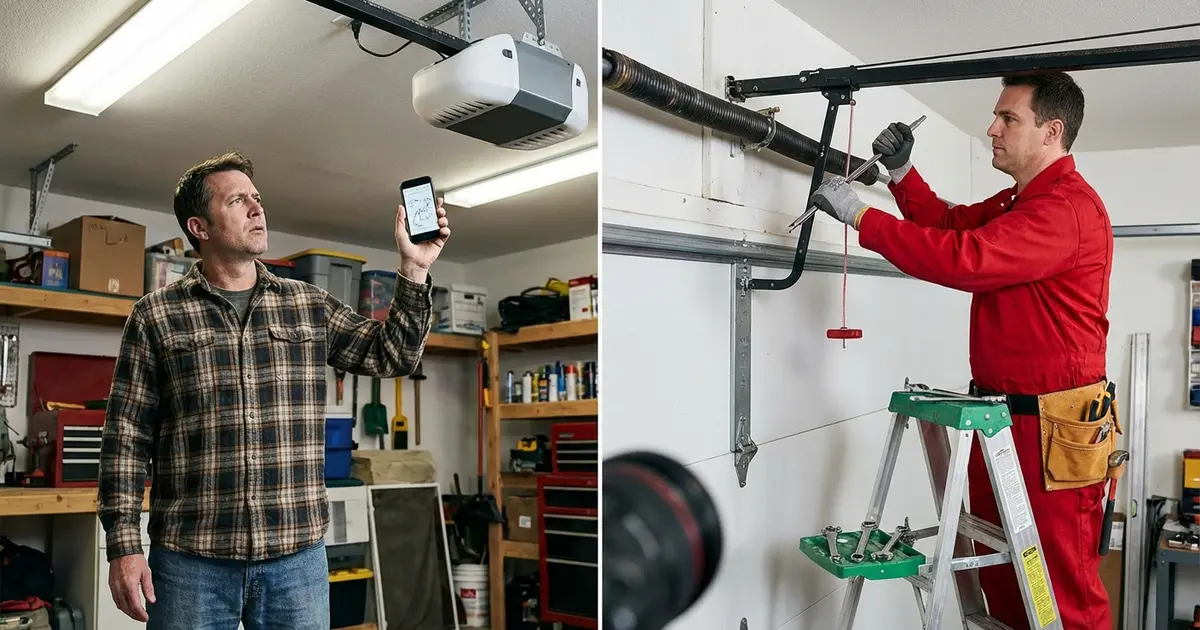
The Fundamental Rule for Garage Door DIY
Before touching any part of your garage door, ask yourself one question:
"Does this component hold significant tension or directly support the weight of the door?"
If the answer is yes — call a professional. If the answer is no — you can almost certainly handle it yourself.
This rule filters out the two most dangerous components on a garage door: springs and cables. Both are under enormous stored energy when the door is in its normal operating state. A torsion spring (the horizontal spring above the door) holds 150–200+ foot-pounds of torque. A cable failure under load can snap with enough force to cause serious injury. These are not exaggerations — they're the reason garage door technicians are trained specifically for these components.
Everything else on a garage door? The rollers, hinges, tracks, sensors, weatherstripping, opener electronics, panels — these are far less dangerous, and many homeowners comfortably repair them themselves with standard tools and a little patience.
✅ Key Takeaway: Safe DIY: lubricating hinges and rollers, replacing weather seals, tightening loose bolts, cleaning sensors, and swapping remote batteries. Unsafe DIY: anything involving springs or cables.
Repairs That Are Safe to DIY
The following repairs are appropriate for most homeowners. They require no specialized knowledge, carry minimal safety risk when performed correctly, and offer significant cost savings over professional service calls.
1. Lubrication and Maintenance
Lubricating your garage door is the highest-ROI maintenance task you can do — it takes 20 minutes, costs $15 in supplies, and prevents accelerated wear on every moving component. Apply white lithium grease spray to springs, hinge pivot points, and roller stems. Use silicone spray on weatherstripping and nylon roller wheels. Never lubricate the inside of the tracks — they should stay clean and dry. See our complete garage door lubrication guide for step-by-step instructions.
2. Tightening Hardware
Vibration from thousands of door cycles loosens bolts throughout the door system. Every hinge bolt, track mounting bracket, and top fixture bracket should be snug. Walk the door with a socket wrench (½" and 9/16" sockets cover most residential door hardware) and tighten any hardware with movement. This is pure maintenance — no components under tension, no risk, and it can prevent costly failures down the road.
3. Replacing the Bottom Seal
The rubber strip along the bottom of your door keeps out rain, wind, pests, and cold air. When it cracks, flattens, or tears away from its retainer channel, it's simple to replace: the old seal slides out of a U-shaped aluminum retainer, and a new one slides in. Replacement seals cost $15–$40 at any home improvement store and come in standard widths (2" and 3" are most common). The full process takes about 20 minutes. Instructions are in our weatherstripping replacement guide.
4. Replacing Weatherstripping on Sides and Top
The rubber or vinyl strip that runs along the sides and top of the door frame (the "stop molding") keeps the door weathertight when closed. It's held on by staples or nails and is straightforward to replace — pry the old strip off, measure the length, cut new material to fit, and fasten it back. Available at home improvement stores for $1–$3 per foot.
5. Safety Sensor Alignment and Replacement
The photo-eye safety sensors at the base of the door frame are bumped out of alignment surprisingly often — by a broom handle, a trash can, or a small child. When misaligned, the door will refuse to close (or will close and then reverse). Realigning them takes under 10 minutes: loosen the mounting wing nut, aim the sensor so the LED becomes solid (rather than blinking), and retighten. If a sensor is physically damaged, replacement sensors cost $20–$50 and wire up with simple plug connections. See the complete sensor troubleshooting guide for step-by-step help.
6. Remote and Keypad Troubleshooting
Most remote failures are dead batteries — a $3 fix. If a battery swap doesn't solve it, most remotes and keypads can be reprogrammed in under five minutes by pressing the "Learn" button on the opener motor unit. If you need a replacement remote, universal remotes compatible with most major brands are available for $15–$40, and manufacturer-specific remotes run $25–$60. See the keypad troubleshooting guide for brand-specific reset steps.
7. Replacing Individual Rollers
Rollers are the small wheels that guide the door through the tracks. When they crack, chip, or the bearings fail (grinding or rough movement), they can be replaced individually. With the door fully open (to relieve tension on the rollers), use a flathead screwdriver to pop the roller stem out of the hinge bracket, slide in the new roller, and press it back in. Standard nylon rollers with sealed bearings cost $6–$15 each. The top two rollers on each side — which are inside the curved section of the track — are harder to access and some homeowners prefer to have a pro replace those. See the complete roller replacement guide.
8. Minor Dent Repair
Small to medium dents (under 2 inches deep) in steel garage door panels can often be worked out with a dedicated dent repair kit or the classic trick of heating the dent with a hair dryer and then immediately spraying it with compressed air — the rapid temperature change can cause the steel to pop back. This works best on relatively new, thin-gauge steel panels and less well on older or thicker material. See the dent repair guide for full techniques.
⚠️ Warning: Never DIY spring replacement, cable replacement under tension, or track realignment. These are the three most injury-prone garage door tasks. Professional service is mandatory.
Repairs You Should Never DIY
The following repairs carry serious injury risk and should always be performed by a trained professional. This isn't a recommendation — it's a firm boundary based on documented injury data and the physics of what these components do.
1. Torsion Spring Replacement or Adjustment ⚠️
Torsion springs — the horizontal spring or springs mounted on the metal shaft above your garage door — are the most dangerous component on any residential garage door. They hold 150–200+ foot-pounds of torque when wound. A spring that breaks during installation (because a winding bar slips or an improvised tool is used) releases all that energy instantly. Proper installation requires a matched pair of winding bars, specific technique for turning the spring a precise number of turns, and experience to recognize when something is about to go wrong.
Professional torsion spring replacement costs $180–$350 for a standard residential door, including both springs (you should always replace both even if only one broke, since they age together). This is the one repair where the professional fee is genuinely a bargain relative to the risk. See our spring replacement guide for what to expect from a professional service call.
2. Extension Spring Replacement or Adjustment ⚠️
Extension springs (the type that run horizontally along the tracks, parallel to the ceiling) are under somewhat less tension than torsion springs but still carry serious risk. They should always have a safety cable running through the coil — this cable catches the spring if it breaks, preventing it from launching across the garage. If your extension springs lack safety cables, a technician can add them at minimal cost. Extension spring replacement runs $150–$300 and, like torsion springs, should always involve replacing both sides simultaneously.
3. Cable Replacement or Adjustment ⚠️
The two lift cables that run from the bottom brackets of the door up to the cable drums at the ends of the torsion spring shaft operate in constant tension. Replacing a broken or fraying cable requires first releasing the spring tension (itself a dangerous step without proper tools), removing the cable from the drum, threading the new cable through the system, and re-tensioning everything correctly. Getting cable tension unequal between sides can make the door come off-track mid-cycle. Cable replacement costs $150–$300 for both sides and is always worth professional labor.
4. Severely Bent or Damaged Track Replacement
Minor track adjustments — slightly out-of-plumb vertical sections that can be nudged back with a rubber mallet after loosening mounting bolts — are manageable DIY work. But significantly bent or kinked track sections require replacement. Replacing a track section while keeping the door in place requires understanding how to safely support the door during the process and re-tensioning cables after. Costs run $150–$350 per track section installed.
5. Full Door or Panel Replacement
Replacing a full garage door requires removing all the hardware (springs, cables, drums, tracks, opener) and reinstalling it on the new door, or installing a complete new door system from scratch. This is heavy, physically demanding work involving components under tension throughout the process. Professional door installation costs $1,000–$3,500 depending on door size, material, and opener. Panel replacement ($350–$1,000 per panel installed) is similarly labor-intensive and requires sourcing a matching panel, which may be difficult for older door models.
The Middle Ground: Judgment Calls
Some repairs fall in between "obvious DIY" and "obvious pro" depending on your mechanical confidence and comfort level. Be honest with yourself before attempting these:
Opener Installation
Installing a new garage door opener is documented in the manufacturer's manual and is within reach for a mechanically confident homeowner. The wiring is low-voltage (safe), the mounting hardware is standard, and the process is step-by-step. However, you need to correctly set the travel limits and force settings — getting these wrong means the opener either doesn't fully open/close the door, or fails the auto-reverse safety test. Professional opener installation costs $150–$300 in labor on top of the opener price ($150–$400 for the unit). If you're comfortable with basic wiring and following technical instructions, this is a reasonable DIY project on a weekend.
Track Cleaning and Minor Adjustment
Cleaning debris from tracks and making minor alignment adjustments (less than ¼ inch of deviation from plumb) is manageable DIY work. More significant misalignment — especially if the door has been off-track — is best handled professionally, since the root cause (worn rollers, loose cable, spring imbalance) needs to be diagnosed, not just the symptom.
Opener Circuit Board or Motor Replacement
If an opener fails and it's out of warranty, replacing just the logic board or motor (rather than the whole unit) can save $100–$200. OEM boards are available from manufacturer parts sites. This is a viable DIY option if you're comfortable with basic electronics — disconnect power, swap the board, reconnect wiring. If you're not comfortable with electrical work, buy a new opener or hire a tech.
Complete DIY vs Professional Repair Matrix
Use this reference table for any garage door issue. Sort your decision by what you find in the "DIY Safety" column:
| Repair Task | DIY Safety | DIY Cost (Parts) | Pro Cost (All-In) | Recommendation |
|---|---|---|---|---|
| Lubricate springs, hinges, rollers | ✅ Easy | $10–$20 | Included in tune-up | DIY |
| Tighten loose hardware bolts | ✅ Easy | $0 | Included in tune-up | DIY |
| Replace remote batteries | ✅ Easy | $2–$8 | $20–$50 | DIY |
| Reprogram remote or keypad | ✅ Easy | $0 | $50–$100 | DIY |
| Replace bottom door seal | ✅ Easy | $15–$40 | $80–$150 | DIY |
| Replace weatherstripping | ✅ Easy | $20–$60 | $100–$200 | DIY |
| Align safety sensors | ✅ Easy | $0 | $50–$150 | DIY |
| Replace safety sensors | ✅ Easy | $20–$50 | $100–$200 | DIY |
| Replace individual rollers | ⚠️ Medium | $5–$15/each | $120–$200 | DIY if comfortable on ladders |
| Minor dent repair (single panel) | ⚠️ Medium | $15–$50 | $75–$200 | DIY for cosmetic dents |
| Clean and adjust track (minor) | ⚠️ Medium | $0–$20 | $100–$200 | DIY for minor adjustments |
| Replace opener circuit board | ⚠️ Medium | $40–$100 | $150–$350 | DIY with research; Pro safer |
| Replace broken torsion spring | 🚫 Dangerous | Not recommended | $180–$350 | Always hire a Pro |
| Replace extension springs | 🚫 Dangerous | Not recommended | $150–$300 | Always hire a Pro |
| Replace lift cables | 🚫 Dangerous | Not recommended | $150–$300 | Always hire a Pro |
| Straighten severely bent track | 🚫 Difficult | Not recommended | $150–$350 | Always hire a Pro |
| Replace door panels | 🚫 Difficult | Parts: $200–$600 | $350–$1,000+ | Pro — requires proper tools |
| Install new opener | ⚠️ Medium | $150–$400 | $350–$700 | DIY possible; Pro recommended |
| Full door replacement | 🚫 Difficult | Parts: $600–$2,000 | $1,000–$3,500 | Always hire a Pro |
Real Cost Comparison: DIY vs Professional
Here's the honest math on when DIY actually saves you money versus when the "savings" aren't worth it:
High-Value DIY Savings
| Repair | DIY Cost | Pro Cost | Savings |
|---|---|---|---|
| Lubrication (annual) | $15 | $75–$150 (tune-up) | $60–$135 |
| Bottom seal replacement | $25–$40 | $80–$150 | $55–$110 |
| Sensor replacement | $20–$50 | $100–$200 | $80–$150 |
| Full set of rollers (10–12) | $60–$120 | $150–$250 | $90–$130 |
| Opener installation | $200–$400 (unit only) | $350–$700 | $150–$300 |
Regional Labor Rate Differences
Professional garage door service labor varies significantly by geography. Knowing your local rate helps you decide when DIY is worth it:
| Region | Labor Rate (per hour) | Typical Service Call |
|---|---|---|
| Northeast (NY, MA, CT, NJ) | $100–$150/hr | $200–$450 |
| Mid-Atlantic (PA, VA, MD) | $85–$130/hr | $175–$400 |
| Southeast (FL, GA, NC, SC) | $75–$120/hr | $150–$350 |
| Midwest (IL, OH, MI, MN) | $75–$115/hr | $150–$325 |
| South Central (TX, OK, LA) | $70–$110/hr | $140–$310 |
| Mountain (CO, UT, AZ, NV) | $85–$135/hr | $175–$375 |
| West Coast (CA, OR, WA) | $95–$150/hr | $200–$450 |
When "DIY" Actually Costs More
Sometimes attempting a DIY repair leads to a higher total bill than calling a professional from the start. Watch out for:
- Buying the wrong parts — Spring sizing is precise (wire diameter, inside diameter, length, wind direction). A wrong spring creates an imbalance that wears your opener prematurely.
- Causing secondary damage — Prying a roller out without releasing door tension can damage the hinge bracket. Stripping a bolt trying to over-tighten it requires bracket replacement.
- Voiding warranties — Some opener manufacturers specify professional installation as a warranty condition. Verify before attempting a DIY install on a new unit.
- Missed diagnosis — A door that seems to have a roller problem may actually have a spring imbalance or cable issue that's causing accelerated roller wear. A professional service call diagnoses the root cause; a DIY fix might address only the symptom.
When It's an Emergency Situation
Some garage door failures require immediate professional attention — don't attempt DIY fixes for these:
Broken Spring With the Car Trapped Inside
A door with a broken torsion spring is extremely heavy — it loses the counterbalance that makes it liftable by one person. You can use the manual emergency release to disengage the opener and manually force the door open, but doing so requires two people (minimum) and should be done carefully. Once you've retrieved your vehicle, don't operate the door again until the spring is replaced. See our emergency garage door repair guide for step-by-step instructions for common emergency situations.
Door Off Track
A door that has come off its tracks is a safety hazard — it can come down suddenly and unpredictably. Do not attempt to re-hang it yourself unless the issue is extremely minor (a single roller slightly off track at the very bottom of the door). A door significantly off-track means something caused it — worn rollers, a broken cable, a loose bracket, or impact damage — and the root cause must be identified and fixed alongside re-hanging. See the off-track repair guide for what to expect and when it's safe to self-attempt.
Cable Snapped Under Load
If a cable snaps while the door is in motion or partially open, the door may be partially supported only on one side, creating a tilted, unstable situation. Do not go under the door. Call a professional — this is a same-day emergency repair situation.
Emergency Repair Pricing
Most garage door companies charge premium rates for after-hours and weekend calls: expect a $75–$150 emergency surcharge on top of standard labor. Some companies include evenings and weekends in their standard rates — ask when you call. If the situation is urgent but not dangerous (the door just won't open on a weekend), getting a Monday appointment at standard rates and parking on the street for two days may save you $100+ vs. an emergency call.
How to Find a Trustworthy Technician
Not all garage door companies are equal. The industry has its share of bait-and-switch operators who advertise cheap service calls and then pressure homeowners into unnecessary repairs. Here's how to protect yourself:
Before the Service Call
- Verify insurance — Ask if the company carries general liability insurance and workers' compensation. If a technician is injured on your property without coverage, you may be liable.
- Check reviews critically — Read 1- and 3-star Google reviews, not just the 5-stars. Look for patterns in complaints: repeated mentions of upselling, parts that failed quickly, or techs who won't provide written estimates.
- Ask about the service call fee — Most companies charge $50–$100 just to come out and diagnose the issue. This fee is sometimes waived if you proceed with the repair. Know this before they arrive so you're not surprised.
- Get a written quote before work starts — A reputable company will diagnose the problem and give you a written estimate before beginning any repair. Refuse verbal-only estimates.
During the Service Call
- Ask for the old parts back — When a spring or cable is replaced, ask the tech to show you the old part. This confirms the repair was actually performed and lets you see the wear.
- Understand the warranty — Get warranty terms in writing: how long on parts, how long on labor, and what voids it.
- Resist high-pressure upselling — A door that needs a new spring doesn't necessarily need a new opener, new rollers, new cables, AND new weatherstripping all at once. Address the primary issue; schedule secondary maintenance separately if needed.
Red Flags to Walk Away From
- Won't provide a written estimate before starting work
- Quotes a very low price on the phone, then dramatically increases it on-site ("I saw the door and it needs much more than I thought")
- Pressures you to approve the most expensive option immediately
- Can't provide proof of insurance when asked
- No physical business address or local presence (many scam operations are fly-by-night)
Does Homeowners Insurance Cover Garage Door Repairs?
The short answer: it depends on what caused the damage.
Typically Covered
- Vehicle collision damage (a car backing into the door)
- Storm damage — hail, wind, or falling trees or branches
- Fire damage
- Vandalism or theft-related damage
- Weight of snow or ice causing structural damage
Typically NOT Covered
- Normal wear and tear — spring fatigue, worn rollers, aged cables
- Mechanical failure from improper maintenance
- Cosmetic damage (paint fading, surface rust, minor dents)
- Flooding (covered by flood insurance, not standard homeowners policies)
How to Handle a Claim
Get a professional estimate first — if the repair cost is under your deductible ($500–$2,500 for most policies), filing a claim isn't worth the potential rate increase. Document the damage with photos immediately after the event. For major damage (a vehicle-vs-door collision, severe hail damage to multiple panels), call your insurer before beginning any repairs and ask about the claims process. Many insurers require an adjuster visit before authorizing work.
Find Trusted Garage Door Pros Near You
For any garage door repair involving springs, cables, or significant structural damage, find a vetted local professional:
- Find trusted garage door pros in Houston
- Find trusted garage door pros in Phoenix
- Find trusted garage door pros in Dallas
- Find trusted garage door pros in Charlotte
- Find trusted garage door pros in Denver
- Find trusted garage door pros in Las Vegas
Also helpful: our complete guides index covers every major garage door repair and maintenance topic with step-by-step instructions.
Frequently Asked Questions
What garage door repairs can I safely do myself?
Safe DIY garage door repairs include: replacing the bottom seal or weatherstripping, lubricating all moving parts (springs, hinges, roller stems), tightening loose hardware bolts, reprogramming remotes and keypads, replacing batteries in remotes, cleaning and aligning safety sensors, replacing individual nylon or steel rollers, and patching minor dents in steel panels with a dent repair kit. These tasks involve no high-tension components and carry manageable risk for a careful homeowner with basic tools. The key question to ask before starting any repair is: "Does this component hold significant tension or support the weight of the door?" If yes, call a professional.
Why is it dangerous to replace garage door springs yourself?
Torsion springs — the horizontal springs mounted above your garage door — store an enormous amount of energy: a single residential torsion spring holds 150 to 200+ foot-pounds of torque. When a spring breaks suddenly (which is how they typically fail), it releases that energy explosively. Technicians use specialized winding bars to control spring tension during installation — improvised tools can slip and result in serious injury. According to the Consumer Product Safety Commission, garage doors are involved in approximately 30,000 injuries per year in the US, with spring-related injuries among the most severe. Extension springs (the type on each side of the door) are somewhat less dangerous but still carry serious risk — they should always have a safety cable running through the coil to contain a break. Professional spring replacement costs $180–$350 and includes a safety inspection of related components. This is money extremely well spent.
How much does it cost to hire a garage door technician?
Garage door technicians typically charge $75–$150 per hour for labor, with most service calls including a trip/diagnostic fee of $50–$100. Total repair costs depend on what needs fixing: spring replacement runs $180–$350, cable replacement $100–$400, opener repair $100–$500, track repair $75–$400, and panel replacement $250–$1,000 per panel. The national average for a typical garage door repair is $264, with most jobs falling between $155 and $378 according to HomeAdvisor. Emergency or after-hours service adds a premium of $50–$150 to any service call. When getting quotes, ask whether the estimate includes parts and labor, and confirm the warranty on both.
How do I know if my garage door needs repair or full replacement?
Replace your garage door (rather than repair it) if: (1) The door has been significantly damaged in a collision or severe storm, affecting multiple panels or the frame. (2) The door is more than 20–25 years old and requires repeated repairs — at some point, accumulated repair costs exceed replacement value. (3) The structural integrity of the door is compromised — panels that are bent, warped, or have rusted through affect the door's ability to operate safely and seal properly. (4) A single panel replacement would cost more than 50% of a new door cost. (5) You want to upgrade for energy efficiency, security, or curb appeal. Repair (vs. replace) when damage is limited to one or two panels, the frame and hardware are sound, and the door is less than 15 years old. See our complete guide on garage door opener repair vs. replace for the opener component specifically.
Does homeowners insurance cover garage door repairs?
It depends on the cause of damage. Homeowners insurance typically covers garage door damage from: sudden and accidental events (a vehicle backing into the door), weather events like hail, wind, or falling trees, fire damage, and vandalism. Coverage usually falls under your dwelling coverage (for the door structure) or "other structures" coverage if your garage is detached. What is NOT typically covered: general wear and tear, mechanical failure of springs or cables from age, and cosmetic damage. Your deductible will apply — if your deductible is $1,000 and the repair is $600, filing a claim makes no sense and may raise your rates. Always get a professional repair estimate before deciding whether to file. For spring or cable failures that happen due to wear, you'll pay out of pocket — which is why regular maintenance (catching problems before failure) saves money in the long run.
Can I save money by buying parts myself and hiring a tech just for labor?
Sometimes, but not always. Some garage door technicians will install customer-supplied parts, but many won't — for liability reasons and because they can't warranty parts they didn't supply. When a tech supplies parts, they often get them at wholesale cost (20–40% below retail) and mark them up — but they also stand behind them with a warranty. If you source a roller kit from Amazon and it's the wrong size or fails early, you're stuck. Where you can genuinely save money: buying replacement weatherstripping, bottom seals, remote controls, and keypad units yourself — these are commodity items with universal sizing standards and no safety implications. Do not try to source springs yourself — spring sizing requires precise measurements of wire diameter, inside diameter, and length, and getting it wrong creates a dangerous imbalance. Springs are not a commodity item; let the pro supply them.
How can I find a trustworthy garage door repair company?
Look for these indicators of a reputable company: (1) Licensed and insured — ask for proof of general liability insurance and workers' compensation before anyone works on your door. (2) Clear written estimates before work begins — a pro should diagnose the problem and give you a price before starting. (3) Warranty on both parts and labor — reputable companies typically offer 1-year or longer warranties on replacement parts and at least 30–90 days on labor. (4) Established local presence — check Google reviews (look at 3-star reviews, not just 5s), BBB rating, and how long they've been in business. (5) Transparent pricing — be cautious of "$29 tune-up" deals that lead to high-pressure upselling. (6) No pressure — a good tech explains the issue, gives you options at different price points, and lets you decide. Ask neighbors for referrals and check your local chapter of the International Door Association (IDA) for certified members.