Commercial Garage Door Repair: What Business Owners Need to Know
A failed commercial garage door isn't just an inconvenience — it can halt operations, create safety hazards for employees, and expose your business to regulatory liability. Whether you manage a warehouse, auto shop, self-storage facility, restaurant, or retail property, understanding commercial garage door repair is part of running a tight operation.
This guide covers everything business owners need to know: the different types of commercial doors, realistic repair costs, emergency service options, service contracts, safety compliance, and how to vet a contractor before your door fails at 6 AM on a Monday.
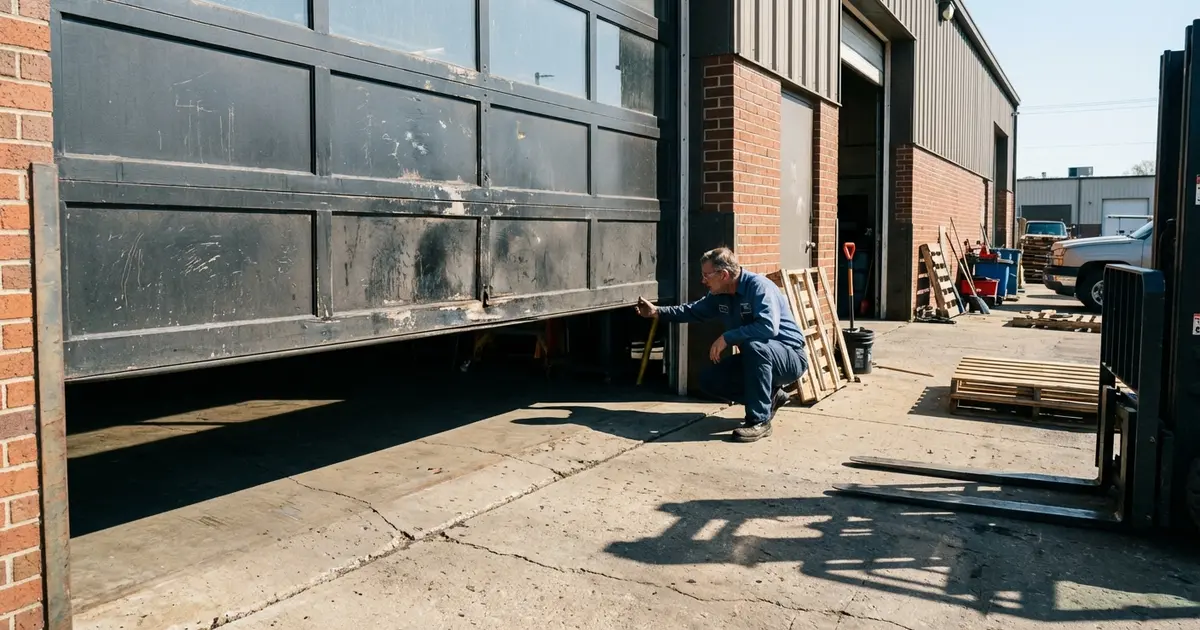
⚠️ Warning: Commercial garage door repair requires technicians certified for high-cycle springs and industrial hardware. Verify commercial experience before booking any technician.
Commercial vs Residential Garage Doors: Key Differences
If you've dealt with residential garage door repair before, don't assume commercial repair is similar. The scale, complexity, and regulatory environment are substantially different.
| Factor | Residential | Commercial |
|---|---|---|
| Door weight | 100–300 lbs | 200–2,000+ lbs |
| Spring tension | Light–medium | Heavy–industrial |
| Daily cycles | 2–6 | 20–500+ |
| Operator horsepower | 1/3–3/4 HP | 1/2–5+ HP |
| Compliance requirements | UL 325, local code | OSHA, NFPA 80, UL 325, local code, possibly FDA/USDA |
| Service urgency | Inconvenient if down | Business-critical; operational loss if down |
| Technician certification | General garage door tech | Requires commercial/industrial experience |
| Typical repair cost range | $75–$1,500 | $150–$8,000+ |
The most important takeaway: not every residential garage door company is qualified to work on commercial doors. The springs are heavier (and more dangerous), the operators are more complex, and the regulatory stakes are higher. Always confirm commercial experience before hiring.
Types of Commercial Garage Doors
Commercial properties use several distinct door configurations, each with different maintenance needs and repair approaches.
1. Commercial Sectional Overhead Doors
The commercial version of a standard garage door — horizontal sections that travel up a track and park horizontally overhead. Common in auto shops, car dealerships, self-storage units, and light commercial buildings. Operate similarly to residential doors but use heavier steel panels (24–26 gauge commercial grade vs 27–28 gauge residential), stronger springs, and more powerful operators. Repair is more accessible because technicians familiar with residential doors can often work on these with appropriate commercial parts.
2. Commercial Roll-Up (Coiling) Doors
Instead of sections on a track, the door curtain is made of interlocking metal slats that roll up into a coil above the opening. Extremely space-efficient — no horizontal track needed — making them common in shipping and receiving areas, loading docks, storage facilities, and any space where ceiling clearance is limited. Repair requires specific knowledge of coiling door mechanics; individual slat replacement and spring (torsion barrel spring) work is specialized.
3. High-Speed / Rapid Roll Doors
Fabric or aluminum doors that open and close at 20–150 inches per second (compared to 6–12 inches/second for standard commercial doors). Used in warehouses, food processing plants, cold storage, pharmaceutical facilities, and any environment where quick cycles reduce air exchange, maintain temperature, or improve throughput. These doors have sophisticated control systems, soft-edge bottom bars that absorb impact, and self-reinserting mechanisms if the curtain comes off track. Repairs require manufacturer-specific training; many are serviced under brand-specific service contracts (Assa Abloy, Rytec, Hörmann, etc.).
4. Fire-Rated Doors
Required in certain occupancy types and wall assemblies to compartmentalize fire. These are typically rolling steel doors with fusible links that cause the door to drop closed automatically in a fire. They must comply with NFPA 80 and UL listings. Fire-rated doors require annual inspection and testing by a qualified technician — this is a code requirement, not optional. Any repair or modification must preserve the UL listing; non-compliant modifications void the rating and can expose business owners to significant liability.
5. Bi-Fold / Airplane Hangar Doors
Large two-section doors that fold upward, used in aviation facilities, large equipment storage, and specialized applications. The mechanisms are unique; repairs require specialized contractors.
6. Sectional Steel Service Doors (Smaller)
Common in multi-tenant commercial properties, ground-floor retail, and service bays — essentially similar to residential sectional doors but with commercial-grade hardware. Often the most DIY-accessible of the commercial door types for minor repairs.
Most Common Commercial Garage Door Repairs
Spring Failure
Commercial torsion springs are rated for a specific number of cycles (typically 25,000–100,000+ depending on specification). When they reach end-of-life, they break — often suddenly and loudly. Unlike residential spring repair, commercial spring replacement involves much heavier spring assemblies with greater stored energy. This is not a DIY repair under any circumstances. A failed commercial spring under tension can cause catastrophic injury.
Warning signs of spring wear: door becomes noticeably harder to operate, uneven lifting (one side higher than the other), visible coil gaps or cracking on the spring, squealing or groaning during operation.
Operator / Motor Failure
Commercial operators run more hours than residential openers and are subject to greater strain. Common failure points include motor brushes (wear item in brush motors), capacitors (fail in high-heat environments or with age), control boards (susceptible to power surges and moisture), and limit switch assemblies. Many commercial operator failures present as intermittent operation before full failure — unusual behavior like random stops mid-travel, needing multiple button presses to respond, or inconsistent speed are early warning signs.
Slat / Panel Damage
Forklifts, pallet jacks, vehicles, and loading equipment impact doors regularly in busy commercial settings. Individual steel slats on a roll-up door can be dented, bent, or broken. On sectional doors, sections can be cracked or punctured. Minor dents may not affect function; severe damage can bind the door in its track or create gap-seal problems. Individual slat or section replacement is often possible without full door replacement.
Track Misalignment and Damage
Commercial door tracks handle significantly more load than residential tracks and are subject to vehicle impact. Bent track sections prevent smooth door travel and can cause complete binding. Track realignment and replacement is a labor-intensive repair, typically requiring 2–4 hours for a standard commercial door.
Bottom Seal Replacement
The bottom seal (rubber or brush) creates a pest and weather barrier at the base of the door. In commercial settings, this seal takes a beating from forklift traffic, vehicle clearance, and heavy seasonal use. A compromised bottom seal allows water infiltration, pest entry (a serious issue in food facilities), and loss of temperature control in climate-sensitive environments. This is a relatively routine repair.
Control System and Sensor Issues
Commercial doors use more sophisticated access control than residential systems — loop detectors embedded in pavement, proximity card readers, keypad entry, integration with facility management systems, and connection to fire alarm systems (for fire-rated doors). These systems require technicians with electronics experience; not all garage door companies have this capability.
Weatherstripping and Side Seals
Side and top weatherstripping degrades from UV exposure, temperature cycling, and abrasion. Failed weatherstripping in a cold storage or food processing environment creates immediate compliance issues. Replacement is straightforward but must use the correct profile for the door and application.
💡 Pro Tip: Get at least 3 written quotes for commercial door work. Pricing varies widely, and a low bid may exclude parts or use non-OEM hardware that voids the door warranty.
Commercial Garage Door Repair Costs (2026)
Commercial repair costs are substantially higher than residential due to parts cost, labor time, specialized tools, and the commercial overhead of the service company. The following ranges reflect standard business hours; emergency or after-hours service typically adds 50–100%.
Repair Cost by Service Type
| Repair Type | Low End | High End | Notes |
|---|---|---|---|
| Service call / diagnostic | $150 | $300 | Minimum charge; often applied to repair total |
| Spring replacement (single) | $300 | $800 | Light commercial sectional door |
| Spring replacement (pair) | $500 | $1,500 | Heavy commercial or roll-up door |
| Operator replacement | $800 | $2,500 | Depends on HP and door size |
| Track replacement (section) | $300 | $800 | Per damaged track section + labor |
| Panel/slat replacement | $200 | $600 | Per panel; steel slats vary by door spec |
| Bottom seal replacement | $150 | $400 | Wide doors or brush seals cost more |
| Cable replacement | $250 | $600 | Commercial cable + drum hardware |
| Control board / wiring | $300 | $900 | Operator-specific parts; can be hard to source |
| Annual fire door inspection | $150 | $400 | Per door; documentation required |
| Full door replacement (sectional) | $1,500 | $5,000 | Standard commercial sectional door |
| Full door replacement (roll-up) | $2,000 | $8,000+ | Depends on door width, height, spec |
| High-speed door service | $400 | $2,500 | Highly variable; brand and model dependent |
Regional Cost Variation
| Region | Service Call | Spring Replacement | Operator Replacement |
|---|---|---|---|
| Northeast (NY, MA, NJ, PA) | $200–$350 | $600–$1,600 | $1,200–$3,000 |
| Southeast (FL, GA, TX, NC) | $150–$275 | $400–$1,200 | $900–$2,200 |
| Midwest (IL, OH, MI, MN) | $150–$280 | $450–$1,300 | $900–$2,400 |
| West Coast (CA, WA, OR) | $175–$325 | $550–$1,500 | $1,100–$2,800 |
| Mountain/Southwest (CO, AZ, NV) | $150–$280 | $450–$1,200 | $900–$2,200 |
Emergency and After-Hours Pricing
Most commercial door companies offer 24/7 emergency service but charge a premium:
- Evening/night (5 PM–10 PM): typically 25–50% surcharge
- Late night/overnight (10 PM–7 AM): typically 75–100% surcharge
- Weekend: 50–100% surcharge depending on company and day
- Holidays: often 100–150% surcharge
For a failed door at 11 PM on a Saturday, a repair that would cost $600 during business hours could easily run $1,200–$1,500. This is a strong argument for proactive maintenance and service contracts.
Emergency Service and Response Times
When a commercial garage door fails, time is money. Here's how to handle an emergency repair situation effectively.
What Qualifies as a Commercial Door Emergency
- Door stuck open: Security risk — vehicle or pedestrian access to the facility is unrestricted. This is typically the highest-priority emergency.
- Door stuck closed (inside): Vehicles, equipment, or employees may be trapped. Operations are halted.
- Door stuck closed (outside): Staff cannot access the facility; deliveries cannot be received.
- Door off-track or structurally compromised: Door may fall; creates immediate safety hazard.
- Fire door failure: Fire-rated door that won't close or is stuck closed may violate code and create immediate compliance issues.
Immediate Steps When a Commercial Door Fails
- Ensure safety first. If the door is partially off-track or looks structurally compromised, keep employees away from the door area. A falling commercial door is extremely dangerous.
- Use the manual release. Commercial operators have an emergency manual release (typically a red cord or handle). If the door is stuck in the down position and power is available, try the release to see if the door can be manually raised. Do not force a door that's binding on the track.
- Secure the opening. If the door is stuck open, assess whether portable security barriers, temporary fencing, or a security guard can protect the opening while waiting for the technician.
- Call your service contractor. If you have a service contract, call the emergency line. If not, call 2–3 commercial door companies to find one that can respond quickly.
- Document the situation. Take photos before the technician arrives. This helps with insurance claims, contractor disputes, and future preventive maintenance planning.
Response Time Expectations
Response times vary significantly by market and company:
- With a service contract (priority response): Typically 2–4 hours, sometimes same day
- Without a contract, major metro area: Same day to next morning, depending on time of call
- Without a contract, smaller market: Next day is common; same-day responses may be limited
- Rural areas: May require 1–3 days; some repairs may need parts ordered
Key lesson: Establish a relationship with a commercial door service company before you have an emergency. Ask about their emergency response time guarantee, what they consider emergency vs standard calls, and whether emergency response is included in a service contract.
Service Contracts: Are They Worth It for Commercial Properties?
For most commercial properties with significant door activity, a service contract is a sound investment. Here's what they cover and how to evaluate them.
What Commercial Service Contracts Typically Include
- Scheduled preventive maintenance visits (quarterly, semi-annually, or annually)
- Priority emergency response (guaranteed response time windows)
- Labor discounts on repairs (typically 10–25% off standard rates)
- Parts discounts
- Annual safety inspections and documentation
- Fire door annual inspection and testing (often included in premium contracts)
- No after-hours surcharge (on premium contracts)
Typical Contract Costs
| Property Type | Number of Doors | Annual Contract Cost |
|---|---|---|
| Small commercial (auto shop, small retail) | 1–3 doors | $300–$800/year |
| Mid-size commercial (warehouse, distribution) | 4–10 doors | $800–$2,500/year |
| Large facility (manufacturing, large logistics) | 10–30 doors | $2,500–$8,000/year |
| High-speed door contract (per door) | 1 door | $600–$2,500/year |
When a Service Contract Makes Sense
- Your facility has 3+ commercial doors
- Your operation runs shifts outside normal business hours and a door failure would be costly
- You have fire-rated doors requiring annual documentation
- Your facility has high-speed or specialty doors under manufacturer warranty requirements
- You've already had one emergency repair — the contract usually pays for itself in 1–2 emergency calls avoided
When You Might Skip a Contract
- You have a single, light-use commercial door with low cycle count
- Your property is managed and maintenance is handled by a property management company
- Your door is under active manufacturer warranty with included service coverage
Safety Regulations and Compliance for Commercial Doors
Commercial garage doors operate in a more regulated environment than residential doors. Failure to maintain compliant doors exposes business owners to OSHA citations, insurance complications, and liability in the event of injury.
OSHA Requirements
OSHA 29 CFR 1910.176 (Material Handling) requires that powered industrial door openings be conspicuously marked with appropriate signage, that doors be maintained in safe working condition, and that employees who operate powered doors be properly trained. In practice, this means:
- Doors must have functioning safety features (auto-reverse, entrapment protection)
- Malfunctioning doors must be tagged out of service until repaired
- Operating instructions should be posted for powered doors
- Employees must know how to use the emergency manual release
UL 325 — Operator Safety Standard
All commercial door operators sold in the US must meet UL 325, which mandates entrapment protection systems, secondary entrapment protection, warning labels, and auto-reverse functionality. When replacing a commercial operator, ensure the replacement meets current UL 325 standards. Non-compliant operators create liability exposure.
NFPA 80 — Fire Door Annual Inspection
Fire-rated garage doors (typically steel rolling fire doors with fusible link release) must be inspected and tested annually per NFPA 80 Standard for Fire Doors and Other Opening Protectives. The annual inspection must:
- Verify the door closes and latches correctly
- Test the fusible link release (door drops freely when triggered)
- Verify no modifications have been made that void the UL listing
- Produce written documentation retained on-site for inspector review
Failure to have documented annual fire door inspections is a serious code violation that can result in failed fire marshal inspections, insurance coverage issues, and significant liability if a fire occurs. Budget $150–$400 per door per year for this inspection.
Local Building Code and ADA
Local codes vary but often specify minimum clear opening dimensions for vehicle access and occupancy types. If pedestrians use a door as a primary access point, ADA requirements for powered door operators may apply. Consult your local building department for jurisdiction-specific requirements.
Minimizing Business Downtime from Door Failures
A proactive approach is far less expensive than reactive emergency repair. These strategies reduce both the frequency and impact of commercial door failures.
Implement a Preventive Maintenance Schedule
The #1 way to avoid emergency repairs. A basic commercial door PM schedule:
- Monthly (staff-performed): Visual inspection of springs, cables, tracks, and bottom seal. Listen for unusual sounds during operation. Check that auto-reverse functions with a 2x4 test. Wipe down sensors.
- Quarterly (for high-cycle doors): Lubricate springs, hinges, tracks, rollers, and operator chain/belt with manufacturer-approved lubricant. Check cable tension. Verify bottom seal condition.
- Annually (professional): Full inspection and adjustment by a qualified technician. Replace wear items before failure. Document all fire door tests if applicable.
Maintain a Backup Access Plan
Every commercial facility should have a designated secondary access plan for when a primary door is down:
- Identify which personnel door or secondary entry can handle emergency vehicle traffic if needed
- Keep forklift emergency keys accessible so equipment isn't trapped
- Brief staff on manual door operation procedures so they can safely open a stuck door while awaiting service
Keep Critical Spare Parts On-Site
For high-cycle facilities, work with your service contractor to identify which parts are most likely to fail and keep critical spares on hand. A spare bottom seal, replacement slats (for roll-up doors), and a set of the correct springs (if you have multiple identical doors) can dramatically reduce repair time.
Track Door Cycle Counts and Age
Most commercial springs and operators have published cycle life ratings. If you know how many cycles per day your doors average, you can calculate when springs and operators are approaching end of life and replace them proactively during planned downtime rather than waiting for failure.
DIY vs Calling a Professional: Commercial Door Repairs
The DIY calculus for commercial doors is significantly different from residential doors. Most commercial repairs should be handled by qualified technicians.
✅ Reasonable to Handle In-House
- Cleaning sensor lenses and checking beam alignment
- Removing obstructions from the door path and sensor area
- Checking and tightening loose hardware (hinges, brackets) if you are comfortable with basic mechanical work
- Replacing a bottom seal on a light commercial sectional door (rubber T-type seal)
- Reprogramming keypads or access card readers per manufacturer documentation
- Resetting a tripped circuit breaker for the operator
- Visual inspection and documentation for your own records
⛔ Always Call a Professional
- Any spring work — Commercial springs are under extreme tension. Improper handling causes severe injury. This is non-negotiable.
- Any cable work — Cables under tension with failing hardware can snap and cause serious injury.
- Operator replacement or major electrical work
- Track replacement or major realignment
- Any fire-rated door maintenance or adjustment — Must be performed by a qualified technician to preserve UL listing and maintain compliance documentation
- Any high-speed door repair — These require manufacturer-specific training
- Any door that is off-track or structurally compromised
See also our guide on garage door cable repair and our spring replacement guide for detailed safety information on these specific repairs.
How to Vet a Commercial Garage Door Contractor
Not all garage door companies are equipped to handle commercial work. Here's how to separate the qualified from the under-qualified before you're in an emergency situation.
Questions to Ask Before Hiring
- "Do you work on [specific door type] regularly?" — A company that's uncomfortable saying the brand and model of your door type with familiarity may not be the right choice.
- "Do your technicians carry commercial parts in their vehicles?" — Companies that primarily serve commercial customers stock commercial springs, operators, and hardware. Companies that order parts suggest they primarily do residential work.
- "What's your emergency response time guarantee?" — Get this in writing.
- "Are your technicians certified?" — Look for IDA (International Door Association) certification or manufacturer-specific training certificates.
- "Are you licensed and insured for commercial work in this state?" — Licensing requirements vary by state; some states require specific licenses for commercial door work. Minimum: $1M general liability insurance, workers' comp.
- "Can you service fire-rated doors and provide NFPA 80 documentation?" — If you have fire doors, this is mandatory.
- "Do you offer service contracts?" — A company that doesn't offer service contracts is unlikely to be a primary commercial provider.
Red Flags
- Cannot provide proof of insurance immediately
- Unusually low estimate (may indicate inexperienced technicians or plans to upsell on-site)
- No physical address or warehouse — just a phone number
- Cannot provide references from similar commercial customers in your area
- Pushes for cash-only payment
- Provides a quote without inspecting the door
Read our detailed guide on how to choose a garage door repair company for a full vet checklist that applies to both commercial and residential situations.
Find a Commercial Garage Door Pro Near You
Commercial door repair requires specialists. These city pages list vetted garage door companies that service commercial properties.
- Find trusted garage door pros in Houston
- Find trusted garage door pros in Los Angeles
- Find trusted garage door pros in Chicago
- Find trusted garage door pros in Dallas
- Find trusted garage door pros in Philadelphia
- Find trusted garage door pros in Miami
Or browse all cities to find commercial door specialists in your area.
Frequently Asked Questions
How much does commercial garage door repair cost for a business?
Commercial garage door repair costs range from $150 to $2,500+ depending on the repair type and door size. A basic service call with minor adjustments runs $150–$300. Spring replacement on a commercial door costs $300–$800 for a single spring, and heavier industrial doors may require springs costing $500–$1,200 installed. Complete commercial door replacement runs $1,500–$8,000+ for a standard roll-up door and $5,000–$25,000+ for large sectional or high-speed doors. Emergency after-hours service adds a 50–100% premium over standard rates.
What types of garage doors do commercial buildings typically use?
Commercial properties use several specialized door types: Roll-up doors (coiling doors) are the most common — the curtain rolls into a coil above the opening and is space-efficient for loading docks. Sectional commercial doors look like oversized residential garage doors but are made with heavier steel panels and commercial-grade hardware. High-speed doors (also called rapid roll or fast doors) open and close at 20–150 inches per second, used in food processing, cold storage, and high-traffic warehouses to maintain temperature control and minimize air exchange. Fire-rated doors provide compartmentalization in the event of a fire. The type of door determines the repair approach, parts availability, and labor costs.
Can I use a residential garage door company for commercial repairs?
In some cases yes, but with important caveats. Many residential garage door companies also service light commercial doors — particularly sectional overhead doors similar to residential construction. However, for heavy-duty roll-up doors, high-speed doors, fire-rated doors, or any door with a motor over 1/2 HP, you need a company specifically experienced with commercial equipment. The spring tensions, torsion tube sizing, operator specifications, and code requirements for commercial doors are substantially different from residential work. Ask specifically about the door type you have and whether they carry commercial parts or must order them.
How do I minimize business downtime during a commercial garage door repair?
Plan ahead. When you notice problems early (unusual noises, slowing operation, visible wear), schedule repairs proactively rather than waiting for a complete failure. Maintain a service contract with a commercial door company that guarantees response times. For critical operations, keep a designated secondary access point (service door, alternate loading dock) clear and functional. When scheduling repairs, book first-call-of-day slots or request the technician arrive before your business opens. For planned replacements, request a temporary door or ask whether the company offers after-hours installation.
What safety regulations apply to commercial garage doors?
Commercial garage doors fall under several regulatory frameworks. OSHA 29 CFR 1910.176 (Material Handling and Storage) requires that powered industrial door openings be marked and that doors are maintained to prevent injury. UL 325 governs safety features of commercial door operators (similar to residential requirements). Local building codes specify minimum clear opening heights and widths for vehicles and occupancy types. Fire-rated doors must comply with NFPA 80 and UL 10B/10C and require annual inspection and documentation. ADA compliance may apply to pedestrian access points. High-speed doors in food facilities may fall under FDA guidelines for pest exclusion. Always ensure your service company understands the applicable regulatory requirements for your facility type.
How often should commercial garage doors be serviced?
The service frequency depends heavily on usage. Light commercial (10–20 cycles/day): annual professional inspection with semi-annual lubrication is typically sufficient. Medium commercial (20–50 cycles/day): inspect and service every 6 months. High-cycle commercial (50–100+ cycles/day): quarterly inspection and service, with monthly self-inspection by facility staff. Very high-cycle (100–500+ cycles/day, warehouses and logistics): monthly professional inspection, parts replacement on a defined schedule before failure. For high-speed doors, manufacturers often specify specific service intervals tied to cycle counts (e.g., every 250,000 cycles). A service contract with a commercial door company is strongly recommended for any facility with more than 20 cycles per day.
What are the most common commercial garage door failures?
In commercial settings, the most common failures are: (1) Spring failure — commercial torsion springs carry much heavier loads than residential springs and fail when they reach their cycle life. (2) Operator/motor failure — commercial operators run more hours and are subject to greater strain; motor brushes, capacitors, and control boards are common wear items. (3) Slat damage on roll-up doors — individual slats get bent by forklifts, pallet jacks, or vehicles and need replacement. (4) Track misalignment — heavy use causes track mounting hardware to loosen or tracks to shift. (5) Bottom seal failure — the bottom rubber or brush seal wears away, compromising weather and pest exclusion. (6) Control system faults — loop detectors, proximity sensors, and card reader integrations fail and require specialized diagnostic work.