Garage Door Insulation: Types, R-Values, and Installation Guide
An uninsulated garage door is a large thermal hole in your home's envelope. Whether you're buying a new door or retrofitting an existing one, this guide explains exactly what insulation options exist, how much they cost, and whether the investment makes financial sense for your situation.
Why Garage Door Insulation Matters
Your garage door is typically the largest moving object in your home, often spanning 9×7 ft (single) or 16×7 ft (double). That's 63 to 112 square feet of surface area — which, if uninsulated, acts as a large thermal bridge between the outdoor temperature and your living space.
Heat Transfer in Three Forms
Garage door insulation works against all three mechanisms of heat transfer:
- Conduction: Heat moves directly through solid materials. A bare steel panel conducts heat from a 100°F summer day straight into your garage. Insulation slows this transfer.
- Convection: Air currents carry heat. An uninsulated door with gaps at the edges lets warm or cold air flood in. Weatherstripping addresses this specifically.
- Radiation: The sun radiates heat onto your door surface. Reflective foil insulation is specifically designed to bounce radiant heat back outward, which is why it's popular in Southern and Southwestern climates.
When Insulation Has the Biggest Impact
| Situation | Insulation Impact | Recommendation |
|---|---|---|
| Attached garage, living space above | High — floor above and adjacent walls are thermal boundaries | Maximum R-value (R-16 to R-18) |
| Attached garage, shared wall with living room/bedroom | High — heat/cold transfers through shared wall | R-12 to R-18 polyurethane |
| Attached garage, used as workshop year-round | Medium-high — for comfort and energy | R-12 to R-18 + weatherstripping |
| Attached garage, parking only | Medium — reduces temperature swings in adjacent rooms | R-9 to R-13 is sufficient |
| Detached garage, parking/storage only | Low — no shared thermal boundary with home | DIY kit or skip insulation |
| Detached garage, workshop with HVAC | High — needed to make heating/cooling efficient | R-13 to R-18 + full air sealing |
Understanding R-Value for Garage Doors
R-value (thermal resistance) measures how well a material resists heat flow. Higher R-value = better insulation. Here's what the numbers mean in practical garage door terms:
R-Value Reference Table
| R-Value | Insulation Level | Typical Application |
|---|---|---|
| R-0 to R-2 | None / minimal | Single-layer steel doors with no added insulation |
| R-3 to R-6 | Low | Basic polystyrene panel, two-layer doors |
| R-7 to R-10 | Moderate | Thicker polystyrene or thin polyurethane |
| R-11 to R-13 | Good | Standard three-layer polystyrene |
| R-14 to R-16 | High | Three-layer polyurethane (mid-range doors) |
| R-17 to R-18 | Very high | Premium polyurethane-injected doors |
Context: How Garage Door R-Value Compares to Other Building Components
- Single-pane window: R-1
- Double-pane window: R-2 to R-4
- Uninsulated garage door: R-0 to R-2
- Standard insulated garage door: R-6 to R-12
- Premium insulated garage door: R-16 to R-18
- 2×4 wall with R-13 batt insulation: R-13
- 2×6 wall with R-21 batt insulation: R-21
- Typical attic with blown insulation: R-30 to R-49
This context shows that even a high-R-value garage door (R-18) doesn't approach the insulation level of a well-insulated wall. The door's thermal performance is one factor; the adjacent wall insulation, ceiling insulation, and air sealing matter just as much.
The Door-in-Context Rule
If your garage-to-living-space wall is insulated with R-13 to R-21, upgrading your door from R-9 to R-18 will have a measurable but modest impact on energy costs — because the wall is the primary thermal boundary. If that shared wall has no insulation (common in older attached garages), adding wall insulation will have a bigger impact than door insulation, and you should do both.
Insulation Types: Polystyrene vs Polyurethane vs Reflective
Expanded Polystyrene (EPS) — The Standard
EPS is the rigid white foam you recognize from packaging and foam coffee cups. In garage doors, it comes as pre-cut rigid panels that sit inside the door sections. It's widely used because it's affordable, moisture-resistant, and effective.
- R-value: ~R-3.8 per inch of thickness. A 2" thick EPS panel achieves approximately R-7 to R-9.
- Pros: Inexpensive, moisture-resistant, compatible with most steel door profiles, widely available in DIY kits
- Cons: Lower R-value per inch than polyurethane, can shift or rattle if not properly secured, doesn't bond to door steel (leaving air gaps)
- Typical applications: Budget to mid-range doors (two-layer), DIY retrofit kits
Extruded Polystyrene (XPS) — Denser Blue/Pink Foam
XPS (the blue Owens Corning or pink CertainTeed rigid foam) is denser than EPS and achieves ~R-5 per inch. It's used in some mid-range doors and premium DIY retrofit kits. Better moisture resistance than EPS but costs more.
Polyurethane Foam — The Premium Choice
Polyurethane is injected as a liquid into the cavity between two steel skins, where it expands and bonds to both surfaces. This creates a structural composite — the foam literally becomes part of the door panel, increasing rigidity and eliminating air gaps.
- R-value: ~R-6.5 per inch. A standard 1.75" cavity gives R-11 to R-12; premium designs reach R-17 to R-18.
- Pros: Highest R-value, no air gaps, makes door stiffer and quieter, bonds structurally, moisture-resistant
- Cons: Costs more, can't be added via DIY retrofit (it's injected at the factory), may be harder to repair if a panel is damaged
- Typical applications: Premium triple-layer steel doors (Wayne Dalton ThermoStar, Clopay Premium Series, Amarr Lincoln/Classica)
Reflective Foil Insulation
Reflective foil insulation (metalized film with foam core or bubble wrap fill) works differently from mass-based insulation. Instead of slowing conductive heat transfer, it reflects radiant heat — the infrared radiation from the sun hitting your door surface.
- R-value: R-3 to R-8 depending on product and air gap. Performance claims vary widely and are controversial.
- Pros: Lightweight, easy to install in DIY applications, very effective against radiant summer heat in hot/sunny climates (South, Southwest)
- Cons: Less effective in cold climates where conductive heat loss is the primary problem, R-value marketing can be misleading
- Best for: Florida, Texas, Arizona, California — anywhere summer sun beating on the door is the primary energy problem
Single-Layer vs Two-Layer vs Three-Layer Doors
Garage doors are sold in three construction configurations that directly determine what insulation is possible and how the door performs overall.
Single-Layer Doors
A single sheet of steel (typically 27–28 gauge), bent into panel shapes, with no additional structure. These are entry-level budget doors and the most common type on homes built before the 1990s.
- Insulation: None. R-0 to R-1.
- Pros: Cheap ($600–$1,200 installed for a double door), lightweight
- Cons: Flimsy, loud, no thermal or sound performance, dents easily, doesn't accept DIY insulation well (no interior panel space)
- Verdict: Fine for a detached storage garage. A poor choice for an attached garage or any application where comfort matters.
Two-Layer Doors
A steel exterior skin plus an inner layer of EPS polystyrene foam panels backed by vinyl or another steel skin. This is the most common construction on mid-range doors.
- Insulation: EPS polystyrene, typically R-6 to R-9.
- Pros: Good value, available from most manufacturers at mid-range prices, significantly better than single-layer
- Cons: EPS can shift if not well-secured, gaps around panel edges reduce effective R-value
- Verdict: A solid choice for moderate climates where extreme temperatures aren't a major concern.
Three-Layer (Triple-Layer) Doors
Steel exterior skin + insulation core + steel interior skin. The sandwich construction makes these doors noticeably stiffer, heavier, and quieter than two-layer designs. The best three-layer doors inject polyurethane into the cavity for maximum performance.
- Insulation: Polystyrene R-9 to R-13; polyurethane R-12 to R-18.
- Pros: Best thermal and acoustic performance, structurally superior (polyurethane bonds the steel layers), significantly quieter operation
- Cons: Higher cost ($300–$700 more than comparable two-layer doors), heavier (needs appropriately tensioned springs)
- Verdict: The right choice for any attached garage in a climate with significant heating or cooling costs. The noise reduction alone is worth it for many homeowners.
| Construction | Typical R-Value | Double Door Weight | Noise Reduction | Price Premium vs Single-Layer |
|---|---|---|---|---|
| Single-layer | R-0 to R-1 | 85–130 lbs | None | Baseline |
| Two-layer (EPS) | R-6 to R-9 | 130–160 lbs | Moderate | +$300–$500 |
| Three-layer (EPS) | R-9 to R-13 | 150–175 lbs | Good | +$450–$700 |
| Three-layer (polyurethane) | R-12 to R-18 | 155–185 lbs | Excellent | +$700–$1,200 |
Do You Actually Need Garage Door Insulation?
Honestly, not always. Run through this checklist:
- ✅ Yes, insulate — If your garage is attached to your home and you live in a climate with cold winters or hot summers
- ✅ Yes, insulate — If there's a bedroom, playroom, or office directly above the garage
- ✅ Yes, insulate — If you use the garage as a workshop and want to heat or cool it effectively
- ✅ Yes, insulate — If garage noise from the door rattling is bothering people inside the house
- ⚠️ Maybe — If you have an attached garage in a mild climate (e.g., Southern California, Pacific Northwest valleys) and only use it for parking
- ❌ Skip it — If you have a detached garage used purely for storage in a moderate climate
- ❌ Skip it — If you're replacing the door anyway and the budget is tight — put the savings toward a better door in another respect
The Real Energy Savings Math
Upgrading from an uninsulated door to an R-16 door on an attached two-car garage saves an estimated $100–$200/year on heating and cooling in most US climates. At a $600 cost premium for the insulated door, that's a 3–6 year payback period — reasonable if you plan to stay in the home. In climates with extreme winters (Minnesota, Wisconsin) or extreme summers (Arizona, Texas), savings can be higher.
However, if you're retrofitting an older home, check the wall between your garage and living space first. If that wall has no insulation, adding insulation there will pay back faster than a door upgrade. Both help; the wall usually has more impact.
Buying a New Insulated Door: What to Look For
If you're replacing your garage door, here's how to evaluate insulation options without getting overwhelmed:
Decide on Polystyrene or Polyurethane First
For attached garages in heating or cooling climates, go polyurethane. The price difference between polystyrene and polyurethane is roughly $200–$400 for a two-car door — money well spent for the higher R-value, structural rigidity, and noise reduction.
Ask for the R-Value of the Whole Door System
Some manufacturers advertise the R-value of just the insulation material (e.g., polyurethane foam alone might be R-25), not the assembled door. The whole-door R-value is what matters — it accounts for the steel skins, the edges, and any thermal bridging. A good assembled R-value for a premium door is R-14 to R-18.
Check the Door's Perimeter Seal
Even R-18 insulation can't compensate for poor edge sealing. Look for a door with:
- Thermal breaks at the track interface (minimizes conduction through the steel track into the garage wall)
- Perimeter weatherstripping included or available (top and side seals that compress against the frame)
- A bottom seal that creates a flush contact with the floor (no gaps)
Steel Gauge Matters Too
A thicker steel gauge (24 gauge vs 27 gauge) improves dent resistance and adds slight thermal mass. Premium insulated doors are typically 24 gauge; budget two-layer doors are 26–28 gauge. Ask specifically — it's not always advertised prominently.
Find local contractors who can source and install insulated doors in Houston, Phoenix, and Denver.
DIY Insulation Kits: Products, Costs, and How to Install
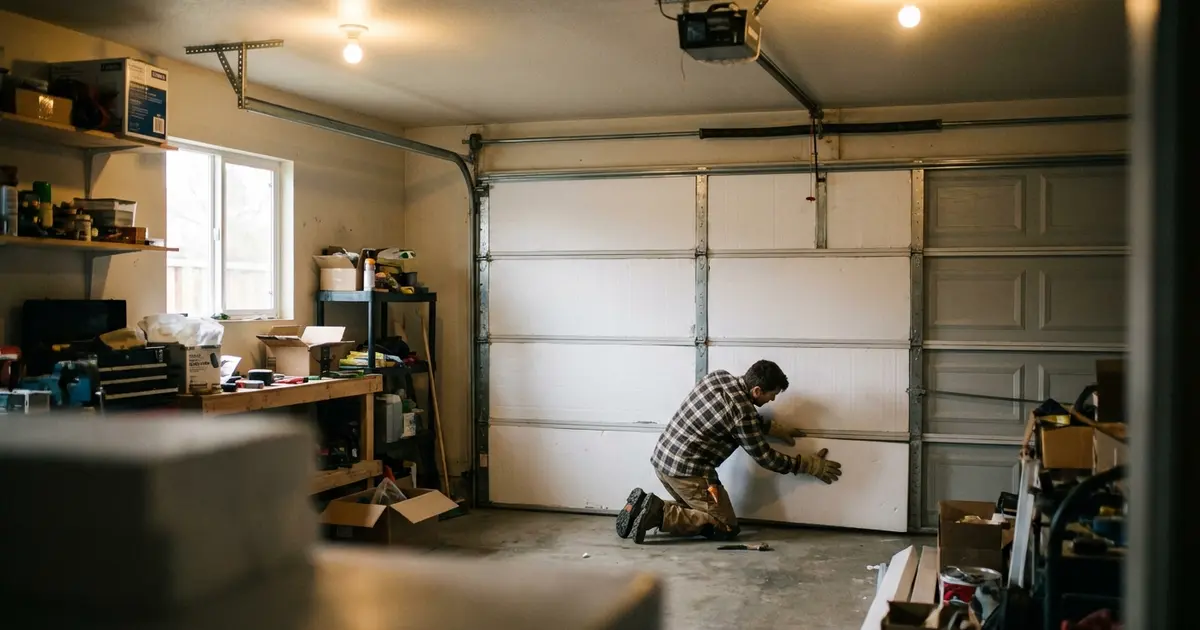
If you have an existing steel garage door and aren't ready to replace it, a DIY insulation kit is a practical upgrade that most homeowners can complete in 2–4 hours.
Popular DIY Kit Options (2026)
| Product | Type | R-Value | Coverage | Approx. Price |
|---|---|---|---|---|
| Clopay Garage Door Insulation Kit | EPS polystyrene | R-4 to R-6 | Single or double door | $50–$90 |
| Matador Garage Door Insulation Kit | EPS polystyrene | R-8 | Double door (8 panels) | $80–$120 |
| Reach Barrier 3009 Garage Door Kit | Reflective foil + bubble | R-8 (reflective) | Single or double door | $70–$100 |
| NASA Tech Foil Kit | Reflective foil + EPS | R-8 to R-10 | Double door | $90–$150 |
| Custom EPS foam cut to fit | EPS polystyrene | R-8 to R-12 | Any size | $80–$200 |
Step-by-Step DIY Installation (Polystyrene Panel Kit)
- Measure your door sections: Garage doors are made of horizontal sections (typically 4–5 sections for a 7' door). Measure the interior width and height of each section before ordering — most kits are designed for standard sizes but confirm fit.
- Clean the door interior: Wipe down the steel interior with a dry cloth to remove grease and dust. Adhesion depends on a clean surface if you're using adhesive.
- Cut panels to fit (if needed): Most kits include pre-cut panels or cutting guides. Use a utility knife and straightedge to trim EPS foam — score and snap, don't saw.
- Install retainer clips (if included): Many kits use plastic retainer pins that press through the foam into holes drilled in the steel interior. These are cleaner than adhesive and allow removal if needed. Install per the kit instructions before placing foam.
- Place foam panels: Working section by section from the top down, fit each foam panel into its section. Press clips through the foam to lock in place, or apply adhesive per kit directions. Leave a ½" gap around hinges and brackets for clearance.
- Check clearances: Confirm that foam panels don't catch on the track, rollers, or hinges during door operation. Run the door manually through a full cycle before testing with the opener.
- Check spring balance: If the door feels noticeably harder to lift manually, or if the opener sounds like it's straining, the spring tension needs adjustment. Call a garage door technician for a spring balance adjustment — this is not a DIY task.
Important Caveats for DIY Kits
- DIY kits typically add 8–20 lbs to a double door — confirm your opener's capacity
- EPS foam in a fire involves toxic gases — verify your local code allows foam insulation inside a garage
- Reflective foil kits require an air gap to perform — the foil should not be in direct contact with the steel door surface
- DIY insulation does not improve weatherstripping — add a door perimeter seal kit ($15–$40) for full air sealing
Full Cost Breakdown: New Insulated Door vs DIY Retrofit
| Option | Upfront Cost | R-Value Achieved | Labor Required | Expected Lifespan |
|---|---|---|---|---|
| DIY polystyrene kit | $50–$200 | R-4 to R-9 | 2–4 hours DIY | 5–10 years (foam degrades) |
| DIY reflective foil kit | $70–$150 | R-6 to R-10 | 2–4 hours DIY | 5–10 years |
| New two-layer door (EPS) + install | $1,100–$2,000 | R-6 to R-9 | Professional (3–5 hrs) | 20–30 years |
| New three-layer door (polystyrene) + install | $1,400–$2,400 | R-9 to R-13 | Professional (3–5 hrs) | 20–30 years |
| New three-layer door (polyurethane) + install | $1,800–$3,500 | R-12 to R-18 | Professional (3–5 hrs) | 20–30 years |
Regional Cost Variation
| Region | DIY Kit | New Insulated Door (2-car, installed) |
|---|---|---|
| Northeast (NY, Boston, DC) | $60–$200 | $2,200–$4,500 |
| West Coast (LA, SF, Seattle) | $60–$200 | $2,000–$4,200 |
| Midwest (Chicago, Detroit, Minneapolis) | $50–$175 | $1,800–$3,800 |
| Southeast (Atlanta, Charlotte, Miami) | $50–$175 | $1,700–$3,500 |
| Southwest (Phoenix, Dallas, San Antonio) | $50–$175 | $1,700–$3,500 |
DIY vs Professional: What to Handle Yourself and What Not To
Safely DIY
- ✅ Installing a polystyrene or reflective foil insulation kit on an existing door
- ✅ Adding weatherstripping to the door frame (perimeter seal, top seal)
- ✅ Replacing a bottom door seal (rubber strip at the floor contact point)
- ✅ Painting the door exterior
Call a Professional
- 🚫 Any spring adjustment or replacement (high stored energy, serious injury risk)
- 🚫 Full door replacement (involves spring installation)
- 🚫 Adding cable drum or cable adjustments
- 🚫 Track work (misaligned tracks lead to off-track failures)
For a full door replacement to an insulated model, the professional installation cost ($300–$500 for a standard door) is worth every dollar. Spring installation done wrong can cause the door to fall, the spring to snap, or opener damage that costs more than the installation would have.
Find trusted garage door pros in Columbus, Indianapolis, and Milwaukee — all cold-climate markets where insulated doors pay off fastest.
Weatherstripping: The Other Half of the Insulation Equation
A garage door with R-18 insulation but gaps in the perimeter seal will lose that thermal advantage to air infiltration. Weatherstripping is the complementary project to any door insulation upgrade.
Bottom Seal (Floor Contact)
The rubber or vinyl strip that contacts the floor when the door is closed. This is the most critical air seal — gaps here let cold air, insects, and water enter the garage. Bottom seals wear and flatten over time.
Cost: $15–$40 for materials. DIY installation involves removing the old retainer, sliding in the new seal, and trimming to length.
Perimeter/Top and Side Seals
The weatherstripping around the door frame (sides and top) creates a seal between the door and the frame when closed. These can be foam, rubber, or brush-type strips.
Cost: $25–$60 for a perimeter weatherstripping kit. DIY installation with a hammer and nails or adhesive tape.
Between Sections (Top of Each Panel)
The rubber or vinyl stop between each horizontal door section flexes as the door articulates. When these wear out, small gaps appear between sections. Replacement stop molding is available in rolls.
Cost: $20–$50 for section stop molding. DIY-installable with basic tools.
The Complete Air Sealing Package
For maximum insulation performance, do all three: bottom seal + perimeter seal + section stops. Total cost in materials: $50–$120. This combined with an R-12+ door is the full solution for an attached garage.
Related Guides
Find Garage Door Insulation Pros Near You
Find trusted garage door pros in Houston · Phoenix · Denver · Columbus · Milwaukee
FAQs
Does garage door insulation actually save money on energy bills?
Yes, but the savings depend on how your garage connects to your home. If you have an attached garage with a living space above it or adjacent bedrooms, an insulated door can meaningfully reduce heat transfer and lower heating/cooling costs — often $100–$200 per year in cold or hot climates. If the garage is detached or only used for storage, the payback period on an insulated door upgrade stretches to 10–15+ years and may not be worth the premium.
What R-value do I need for my garage door?
The right R-value depends on your climate and how you use your garage. For mild climates (USDA Zone 3–5) or a garage used only for parking: R-6 to R-12 is sufficient. For cold climates (Zone 6+) or a garage used as a workshop: R-13 to R-18 is recommended. If you have a living space (bedroom, playroom) above the garage, maximize R-value — go R-16 to R-18. Remember that the garage door is just one of several thermal boundaries; the wall between the garage and living space is typically the more important insulation point.
What is the difference between polystyrene and polyurethane insulation in garage doors?
Polystyrene (EPS foam) insulation is a rigid foam board inserted or glued inside the door panels. It's effective and affordable, typically achieving R-6 to R-13. Polyurethane foam is injected into the cavity between two steel skins, bonding to both surfaces and filling every corner. Polyurethane achieves higher R-values (R-12 to R-18), makes the door noticeably stiffer and quieter, and is slightly more moisture-resistant. Polyurethane-insulated doors cost $200–$600 more than equivalent polystyrene doors for a two-car door.
Can I add insulation to my existing garage door?
Yes. DIY garage door insulation kits are widely available for $50–$200 (brands: Clopay, Matador, Reach Barrier) and fit most single or double-section steel doors. They typically include polystyrene or reflective foam panels that attach to the door's interior with double-sided tape or plastic retainer clips. This is a reasonable project for a handy homeowner and can add R-6 to R-9 to an uninsulated door. However, DIY insulation adds weight (5–25 lbs for a two-car door) and may affect spring balance — have a technician check spring tension after installation.
Will insulating my garage door make it too heavy for my opener?
A DIY polystyrene insulation kit for a two-car door typically adds 10–20 lbs. Most standard openers rated at 1/2 hp or higher can handle this additional weight without issue. However, if your opener is already struggling with your current door weight, or if you're adding a thick polyurethane retrofit kit, have a garage door technician adjust your spring tension after installation. The bigger concern with DIY insulation is spring balance — if the spring tension isn't adjusted for the new weight, the door can be hard to operate manually and stresses the opener motor.
Is an insulated garage door quieter?
Yes, significantly. The polyurethane foam in triple-layer doors bonds the steel skins together, reducing panel vibration and acting as a sound dampener. Homeowners who upgrade from an uninsulated single-layer door to a triple-layer polyurethane door frequently cite the noise reduction as one of the most noticeable differences. This matters especially if the garage is adjacent to a bedroom or if you have an attached garage where door noise travels into the home.