Garage Door R-Value Guide: How Much Insulation Do You Need?
R-value is the single most misunderstood number in garage door shopping. Marketers treat it like a ranking — higher is always better. The reality is more nuanced: the right R-value depends on your climate, how the garage is used, what's attached to it, and what the rest of the garage envelope looks like.
What Is R-Value and Why Does It Matter?
R-value is a measure of thermal resistance — how well a material resists the flow of heat. The "R" stands for resistance. A higher R-value means better insulation: heat flows more slowly through the material, keeping interior temperatures more stable.
The formula is simple: R-value = thickness × material's thermal resistance per inch. This is why material choice matters as much as thickness — polyurethane foam at 2 inches outperforms polystyrene at the same thickness because it has higher resistance per inch.
In the context of garage doors, R-value tells you how much the door panel itself resists heat transfer between the inside of your garage and the outside air. A door with R-0 (single steel panel) has essentially no thermal resistance. A door with R-18 keeps temperatures more stable and reduces the load on any adjacent climate-controlled space.
What R-Value Is Not
R-value measures panel conduction only. It does not account for:
- Air infiltration around the door (gaps at the bottom seal, sides, or between sections)
- Radiant heat gain or loss (relevant in very hot or cold climates)
- Thermal bridging through steel frame members (steel conducts heat well, bypassing insulation)
- The overall insulation level of the rest of the garage
A door rated R-18 in a garage with uninsulated 2x4 walls and no ceiling insulation will perform far below its rated value in practice. The door is one component of a system.
Garage Door Construction and R-Value by Layer Count
Understanding how a garage door is built helps you evaluate R-value claims accurately. Most residential steel and aluminum garage doors fall into one of three construction categories:
Single-Layer (Non-Insulated)
A single sheet of steel or aluminum, typically 25–27 gauge. No insulation layer. These doors are inexpensive ($500–$900 installed) and lightweight, but they offer essentially zero thermal resistance and amplify outside noise. They dent easily and can be noisy in temperature extremes as the metal expands and contracts.
- R-value: R-0 to R-2 (steel's negligible resistance)
- Best for: Detached garages with no climate-controlled adjacent spaces
- Not recommended for: Attached garages, garages with living space above, any garage in an extreme climate
Double-Layer (Steel + Polystyrene)
An outer steel panel with a layer of polystyrene (EPS) foam bonded or pressed to the interior face. The foam is cut to fit each door section. This construction adds meaningful insulation without a major cost premium.
- R-value: R-6 to R-12 (depending on foam thickness)
- Best for: Attached garages in moderate climates, budget-conscious buyers who want some insulation
- Limitations: Foam doesn't fill the entire cavity; steel tracks and hinges bridge the insulation thermally
Triple-Layer (Steel + Polyurethane + Steel)
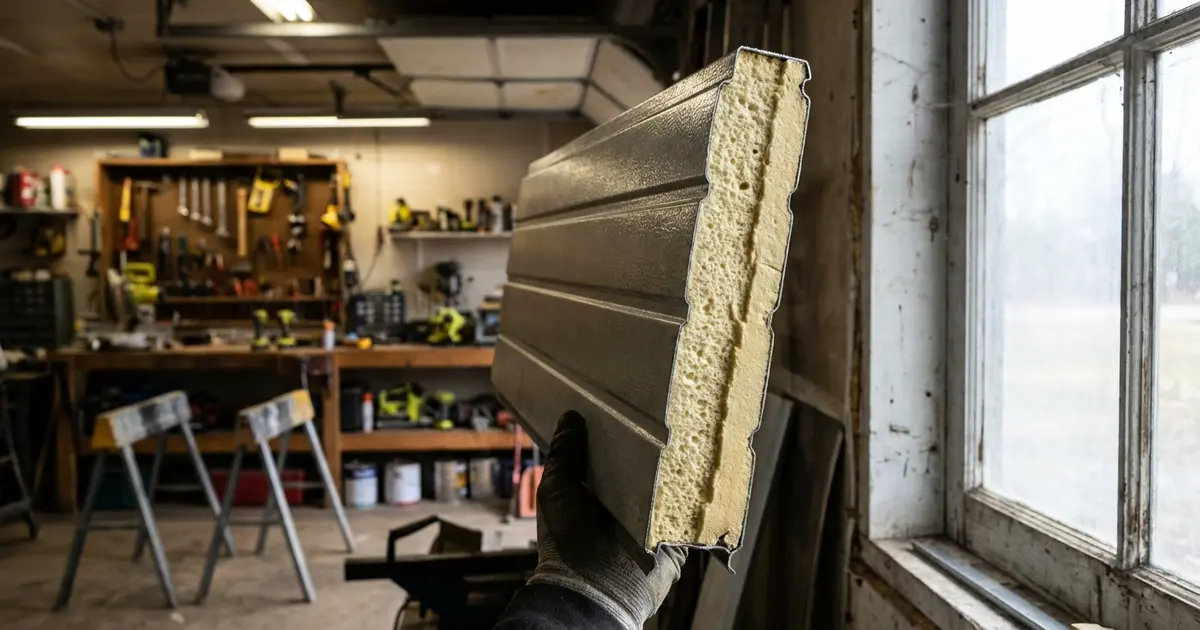
Two steel skins bonded to a core of injected polyurethane foam. The foam is injected as a liquid and expands to fill the entire cavity, bonding chemically to both steel skins. This creates a structurally integrated panel that is stronger, quieter, and far better insulated than double-layer construction.
- R-value: R-12 to R-32 (varies by panel thickness and foam depth)
- Best for: Attached garages, garages with living space above, extreme climates
- Benefits beyond R-value: Superior dent resistance, significantly quieter operation, better panel rigidity
| Construction | R-Value Range | Insulation Type | Typical Cost (Installed) |
|---|---|---|---|
| Single-layer | R-0 to R-2 | None | $500–$900 |
| Double-layer | R-6 to R-12 | Polystyrene (EPS) | $750–$1,400 |
| Triple-layer | R-12 to R-32 | Polyurethane | $1,100–$2,500+ |
Polyurethane vs Polystyrene: Which Is Better?
Both are foam-based insulators, but they perform differently in garage door applications. If you're comparing two doors at similar price points, the insulation type is an important differentiator.
| Property | Polyurethane (PU) | Polystyrene (EPS) |
|---|---|---|
| R-value per inch | R-6 to R-6.5 | R-4 to R-4.5 |
| Application method | Injected (fills cavity completely) | Cut sheet, pressed in |
| Cavity coverage | 100% — no gaps | Partial — edges may not seal |
| Structural contribution | Yes — bonds to steel panels, adds rigidity | Minimal — not bonded structurally |
| Noise damping | Excellent | Moderate |
| Moisture resistance | Good (closed-cell foam) | Fair (open-cell pores absorb moisture over time) |
| Cost premium | Higher | Lower |
Bottom line: Polyurethane is the superior product. For an attached garage or any application where insulation genuinely matters, the cost premium for a polyurethane-core door is well justified. If you're choosing a detached garage door where insulation is secondary, polystyrene is an acceptable middle ground between uninsulated and premium.
What R-Value Do You Actually Need?
The "right" R-value is determined by three factors: what your garage is adjacent to, how you use the garage, and your climate. Here's a decision framework:
Detached Garage — Not Heated or Cooled
If the garage stands alone and you only use it for parking and storage, insulation primarily benefits you by moderating extreme temperature swings. An R-6 to R-9 door is a reasonable upgrade from a bare steel door — it reduces summer heat gain and winter freeze conditions — but a premium R-18+ door offers diminishing returns if the walls are bare studs.
Recommendation: R-6 to R-12 (double-layer, polystyrene)
Attached Garage — No Climate Control
An attached garage shares at least one wall with conditioned living space. Even if the garage itself isn't heated or cooled, the shared wall is a thermal boundary between your living room and the outside air temperatures that fill the garage. A higher-R door means the garage air temperature stays closer to the interior — reducing heat loss through that shared wall in winter and heat gain in summer.
Recommendation: R-12 to R-18 (double or triple layer)
Attached Garage — With Climate Control
If you heat or cool the garage — whether as a workshop, gym, man cave, or general comfort — the door is a major point of heat loss and gain. This is where high R-values pay off most directly.
Recommendation: R-16 to R-32 (triple-layer, polyurethane)
Garage With Living Space Above
This is the most critical scenario. If there's a bedroom, family room, or finished space above the garage, heat loss through the garage ceiling and door directly affects the comfort and energy bills of that living space. Pair a high-R door with ceiling insulation above the garage for maximum effect.
Recommendation: R-18 to R-32 (highest-tier triple-layer)
Workshop or Studio in Garage
Temperature stability matters for tools, materials, and comfort. High R-value doors also reduce noise transmission — relevant if neighbors are close or if you're using power tools.
Recommendation: R-16 to R-32 (triple-layer, polyurethane)
R-Value Recommendations by US Climate Zone
The Department of Energy divides the US into climate zones 1–8, ranging from the hot/humid Gulf Coast to the subarctic interior of Alaska. Here are practical R-value recommendations for garage doors by region:
| Climate Region | Example States/Cities | Minimum R-Value | Recommended (Attached) |
|---|---|---|---|
| Hot/Humid (Zone 1–2) | FL, southern TX, LA, HI | R-6 | R-12 to R-16 |
| Mixed-Humid (Zone 3–4) | GA, SC, VA, TN, NC, AL, AR, KY | R-9 | R-13 to R-18 |
| Mixed-Dry (Zone 3–4) | AZ, NV, NM, parts of CA | R-9 | R-13 to R-18 |
| Cold/Marine (Zone 4–5) | OR, WA, NY, PA, OH, IN, IL | R-12 | R-16 to R-22 |
| Very Cold (Zone 6) | MI, WI, MN, ND, SD, MT, CO | R-16 | R-18 to R-32 |
| Subarctic (Zone 7–8) | AK, parts of northern MN/MT | R-18 | R-25 to R-32 |
Note: These recommendations assume an attached garage. For a detached, unconditioned garage, you can step down one tier. The most important thing in cold zones is pairing the door R-value with air sealing — gaps around the door (especially the bottom seal and weatherstripping) lose more heat than the panel itself in extreme cold.
See our full garage door insulation guide for a deep dive on installation and all insulation types available.
Garage Door Cost Breakdown by R-Value Tier
Insulation level is the single biggest driver of garage door cost, after size and material. Here's what you can expect to pay for a standard 16x7 ft double garage door (the most common size in the US), professionally installed:
| R-Value Tier | Door Construction | Door Cost (16x7) | Installation | Total Installed |
|---|---|---|---|---|
| R-0 (uninsulated) | Single-layer steel | $300–$600 | $200–$400 | $500–$1,000 |
| R-6 to R-9 | Double-layer, polystyrene | $450–$800 | $200–$400 | $650–$1,200 |
| R-12 to R-14 | Double-layer, polystyrene thick | $600–$1,000 | $250–$450 | $850–$1,450 |
| R-16 to R-18 | Triple-layer, polyurethane | $800–$1,400 | $250–$500 | $1,050–$1,900 |
| R-20 to R-32 | Triple-layer, premium polyurethane | $1,200–$2,200 | $300–$600 | $1,500–$2,800 |
The step from uninsulated to R-9 is usually the best value per dollar of insulation improvement. The step from R-9 to R-18 is worth it for attached garages and cold climates. Above R-18, diminishing returns set in — the difference in temperature stability between R-18 and R-32 is measurable but modest in most residential applications.
Single vs Double Garage Door Sizing
A single 9x7 door will cost roughly 60–70% of the price of a 16x7 double door. All R-value tiers still apply — just scale the door price down accordingly. For a complete look at garage door pricing, see our garage door cost guide.
Regional Installation Cost Differences
Installation labor varies significantly across the US. These figures represent professional installation of a 16x7 triple-layer polyurethane door (R-16 range), including removal of the old door:
| Region | Installed Cost Estimate | Notes |
|---|---|---|
| Southeast (TX, FL, GA) | $1,000–$1,700 | High demand for insulated doors due to heat/humidity |
| Midwest (IL, OH, MI, MN) | $1,100–$1,900 | High-R doors more common; insulation standard expectation |
| Mountain West (CO, UT, NV) | $1,200–$2,000 | Wide temp swings; R-16+ common for garages near living areas |
| Northeast (NY, MA, CT, NJ) | $1,400–$2,400 | Highest labor rates; premium doors common in older homes |
| Pacific Coast (CA, OR, WA) | $1,300–$2,300 | Moderate climate but high labor costs in metro areas |
The Whole-Garage Envelope Problem
This is the most important concept in garage door R-value decisions — and the one most often ignored in marketing materials.
A garage is a thermal envelope. Heat flows through every surface: the door, the walls, the ceiling, the floor, the windows (if any), and every gap and crack. If you install a $1,800 R-18 door but leave the garage walls as bare studs with no insulation, you've sealed the biggest opening — but left enormous thermal holes on all four sides.
Where Heat Actually Escapes in a Garage
| Surface | Typical % of Heat Loss (Uninsulated Garage) |
|---|---|
| Garage door (large, single-pane steel) | 20–30% |
| Walls (uninsulated) | 30–40% |
| Ceiling/roof | 15–25% |
| Air infiltration (gaps, seals) | 15–30% |
| Floor (slab) | 5–10% |
The door is a major source of heat loss — but not the only one. For best results, prioritize:
- Ceiling insulation (biggest single improvement if uninsulated) — R-19 to R-38 batts between ceiling joists
- Wall insulation — even R-11 to R-15 batts between studs makes a major difference
- Door R-value — with walls and ceiling done, a high-R door completes the envelope
- Air sealing — bottom seal, weatherstripping, door perimeter — see our weatherstripping guide
If you're only doing one thing, a high-R door is still worthwhile — it's the most visible and impactful single upgrade to the garage envelope. But understand that it works best as part of a complete approach.
Adding Insulation to an Existing Garage Door
If you have a working single-layer door and aren't ready to replace it, a retrofit insulation kit can improve performance at a fraction of the cost of a new door.
Retrofit Kit Options
- Polystyrene panel kits: Pre-cut or cut-to-fit EPS foam panels that press into the door sections. Typical kits for a two-car door cost $50–$120 and add R-4 to R-8. Brands include Clopay ENER-G! kits and Owens Corning foam board cut-to-fit options.
- Reflective foil kits: Foil-faced bubble wrap or reflective insulation. Lower R-value improvement (R-2 to R-4) but effective against radiant heat gain in hot, sunny climates.
- Rigid polyisocyanurate board: Higher R-value per inch than EPS (R-6 to R-7 per inch), but must be cut accurately and fastened to avoid shifting. More involved DIY project but better thermal performance.
Important Warning: Weight and Spring Balance
Retrofit insulation adds weight to your door — typically 30–60 lbs for a full two-car door kit. Your garage door springs are calibrated to the door's exact weight. Adding significant weight without adjusting spring tension will make the door feel heavy, strain the opener, and accelerate wear on cables and springs.
After adding a retrofit kit, manually test door balance: disconnect the opener, open the door halfway, and let go. It should stay in place (or drift only slightly). If it falls closed, the springs need adjustment. Have a professional adjust spring tension — do not do this yourself. See our spring system guide for how this works.
DIY vs Professional Installation
| Task | DIY Feasibility | Notes |
|---|---|---|
| Install retrofit foam insulation kit | ✅ DIY-friendly | Follow kit instructions; check spring balance after |
| Install reflective foil insulation | ✅ DIY-friendly | Cut to fit, tape seams; be sure not to block sensor beams |
| Replace old door with new insulated door | ⚠️ Advanced DIY | Possible with mechanical skill; spring handling is high risk |
| Install new door on existing tracks/hardware | ❌ Pro recommended | Tracks, springs, and hardware must be matched to new door weight/specs |
| Full new door + track + spring installation | ❌ Pro only | Spring calibration requires specialized tools and training |
Most homeowners can handle a retrofit foam kit without professional help. Full door replacement — especially when springs are involved — is a job for a licensed installer. The risk isn't just the door falling; improperly tensioned torsion springs can snap with enough force to cause serious injury.
Getting a Good Quote
When getting quotes for a new insulated door, ask contractors to specify:
- Exact R-value and construction type (single/double/triple-layer)
- Whether the foam is polyurethane or polystyrene
- What's included in the installation (old door removal, new track, hardware)
- Warranty on door panel and on labor
Be cautious of contractors who can't specify the insulation type or who quote unusually low prices — low bids often mean single-layer doors being quoted as "insulated." For help vetting contractors, see our guide to choosing a garage door repair company.
Find Insulated Door Installation Pros Near You
Find trusted garage door pros in Chicago · Find trusted garage door pros in Denver · Find trusted garage door pros in Austin · Find trusted garage door pros in Raleigh · Find trusted garage door pros in Salt Lake City
Frequently Asked Questions
What R-value should I look for in a garage door?
For an attached garage, look for an R-value of at least R-12 to R-18. If your garage is heated or cooled, or has living space above it, aim for R-16 to R-32. Detached garages with no climate control can use lower values (R-6 to R-12) or even non-insulated doors. The higher the R-value, the better the thermal resistance — but only if the rest of the garage is also insulated (walls, ceiling, floor).
Does a higher R-value garage door really save money on energy bills?
It can — but the impact depends on the whole-garage envelope, not just the door. If the garage walls and ceiling are uninsulated, a high-R door alone won't dramatically change energy costs. Studies from Oak Ridge National Laboratory suggest that insulating the garage as a system (door + walls + ceiling) can reduce heating and cooling loads in adjacent living spaces by 5–15%. In extreme climates, the savings are more pronounced. Payback period typically ranges from 3–7 years.
What is the difference between single-layer, double-layer, and triple-layer garage doors?
Single-layer doors are one sheet of steel or aluminum with no insulation — R-value near zero. Double-layer doors add a layer of polystyrene (EPS) foam bonded to the steel back, typically achieving R-6 to R-12. Triple-layer doors sandwich polyurethane foam between two steel panels, yielding R-12 to R-32. Triple-layer doors are stronger, quieter, and better insulated — and cost $200–$600 more than comparable single-layer doors.
Is polyurethane or polystyrene insulation better for garage doors?
Polyurethane is better on both counts. It has a higher R-value per inch (R-6 to R-6.5 per inch vs R-4 to R-4.5 for polystyrene), it fills the door cavity completely (no gaps), and it bonds to both steel panels — acting as structural reinforcement. The result is a stiffer, quieter, better-insulated panel. Polystyrene (EPS) is a cut sheet inserted or glued behind the outer panel and is less thermally efficient and structurally neutral. If budget allows, choose polyurethane.
Can I add insulation to my existing garage door?
Yes, with limitations. Retrofit insulation kits (typically polystyrene panels cut to fit each section) are available at home improvement stores for $50–$120 and can add R-4 to R-8 to an uninsulated door. The trade-off: added weight may unbalance your spring system (springs are calibrated to door weight), and the fit is rarely as airtight as a factory-insulated door. If you add a DIY insulation kit, have the spring balance checked afterward — an off-balance door puts premature wear on cables and springs.
Do R-values matter differently in hot vs cold climates?
Yes. In cold climates (Minnesota, Michigan, Colorado), the goal is heat retention — keeping cold air out of the garage and preventing heat loss to the living space above or beside the garage. In hot climates (Texas, Arizona, Florida), the goal is blocking radiant heat gain — keeping the garage cooler in summer. High R-values help in both scenarios, but in hot climates, exterior surface color and reflectivity also matter significantly. A light-colored door with a radiant barrier can outperform a darker door with higher nominal R-value in hot, sunny climates.