Torsion vs Extension Springs: Which Does Your Garage Door Have?
Garage door springs are the most critical — and most dangerous — component on your door. They counterbalance the door's weight (150–300+ pounds for a typical residential door), making it light enough for the opener motor to lift and for you to raise by hand. Without working springs, your door is essentially a massive deadweight that will wear out your opener in days and creates a genuine safety hazard.
There are two fundamentally different spring systems used on residential garage doors: torsion springs and extension springs. They work differently, wear differently, cost differently to replace, and carry different safety profiles. Understanding which system you have — and how it works — makes you a smarter homeowner when your springs eventually need attention.
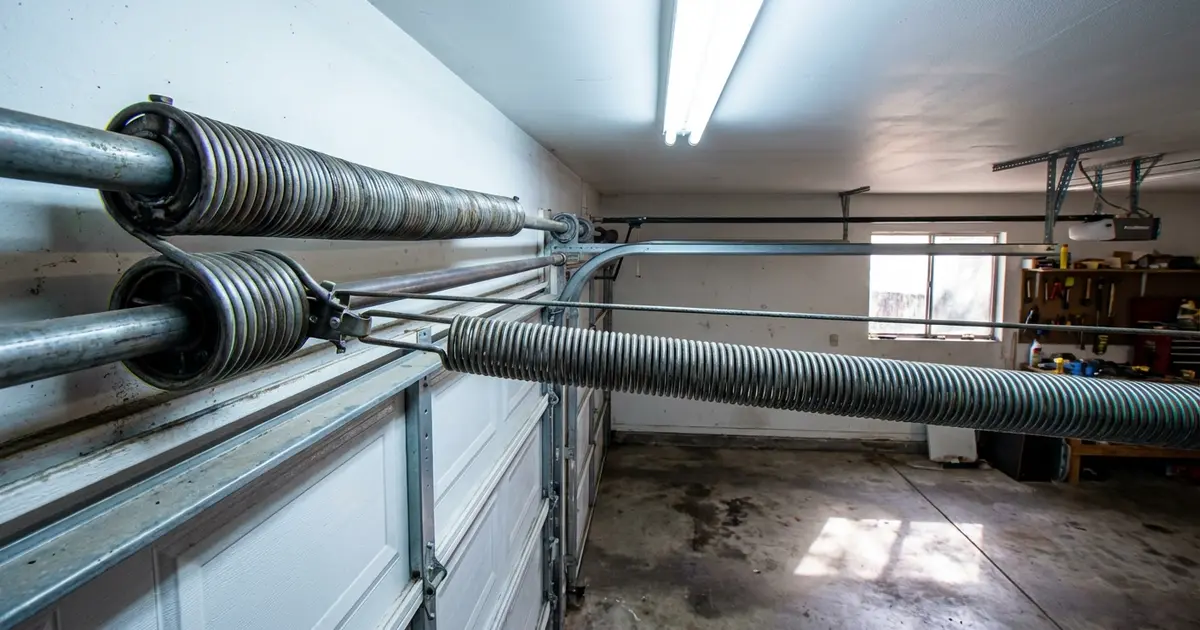
💡 Pro Tip: Stand inside your garage facing the closed door. If you see a single horizontal spring bar above the door with a spring coiled around it — that's torsion. If you see springs stretching along the horizontal tracks on each side — that's extension.
How to Identify Your Spring Type in 30 Seconds
Stand inside your garage and look up at the top section of the door system while the door is fully closed. You're looking for two possible configurations:
You Have Torsion Springs If:
- There is a horizontal metal shaft (1–1.5 inches in diameter) running across the full width of the garage, mounted 6–8 inches above the top of the door
- One or two tightly coiled springs are wound around that shaft — they look like dense, compact coils (each spring is typically 18–36 inches long when wound)
- At each end of the shaft there is a cable drum (a round spool) where the lift cables attach
- The cables run vertically down the inside face of the door to bottom brackets at the door's lower corners
You Have Extension Springs If:
- Instead of a central shaft, you see springs running horizontally along the upper section of each side of the garage, parallel to the ceiling tracks
- The springs look like long, loosely coiled units (typically 24–36 inches long when the door is closed) stretched along the top track area
- A safety cable (or in older setups, sometimes absent — which is a safety hazard) runs through the center of each spring
- The cables from the door corners run at an angle up and over a pulley or sheave near the tracks, then connect to the spring or the spring bracket
Still not sure? Here's a quick shortcut: if your garage was built after approximately 2000 and has a standard 7- or 8-foot door height with normal headroom, it almost certainly has a torsion spring system. Older homes, homes with low ceilings, and homes with lighter hollow-core doors are more likely to have extension springs.
How Torsion Springs Work
Torsion springs operate on the principle of torque — stored rotational energy. Think of it like winding a watch spring.
The Mechanics
The spring is mounted on a steel shaft that spans the width of the garage. Cable drums at each end of the shaft attach to the lift cables that connect to the bottom corners of the door. When the door closes, the cables pull on the drums, which rotate the shaft, which winds the torsion spring tighter — storing energy in the coils. When the door opens, the spring unwinds, rotating the shaft and drums in reverse, which pulls the cables up and lifts the door. The spring's stored torque does most of the actual work of lifting the door's weight — the opener motor provides only the additional force needed to accelerate and control the door's movement.
One Spring vs. Two Springs
Most standard residential doors (7-foot or 8-foot single-car doors) use a single torsion spring centered on the shaft. Larger or heavier doors — double-car doors, doors with heavy wood panels or full insulation — typically use two torsion springs, one on each side of center. Two-spring systems are safer (if one spring breaks, the other provides some support) and offer more balanced lift. If your single-spring system is being replaced, it's worth asking whether upgrading to a two-spring system is appropriate for your door's weight.
Spring Winding Direction
Torsion springs are wound in one of two directions — right-hand wound (RHW) or left-hand wound (LHW). On a two-spring system, one of each is used. The winding direction must be correct for the spring to function properly. This is one of the reasons spring sizing and specification is technical — it's not just about the coil dimensions but also the wind direction. A spring installed with the wrong wind direction will immediately snap under load.
How Extension Springs Work
Extension springs operate on the principle of elastic tension — stored stretching energy. They work much like a rubber band or a classic bungee cord, but made from high-tensile steel coils.
The Mechanics
Two extension springs are mounted horizontally above the horizontal track sections on each side of the door — one spring per side. Each spring connects at one end to a fixed anchor point near the back of the garage and at the other end (via a pulley and cable system) to the bottom corner of the door. When the door closes, the door's weight pulls the cable, which pulls the spring, stretching it and storing energy. When the door opens, the springs contract, pulling the cable and lifting the door. The amount of lift force depends on the spring's stretch length and spring rate (measured in pounds per inch of extension).
The Pulley System
Extension spring systems include a small pulley (sheave) near the rear of each horizontal track. The lift cable from the door corner goes up and over this pulley, then runs horizontally back toward the door and connects to the end of the spring. This pulley arrangement doubles the mechanical advantage, meaning the spring only needs to stretch half the distance the door travels to provide full lift support. The pulley is a wear point that should be checked during annual maintenance — worn pulleys can cause the cable to jump and the door to move unevenly.
Safety Cables: Non-Negotiable
A safety cable threads through the center of each extension spring and attaches to the track bracket at each end. If a spring breaks under tension — which happens suddenly and without warning — the safety cable catches the broken spring and prevents it from flying across the garage. Without safety cables, a breaking extension spring is a genuine projectile hazard. If your garage door has extension springs without safety cables, installing them is a same-week priority. Safety cable installation costs $20–$40 in parts and is straightforward for a professional to add during any service call.
⚠️ Warning: Both torsion and extension springs store hundreds of foot-pounds of energy. Never adjust, wind, or replace springs yourself — this is the #1 cause of serious injury in DIY garage door repairs.
Torsion vs Extension Springs: Side-by-Side Comparison
| Feature | Torsion Springs | Extension Springs |
|---|---|---|
| Mounting location | Horizontal shaft above door center | Along the horizontal tracks, one per side |
| How it works | Stores energy by twisting (torque) | Stores energy by stretching |
| Door types supported | All residential sizes; standard for larger/heavier doors | Lighter residential doors; lower-clearance garages |
| Minimum headroom needed | 10–12 inches above door | 8–10 inches above door |
| Typical lifespan | 7–12 years (10,000 cycles standard) | 5–8 years (10,000 cycles standard) |
| Door operation quality | Smoother, more balanced lift | Adequate but more flex in the door during travel |
| Safety (if spring breaks) | Spring stays on shaft; relatively contained | Spring can whip violently (safety cables required) |
| Typical replacement cost | $180–$350 (both springs) | $150–$300 (both springs) |
| DIY replacement safety | Never — extreme stored torque | Never — stored stretch energy; safety cable risk |
| Common on | Most modern homes built after ~2000 | Older homes; low-clearance garages; lighter doors |
| High-cycle upgrade available | Yes — widely available | Yes — less commonly offered |
| With broken spring: can you operate door? | No — opener does all work, will burn out | No — dangerous weight imbalance |
Torsion Springs: Pros and Cons
Advantages of Torsion Springs
- Smoother door operation. Torsion springs provide more balanced, controlled lift. The torque is applied evenly across the full shaft width, keeping both sides of the door at equal tension throughout travel. The result is a door that moves smoothly without rocking or flexing.
- Longer lifespan. Torsion springs generally last 15–30% longer than extension springs under the same operating conditions. The energy is stored as torsion (twisting) rather than extension (stretching), which creates less fatigue per cycle in high-quality spring steel.
- Better safety profile when a spring breaks. A broken torsion spring stays on the shaft. It can't fly across the garage. The shaft holds the broken spring in place. The door will become very heavy to operate (since the spring is no longer counterbalancing), but there's no projectile hazard from the spring itself.
- Better with heavier doors. Double-car doors, carriage-style doors with real wood, and heavily insulated doors need more lift force than extension springs are typically designed to provide. Torsion spring systems scale up easily with dual-spring configurations.
- Compact design. The spring and shaft assembly takes up space above the door (10–12 inches of headroom needed), but the springs don't take up any side garage space along the ceiling tracks. This can matter in garages where the ceiling is used for storage.
Disadvantages of Torsion Springs
- Require more headroom. Torsion systems need at least 10–12 inches of clearance above the door for the shaft and spring assembly. In low-clearance garages (under 8 inches of headroom above the door), extension springs may be the only option.
- Slightly higher upfront cost. Torsion spring hardware is generally $20–$50 more expensive than extension spring hardware for equivalent quality. Labor costs are similar.
- More complex sizing. Torsion springs must be precisely matched to the door's weight, height, and the cable drum dimensions. Getting this wrong (ordering the wrong spring) creates a dangerous imbalance.
Extension Springs: Pros and Cons
Advantages of Extension Springs
- Work in low-clearance garages. Extension springs only require 8–10 inches of clearance above the door. Older homes, converted spaces, and garages with lower ceilings often can't accommodate a torsion shaft without modification.
- Lower initial cost. Extension spring hardware is typically $15–$40 less expensive per pair than equivalent torsion spring components. For budget-conscious situations, this matters.
- Simpler mechanics to understand. The stretch-and-release mechanism is intuitive and easier to visualize. This doesn't mean they're safer to DIY — they're still dangerous — but the physics are simpler.
- Adequate for most lighter residential doors. Single-car doors with standard steel or aluminum panels (not excessively heavy) are well-served by extension springs throughout their lifespan. If the door isn't over-specified for the springs, they perform reliably.
Disadvantages of Extension Springs
- More door flex during operation. Because extension springs pull from the sides rather than providing a balanced torque across the full shaft, there can be more vertical flex in the door panels during travel — particularly on wider doors. This isn't usually significant on well-maintained doors, but it's measurable.
- Greater safety risk if springs break without safety cables. An extension spring breaking under full tension without a safety cable is a projectile hazard. This is the primary reason most garage door professionals prefer torsion systems for new installations.
- More components to maintain. Pulleys, their axle pins, and the attachment clips that connect the spring to the pulley assembly are all additional wear points beyond the spring itself. A worn pulley can cause uneven door travel just as a worn spring can.
- Less suitable for heavy or large doors. A two-car carriage-style door in real wood can weigh 400+ pounds. Extension springs sized for this load are very stiff and under enormous tension — even more dangerous than standard residential extension springs if something goes wrong.
Safety: What Happens When Springs Break
Both types of springs fail suddenly — there's rarely warning before a spring breaks. Understanding what happens when each type breaks explains the safety precautions you should take.
When a Torsion Spring Breaks
You'll typically hear a loud bang — similar to a firecracker or a gunshot — when a torsion spring breaks. This is the sound of the stored torque releasing suddenly as the coil fractures. After the break:
- The broken spring stays on the shaft — it doesn't fly anywhere
- If it's a single-spring system, the door immediately becomes very heavy (full door weight, no counterbalance)
- If the opener was in motion when the spring broke, it will either stall immediately or finish the cycle very slowly while straining the motor
- If it's a two-spring system, one spring breaks and the other continues providing partial support — the door will be out of balance but may still move
- Do not continue to operate the door — the opener was not designed to lift the full door weight and will burn out quickly
When an Extension Spring Breaks
Extension spring failures are more energetically dynamic. A spring under full stretch tension (when the door is fully closed, the springs are maximally stretched) breaking suddenly releases that stretch energy laterally. Without a safety cable:
- The spring can fly across the garage, striking walls, vehicles, stored items, or people
- The cable tension suddenly drops on one side, causing the door to drop unevenly — it may come off-track
- Flying spring sections can punch through drywall
With a properly installed safety cable:
- The cable catches the broken spring, limiting its travel to within the spring's original mounting length
- The door still loses counterbalance on that side and should not be operated
- But the spring itself doesn't become a projectile
If you don't have safety cables on your extension springs, install them before anything else. A professional can add them for $50–$100 during any service call, or you can purchase the cables at a hardware store and install them yourself (this is one of the few extension spring tasks that's DIY-safe, since the cables thread through the spring without loading or adjusting the spring tension).
Never Work On Springs Yourself
This applies equally to both types. Even inspection should stop short of touching or tapping a loaded spring. See our complete guide on DIY vs professional garage door repair for a full breakdown of which repairs are safe for homeowners and which aren't.
Spring Lifespan and High-Cycle Upgrades
Standard residential garage door springs are rated for 10,000 cycles. One cycle = one full open + one full close. Here's how that translates to years of real-world use:
| Daily Cycles | Typical Household | Years to 10,000 Cycles |
|---|---|---|
| 2 per day | Single person, minimal use | ~13.7 years |
| 4 per day | Single-car household, normal use | ~6.8 years |
| 6 per day | Family home, regular use | ~4.6 years |
| 8 per day | High-use family; home office | ~3.4 years |
| 10 per day | Very high use / rental property | ~2.7 years |
High-Cycle Spring Options
High-cycle springs are made from heavier-gauge spring steel with tighter tolerances. They cost more upfront but dramatically extend the replacement interval:
| Spring Rating | Part Cost Premium | Years at 4 cycles/day | Worth It? |
|---|---|---|---|
| 10,000 cycles (standard) | $0 (baseline) | ~6.8 years | — |
| 25,000 cycles | +$30–$60/pair | ~17 years | ✅ Yes — excellent value |
| 50,000 cycles | +$60–$120/pair | ~34 years | ✅ For high-use or rental properties |
| 100,000 cycles | +$120–$250/pair | ~68 years | ⚠️ Overkill for most homes |
Since labor is the primary cost of spring replacement ($100–$200 of a typical $180–$350 total bill), extending the spring's life from 7 years to 17 years means you avoid 1–2 additional service calls over a 20-year period — saving you $200–$700 in labor. Always ask about high-cycle spring options when getting a replacement quote. Most technicians will offer them; some don't mention them unless asked.
Factors That Shorten Spring Life
- No lubrication — Dry spring coils generate friction heat during operation, which weakens the steel and accelerates fatigue. Lubricating springs annually with white lithium grease adds years to their life.
- Extreme temperature ranges — Springs in garages that swing from -20°F winters to 100°F summers cycle through thermal expansion and contraction thousands of times. This is unavoidable, but well-lubricated springs handle it better.
- Incorrect sizing — A spring doing more work than it was designed for (because the door was improperly specified) wears faster. This happens when homeowners add insulation to a door and increase its weight without replacing the springs.
- High humidity or coastal environments — Salt air accelerates corrosion on spring coils. Garages near the ocean should use stainless steel or galvanized springs and lubricate more frequently.
Signs Your Springs Are Failing
Springs rarely give extensive warning before failure, but there are signs to watch for during your annual garage door tune-up and regular use:
Visual Warning Signs
- Visible gap in torsion spring coils — If you see a 2-4 inch gap somewhere in the coils of your torsion spring, the spring has already broken. The door should not be operated until replaced.
- Rust or corrosion on the coils — Light surface rust is normal on older springs. Heavy rust with visible pitting or flaking suggests the spring is near end of life.
- Extension spring looks elongated — An extension spring that has stretched to the point where the coils no longer touch each other when the door is fully open is worn out. Coils should be tight when the spring is at rest (door open).
- Uneven spring tension — On a two-torsion-spring system, both springs should look similar. One spring noticeably looser or shorter than the other indicates it has weakened or partially broken.
Operational Warning Signs
- Door feels heavier than normal — The balance test (disconnect the opener, lift the door to 3-4 feet, release) should result in the door holding its position. A door that falls quickly means the springs aren't providing adequate counterbalance — they're worn or broken.
- Door moves unevenly — One side of the door lagging behind the other during travel suggests unequal spring tension (one spring wearing faster) or a cable issue caused by uneven spring load.
- Opener struggles or reverses unexpectedly — An opener that strains, moves slowly, or reverses (triggering the auto-reverse safety) during normal operation is working harder than it should, often because weak springs are putting excess load on the motor.
- Loud squeaking or grinding from the spring area — Dry spring coils rubbing against each other or against the winding cone (torsion springs) make metal-on-metal noise. This usually means the springs haven't been lubricated recently — address it immediately to prevent fatigue cracking.
Spring Replacement Cost by Type and Region
Spring replacement costs vary based on the spring type, number of springs, spring cycle rating, and your local labor market:
Torsion Spring Replacement
| Region | Single Spring (Standard) | Both Springs (Standard) | Both Springs (High-Cycle 25K) |
|---|---|---|---|
| Northeast (NY, MA, CT) | $180–$250 | $250–$375 | $290–$440 |
| Mid-Atlantic (PA, VA, MD) | $160–$225 | $220–$340 | $260–$400 |
| Southeast (FL, GA, NC) | $140–$200 | $190–$310 | $230–$370 |
| Midwest (IL, OH, MI) | $130–$190 | $180–$295 | $215–$355 |
| South Central (TX, OK, LA) | $125–$185 | $175–$285 | $210–$345 |
| Mountain (CO, UT, AZ) | $150–$210 | $210–$330 | $250–$390 |
| West Coast (CA, OR, WA) | $180–$260 | $260–$395 | $300–$455 |
Extension Spring Replacement
| Region | Both Springs (Standard) | Both Springs + Safety Cables | Both Springs (High-Cycle) |
|---|---|---|---|
| Northeast | $160–$280 | $190–$330 | $210–$360 |
| Mid-Atlantic | $145–$250 | $175–$300 | $185–$325 |
| Southeast | $125–$220 | $150–$260 | $165–$285 |
| Midwest | $120–$210 | $145–$250 | $155–$270 |
| South Central | $115–$200 | $140–$240 | $150–$260 |
| Mountain | $135–$235 | $165–$280 | $175–$300 |
| West Coast | $165–$290 | $195–$345 | $215–$375 |
Note on replacing one vs. both springs: You should always replace both springs simultaneously, even if only one has broken. Springs are always paired and installed at the same time — which means they've been under the same number of cycles and experienced the same wear. The second spring is likely 60–80% through its lifespan when the first breaks. Replacing both costs $30–$60 more in parts than replacing one; replacing only the broken spring now and facing another service call in 6–18 months for the second costs you another full service call fee ($150–$200+ in labor). Replace both — always.
DIY vs Professional: Always Call a Pro for Springs
This section is short because the answer is simple: never attempt to replace or adjust garage door springs yourself — torsion or extension.
This is not a matter of difficulty or skill level. It's a matter of physics. A torsion spring holds 150–200+ foot-pounds of torque when wound. An extension spring under full stretch for a standard door exerts 100–200 pounds of linear force. If a winding bar slips, a coil cracks, or a cable jumps during spring work, the energy releases instantly and without warning. Professional garage door technicians are specifically trained to manage these forces with proper tools (calibrated winding bars, spring tensioners) and know when to stop if something unexpected happens.
The cost of professional spring replacement ($180–$350 including both springs and labor) is one of the better values in home maintenance — you're buying safety, warranty, and expertise for less than the cost of many household appliance repairs.
What you CAN safely do around springs:
- Lubricate torsion springs annually (spray white lithium grease along the coils — no tools, no tension adjustment, just lubrication)
- Inspect springs visually for rust, gaps, or visible damage
- Install safety cables on extension springs (threads through the spring without affecting spring tension)
- Perform the balance test (disconnect opener, lift door to mid-height, release — this tells you if springs are losing tension without requiring you to touch them)
For everything else spring-related, see our full DIY vs professional repair guide and call a technician.
Find Trusted Garage Door Spring Specialists Near You
When your springs need replacement, find a licensed, insured professional in your area:
- Find trusted garage door pros in Los Angeles
- Find trusted garage door pros in Austin
- Find trusted garage door pros in Nashville
- Find trusted garage door pros in Indianapolis
- Find trusted garage door pros in Philadelphia
- Find trusted garage door pros in Baltimore
Related reading: garage door spring replacement cost guide, 15-point tune-up checklist, and our full garage door guides index.
Frequently Asked Questions
How do I know if my garage door has torsion or extension springs?
The easiest way to tell: look above your closed garage door. If you see a horizontal metal shaft running across the full width of the door (usually 6–8 inches above the door's top edge) with one or two tightly coiled springs wound around it, you have a torsion spring system. If instead you see springs running parallel to the ceiling tracks — stretching horizontally along the upper portion of each side of the garage — those are extension springs. Extension spring systems also have a horizontal metal bar running across the top of the door to connect the springs to the door's lift mechanism, but the springs themselves are off to the sides. Torsion springs are mounted on the center shaft; extension springs are mounted to the sides. If you're still unsure, look at the cables: torsion spring cables run straight up from the bottom corners of the door to drums on the spring shaft; extension spring cables run at an angle from the door corner up and then along the track system.
Can I replace torsion springs with extension springs, or vice versa?
Technically possible but not recommended in most cases. The mounting hardware, cable routing, and counterbalance geometry differ significantly between the two systems. Converting a torsion system to extension springs typically degrades performance and is rarely cost-effective — a torsion spring replacement costs about the same as an extension spring conversion. More importantly, conversion requires new hardware, cable drums, and potentially track modifications. The reverse (converting extension to torsion) is actually common when homeowners upgrade — torsion systems perform better and last longer, and many professional installers will recommend upgrading if your extension springs are worn out and your garage has the necessary headroom (at least 10–12 inches of clearance above the door). If you're replacing springs, the right approach is to replace like-for-like unless you're specifically upgrading the entire spring system.
How long do garage door springs last?
Standard residential garage door springs are typically rated for 10,000 cycles. One cycle equals one complete open-and-close operation. For a household that opens the garage door 4 times per day (twice out, twice back), 10,000 cycles translates to about 6–7 years of use. High-cycle springs rated for 25,000 or 50,000 cycles are available at higher cost and can last 15–25 years under the same usage pattern. Factors that shorten spring life: operating in extreme temperature ranges (the metal contracts and expands, accelerating fatigue), insufficient lubrication (dry coils generate friction and heat that weakens steel), and incorrect spring sizing (a spring doing more work than it was designed for wears faster). Torsion springs generally last slightly longer than extension springs under equivalent conditions because their load is more evenly distributed.
What does it cost to replace garage door springs?
Torsion spring replacement by a professional runs $180–$350 for a standard single or double residential door, including parts and labor for both springs (you should always replace both simultaneously — they age together). Extension spring replacement costs $150–$300 for the pair. High-cycle upgrade springs ($50–$100 more per pair in parts) are worth considering since you're already paying for the labor — upgrading from standard 10,000-cycle to 25,000-cycle springs roughly doubles spring lifespan for an extra $50–$100. Labor rates vary by region: expect $50–$75 more per service call in high-cost-of-living markets (NYC, LA, Seattle) compared to mid-sized Midwest cities. Emergency or weekend calls add $75–$150 in surcharges at most companies. Get quotes from at least two companies and confirm the quote includes parts, labor, and warranty before proceeding.
Is it safe to operate my garage door with a broken spring?
No — do not regularly operate a garage door with a broken spring. A garage door with a broken torsion spring loses the counterbalance that makes it liftable. The opener motor must work far harder to move the door without spring assistance, which can burn out the motor in a matter of days. More critically, a door without proper spring support is an injury hazard: if the opener fails or the door is released manually, it will fall with the full weight of the door (150–300 pounds) with nothing to slow it. In a true emergency (car trapped inside, garage door the only exit), you can manually release the door and carefully raise it with two people — but then prop it securely open with a clamp or locking pliers on the track and don't let it come down until the spring is replaced. See our emergency repair guide for step-by-step instructions.
What are high-cycle springs and are they worth it?
Standard residential garage door springs are rated for 10,000 cycles — enough for about 6–7 years of average use. High-cycle springs are manufactured with heavier-gauge steel, tighter tolerances, and are rated for 25,000, 50,000, or even 100,000 cycles. The 25,000-cycle variety is the most cost-effective upgrade: it typically costs $30–$60 more in parts than a standard spring but lasts 2.5 times as long. Since labor is the majority of the replacement cost ($100–$200), reducing spring replacements from every 7 years to every 17+ years saves you multiple service calls over the door's lifetime. High-cycle springs are particularly worth it if: your household uses the door heavily (6+ cycles per day), the door is on a rental property where you want minimal maintenance, or you've just had a spring break prematurely (suggesting the original springs were under-specified for your usage). When getting a spring replacement quote, ask specifically for high-cycle springs — most techs will offer them if asked.
Why do extension springs need a safety cable?
Extension springs store energy by stretching when the door closes. When a stretched extension spring breaks — and they do break, usually suddenly — that energy is released explosively. Without a safety cable, a broken extension spring can whip across the garage, break through drywall, damage vehicles, or cause serious injury to anyone in its path. A safety cable is a galvanized steel cable that threads through the center of the extension spring and attaches to the track bracket at both ends. If the spring breaks, the cable contains it. Installation of safety cables is simple and inexpensive ($20–$40 per pair in parts, plus labor if you hire it out). If your garage has extension springs without safety cables, this is the highest-priority maintenance item on your door — more urgent than lubrication, more urgent than weatherstripping, more urgent than roller replacement. Do not use your garage without them.