Garage Door Weatherstripping Replacement Guide
Drafty garage? Water sneaking under the door? Bugs getting in? The culprit is almost always worn or damaged weatherstripping — and it's one of the most straightforward garage door fixes you can do yourself in an afternoon.
This guide covers every type of garage door weatherstrip, how to identify which one needs replacing, exact replacement steps for each type, what good materials cost, and when it makes sense to hire a pro instead.
Why Garage Door Weatherstripping Matters
A garage door is the largest moving part in most homes. When it's closed, it should form a reasonably tight seal with the floor and door frame on all four sides. When that seal fails, several problems follow:
Water Infiltration
A failed bottom seal is the primary entry point for rainwater during storms. Water pooling in the garage leads to floor damage, rust on tools and stored items, moisture problems in adjacent living spaces (in attached garages), and potential mold growth.
Energy Loss
For attached garages, weatherstripping gaps are a significant source of conditioned air loss. Heated or cooled air from the house migrates into the unconditioned garage space through gaps in the door seal — and unconditioned garage air infiltrates the living space through the door between the house and garage. Sealing the garage door reduces this thermal transfer.
Pest Entry
Mice can squeeze through a gap as small as 1/4 inch. A deteriorated bottom seal leaves an open invitation for rodents, insects, and snakes. In areas with termites, gaps between the door and frame also create entry points that termite inspectors flag during inspections.
Noise, Dust, and Fumes
A sealed garage door keeps road noise, dust, lawn clippings, and exhaust fumes from adjacent traffic or the garage itself from infiltrating the space. This matters especially for attached garages where vehicle exhaust near an open gap is a carbon monoxide risk.
✅ Key Takeaway: Replace weatherstripping when you see daylight around the door edges, feel drafts, or notice water seeping in at the bottom. It's a $20–$50 DIY fix that makes a big difference in energy efficiency.
💡 Pro Tip: The bottom seal wears out fastest. Replace it every 3–5 years regardless of visible condition. Side and top seals can last 10+ years if undamaged. Focus replacement effort on the bottom first.
Types of Garage Door Weatherstripping
A complete garage door seal system has three distinct components:
1. Bottom Seal (Door Bottom / Floor Seal)
Mounted to the underside of the bottom door panel, the bottom seal compresses against the garage floor when the door is fully closed. It handles the widest gap and takes the most abuse — it's dragged across concrete every time the door moves, compressed under the full weight of the door when closed, and exposed to the outdoors. Bottom seals are the most frequently replaced weatherstrip component.
Bottom seal types:
- T-type (T-slot): The most common style. A rubber or vinyl strip with a T-shaped cross-section that slides into a channel retainer track on the door bottom. Easy to replace — slide out the old, slide in the new.
- J-type: Similar to T-type but with a J-shaped cross-section. Used on some door brands as a proprietary profile.
- Bulb seal: A circular rubber tube-shaped seal that compresses against the floor. Better at conforming to uneven surfaces than T-type but less durable.
- Bead seal: A narrower round-bead profile, often used on older doors without retainer tracks — nailed or stapled directly to the door bottom.
- Brush seal: Dense nylon or polypropylene bristles instead of rubber. Excellent for pest exclusion and uneven surfaces; common on commercial doors. Less effective at water exclusion on its own.
2. Side Seals (Jamb Seals / Stop Seals)
Vertical strips that seal the gap between the door panel edge and the door frame (jamb) on each side. When the door closes, the panel presses against these seals. They prevent drafts, insects, and water infiltration along the sides. Side seals are typically vinyl or rubber strips with a fin or bulb profile, stapled or nailed to the inside face of the door stop (the raised portion of the jamb trim).
3. Top Seal (Header Seal)
A horizontal strip that seals the gap between the top panel and the door header (the structural framing above the opening). This seal is often the last to receive attention but is important for preventing drafts and debris entry at the top of the door. Similar profile to side seals — typically a vinyl or rubber strip attached to the door stop at the top of the opening.
4. Panel-to-Panel Weatherstripping (Section Seals)
On sectional garage doors, each horizontal panel has a flexible rubber or vinyl strip along its top edge that presses against the bottom of the panel above it. These provide thermal insulation between sections and prevent light gaps showing through the door. They're rarely replaced unless damaged (cracked, missing sections, or compressed flat with no resilience).
Signs Your Weatherstripping Needs Replacing
Do a quick inspection to determine which components need attention:
The Light Test (Best Method)
At night, turn on the garage lights and close the garage door. Go outside and look around the perimeter of the closed door. Any line of light visible from outside indicates a gap. Pay particular attention to the corners where the bottom and side seals meet — these are common failure points. Check both bottom corners, the sides at mid-height, and across the top.
Visual Inspection
- Bottom seal: Look for cracks, tears, or sections that have completely broken off. Pinch the rubber — if it doesn't spring back, it's hardened and no longer sealing effectively. Look for areas compressed completely flat with no rubber material remaining.
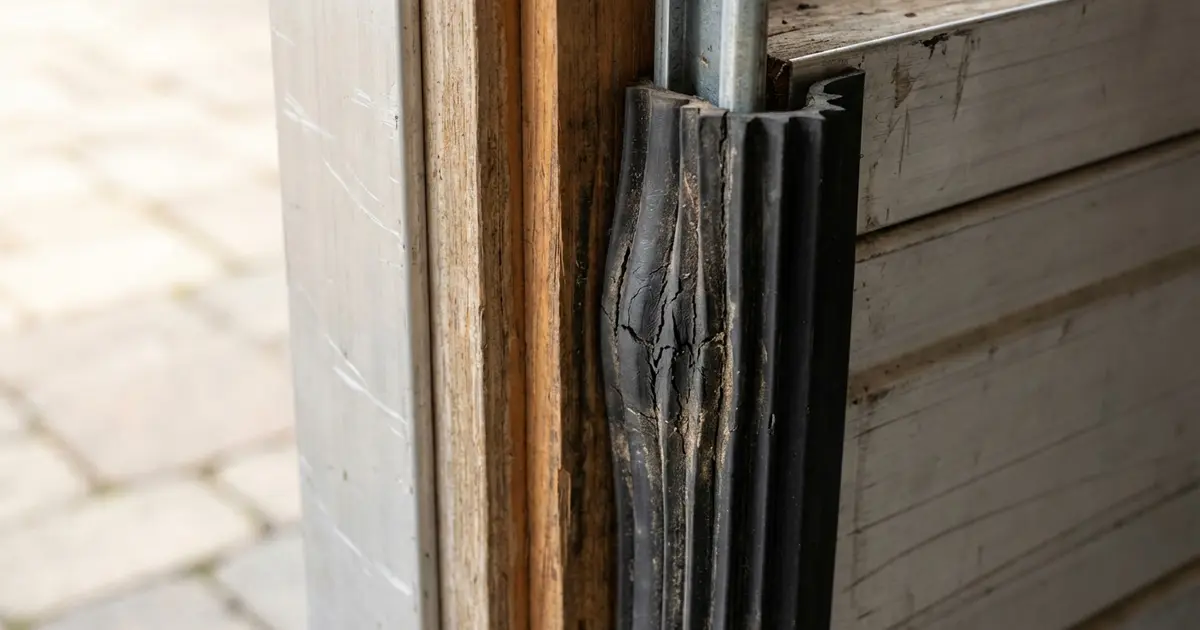
- Side seals: Check whether the vinyl or rubber strip is still attached firmly along its full length. Look for sections that have pulled away from the jamb, curled back, or been torn by the door edge. Older vinyl side seals often become stiff and brittle.
- Top seal: Similar inspection — check for attachment continuity, brittleness, and gaps. Top seals are often the most neglected and are frequently found compressed flat against the header with no sealing profile remaining.
The Hand Test
On a windy day, close the garage door and slowly move your hand around the perimeter at a few inches' distance. You should feel drafts at any gap location. This helps identify specific problem spots even when the weatherstrip looks intact.
After Rain
After a significant rainstorm, inspect the garage floor for water infiltration lines. Water patterns along the base of the door indicate bottom seal failure. Water marks along the sides indicate side seal gaps.
Weatherstrip Materials Compared
| Material | Durability | Temperature Range | Best For | Expected Lifespan |
|---|---|---|---|---|
| EPDM Rubber | Excellent | -40°F to 250°F | All climates; best overall | 7–10+ years |
| Vinyl (PVC) | Good | -20°F to 150°F | Moderate climates; good UV resistance | 5–8 years |
| Neoprene Rubber | Good | -30°F to 200°F | Cold climates; oil-resistant | 5–8 years |
| Standard Rubber | Moderate | 0°F to 150°F | Moderate climates | 3–5 years |
| Foam (Neoprene/PE) | Low | Limited | Budget replacement; mild climates | 2–4 years |
| Brush (nylon) | Excellent | Wide range | Pest exclusion; uneven floors | 8–15 years |
Recommendation: For bottom seals, use EPDM rubber (T-type or bulb profile) — it's worth the small price premium for significantly longer service life and better performance in cold or hot climates. For side and top seals, vinyl is a practical choice for most climates. In northern states where freeze-thaw cycles are severe, EPDM for all components is worth the investment.
How to Replace a Garage Door Bottom Seal (Step-by-Step)
Time required: 30–60 minutes
Skill level: Beginner-friendly
Tools needed: Utility knife or scissors, tape measure, flat-head screwdriver, spray silicone lubricant (optional), ladder
Step 1: Measure the Door Width
Measure the width of your garage door at the bottom panel. Add 2–3 inches to your measurement — you'll trim the new seal to exact length. Most residential garage doors are 8, 9, 10, or 16 feet wide; single doors are typically 8–10 feet and double doors are 16 feet. Write down the measurement before buying replacement material.
Step 2: Identify the Retainer Style
Look at the bottom edge of the door panel. Most modern doors have a metal retainer channel (a track with a slot) that the T or J-shaped seal slides into. Some older doors have the seal nailed or stapled directly to the wood or metal bottom. Take a photo of the existing seal and retainer to reference when purchasing replacement material.
Step 3: Remove the Old Seal
For T-type seals in a retainer track:
- Open the door fully (raise it all the way up) — this gives you the easiest access to the door bottom.
- Look at each end of the retainer track. Most tracks are open on one or both ends. If there are end caps or screws holding the seal in, remove them.
- Grip the old seal and slide it out through the open end of the retainer track. If it's sticky or hardened in place, spray a bit of silicone lubricant at the end to help it slide.
- Clean out the retainer track with a rag to remove any debris, old rubber fragments, or dirt.
For nailed or stapled seals:
Use a flat-head screwdriver or pry tool to carefully remove staples or nails. Work along the entire length without damaging the door bottom edge. Remove the old seal completely.
Step 4: Buy the Right Replacement Seal
Match the profile (T-type, J-type, bulb, etc.) and width to your existing seal. Most T-type seals come in standard widths (2.5", 3", 3.5"). Bring a photo and the old seal end to the hardware store if possible. Replacement seals are available at Home Depot, Lowe's, and online — EPDM T-type seals sell for $15–$35 for a standard 16-foot roll.
Step 5: Install the New Seal
For T-type seals:
- Cut the new seal to the measured door width plus 2 inches (you'll fine-trim after installation).
- Starting from one end of the retainer track, insert the T-fin into the track slot and slide the seal in. If it's tight, a helper is useful — one person guides the seal into the slot while the other pulls it through.
- Continue sliding until the seal extends fully across the door width. The seal should overhang slightly on each end.
- Close the door to verify the seal is compressing evenly against the floor across the full width.
- With the door closed, trim the excess at each end with a utility knife so the seal ends flush with the door edges.
- Replace any end caps or retaining screws you removed.
For nailed/stapled seals:
- Cut the new seal to exact door width.
- Center the seal along the door bottom and temporarily tape one end to hold position.
- Staple or nail every 4–6 inches along the length, keeping the seal straight and flat against the door edge.
- Check alignment and trim any overhang at the ends.
Step 6: Test the Seal
Close the door and perform the light test again — no light should be visible under the door. If you see light in specific spots, check whether the floor is uneven (may require a bulb seal or adjustment) or whether the seal slipped in the retainer during installation.
Troubleshooting: Uneven Floors
If your garage floor has significant dips or rises, a standard flat-bottom seal won't conform well. Options:
- Bulb seal: The round bulb profile compresses and conforms better to surface irregularities
- Brush seal: The bristles flex to follow uneven surfaces
- Threshold seal: A rubber threshold strip (like a speed bump) attached to the floor that rises to meet the door. Used in conjunction with a bottom door seal for problem floors
How to Replace Side and Top Seals (Step-by-Step)
Time required: 45–90 minutes (all three sides)
Skill level: Beginner-friendly
Tools needed: Staple gun or hammer and finish nails, utility knife, tape measure, flathead screwdriver or pry tool, ladder
Step 1: Measure the Door Opening
Measure the height of each side from floor to header. Measure the width of the header (top). Add 4–6 inches to each measurement for cutting allowance. Most standard residential doors are 7 or 8 feet tall and 8–16 feet wide.
Step 2: Remove the Old Seals
Side and top seals are typically attached to the door stop — the raised strip of trim that runs around the inside perimeter of the door frame. Use a flat screwdriver or pry tool to carefully pull out staples or nails holding the old weatherstrip in place. Work from top to bottom on the sides, and remove the top seal last. Pull away the old material completely and discard.
Some older side seals are attached with an aluminum retainer strip nailed to the jamb. If this is the case, you may need to remove the retainer to replace the seal material, or buy compatible replacement seal that works with the existing retainer.
Step 3: Clean the Surface
Wipe down the door stop surface with a damp rag to remove old adhesive residue, staple holes, and dirt. A clean surface helps the new seal attach firmly and makes the finished result look professional.
Step 4: Cut and Position the New Seals
Cut each seal piece about 2 inches longer than measured. Position the seal against the door stop so that the fin or bulb portion faces inward — toward the door panel — so that when the door closes, it presses against the seal's flexible face. The seal should be positioned so the door makes firm contact with it across the entire height on each side.
Tip: Close the door and hold the new seal strip against the stop in the correct position before fastening. Observe where the door panel contacts the seal. You want the seal positioned so there's slight compression when the door closes — not so tight that it strains the door hardware, not so loose that it leaves a gap.
Step 5: Fasten the Seals
Starting from the top of each side strip, staple or nail the weatherstrip to the door stop every 6–8 inches. Keep the seal straight and the contact edge facing inward consistently. For the top seal, work from one end to the other, ensuring the seal is parallel to the header and flush with the inside face of the stop.
At the corners (where side meets top), cut the seals at 45° angles for a clean, professional miter joint — or simply butt them together, which is functional if not quite as clean-looking.
Step 6: Trim and Test
Trim any excess seal at the bottom of each side strip. Close the door and check all sides visually (from outside) and with the light test. The door should close smoothly without the seal creating noticeable resistance — if the door strains or the opener struggles, the side seals may be positioned too tightly against the door panel.
Panel-to-Panel Weatherstripping (Section Seals)
On sectional garage doors, each horizontal panel has a rubber or vinyl seal along its top edge that presses against the panel above it when the door is closed. These seals are often overlooked but contribute to energy efficiency and noise reduction.
Signs of Worn Section Seals
- Visible light showing through the door between panels when viewed from inside
- Increased drafts felt at mid-door height on windy days
- Visible rubber strip missing or hanging loose between panels
- Rubber that's compressed completely flat with no soft resilience when pressed
Replacing Section Seals
Section seals are typically held in a channel along the top edge of each panel and replaced similarly to bottom seals — slide out the old material, slide in the new. The panel must be accessible (door in the closed or partially-open position depending on which panel's seal is being replaced). Replacement section seal material costs $20–$50 for a full roll at garage door suppliers. This is slightly more involved than bottom seal replacement because accessing interior panels requires the door to be positioned correctly, but it's still a manageable DIY repair.
Weatherstrip Replacement Costs (2026)
DIY Material Costs
| Component | Material Cost (DIY) | Coverage |
|---|---|---|
| Bottom seal (T-type rubber/vinyl) | $15–$35 | Single door (up to 16 ft) |
| Bottom seal (EPDM premium) | $25–$55 | Single door (up to 16 ft) |
| Bottom seal (bulb type) | $20–$45 | Single door (up to 16 ft) |
| Side and top seal (vinyl roll) | $20–$40 | Standard 1-car door perimeter |
| Side and top seal (rubber) | $25–$50 | Standard 1-car door perimeter |
| Complete weatherstrip kit (all four sides) | $40–$80 | Standard 1-car door; 2-car kits run $60–$120 |
| Section panel seals | $20–$50 | Full door set |
| Threshold seal (floor mount) | $30–$60 | Single door (up to 16 ft) |
Professional Installation Costs
| Service | Typical Cost Range |
|---|---|
| Bottom seal replacement only | $75–$150 |
| Side and top seals only | $75–$175 |
| Full weatherstrip replacement (all seals) | $125–$300 |
| Added to annual tune-up visit | $50–$125 add-on |
Regional Cost Variation (Professional Installation)
| Region | Bottom Seal Only | Full Weatherstrip |
|---|---|---|
| Northeast (NY, MA, NJ, CT) | $100–$175 | $175–$350 |
| Southeast (FL, GA, SC, NC) | $75–$130 | $125–$250 |
| Midwest (IL, OH, MI, WI) | $75–$135 | $130–$260 |
| West Coast (CA, WA, OR) | $90–$160 | $150–$300 |
| Mountain/Southwest (CO, AZ, TX, NV) | $75–$140 | $125–$260 |
Weatherstripping replacement offers excellent value for the cost. At $15–$80 in parts, it's one of the cheapest garage door maintenance tasks — and it prevents water damage, pest infiltration, and energy loss that would cost significantly more to address after the fact.
Weatherstripping and Energy Efficiency
For attached garages, the thermal performance of the garage door system directly affects home energy costs. Here's how to think about the energy impact of weatherstripping improvements.
The Full System Matters
Weatherstripping addresses perimeter gap infiltration — but the door panel itself is the primary thermal barrier. An uninsulated single-layer steel door has an R-value near 1–2; an insulated door with polyurethane foam core can reach R-16 to R-18. Sealing the perimeter gaps of an uninsulated door improves infiltration control but doesn't solve the radiant heat transfer through the panel itself.
For maximum energy efficiency in an attached garage, the ideal combination is:
- An insulated door (R-12 or higher)
- Intact perimeter weatherstripping (all four sides)
- A sealed door between the garage and living space (the most important single element for energy transfer)
What to Expect in Energy Savings
Weatherstripping replacement alone — on an already-insulated door — can reduce conditioned air infiltration by 20–40% through the garage door system. For a typical attached garage in a cold climate, this may translate to $50–$150 per year in reduced heating costs, depending on climate severity, garage size, and HVAC system efficiency. The payback period on DIY weatherstripping replacement (at $40–$80 in parts) is often less than one heating season.
For more information on the insulation side of the equation, see our garage door insulation guide.
DIY vs Calling a Professional
✅ DIY-Safe Weatherstrip Work
- All bottom seal replacement (T-type, bulb, bead) on standard residential sectional doors
- Side and top seal replacement with staple gun or finish nails
- Installing a floor threshold seal
- Replacing section-to-section panel seals on sectional doors
These tasks require basic hand tools, can be done safely from the ground or a short step stool, and involve no high-tension components. They're appropriate for most homeowners with basic DIY confidence.
⚠️ Consider Professional Help When
- Your door has a proprietary retainer system that requires brand-specific seal material (some older Amarr, CHI, or Wayne Dalton doors use proprietary profiles)
- The retainer track itself is damaged or bent and needs replacement before the new seal will sit correctly
- You're also addressing other door issues during the same visit (adding weatherstripping to a broader service call is often more cost-effective)
- The door frame/jamb has structural damage that should be addressed before installing new weatherstripping
- You have a roll-up door with specialized brush seals that require more specific installation
For garage door maintenance tasks that go beyond weatherstripping, see our full maintenance schedule guide. If you're also noticing other issues while you're inspecting the weatherstripping, our troubleshooting guide covers the most common door problems.
Weatherstrip Buying Guide: What to Buy and Where
Measuring Before You Buy
- Bottom seal: Measure door width (add 4") + measure the retainer channel width (T-slot opening, typically 1/4" to 3/8") + measure the seal depth from the retainer to the floor
- Side seals: Measure door height (add 6") × 2 sides
- Top seal: Measure door width (add 4")
- Profile: Photograph or measure the cross-section of your old seal — T-type, J-type, bulb, or bead
Where to Buy
- Home Depot / Lowe's: Carry standard T-type rubber seals in common widths. Good for straightforward replacements. Limited specialty profiles.
- Garage door suppliers (local): Best selection of profiles and materials, including brand-specific seals. Prices often similar to or lower than home centers for commercial-grade material.
- Amazon/online suppliers: Good for EPDM upgrades and specialty profiles not stocked locally. Verify dimensions carefully before ordering.
- Your garage door service company: Can source the exact OEM replacement seal for your door model. Convenient but usually the most expensive option.
What to Avoid
- Foam weather tape (the kind with adhesive backing sold for windows and doors) — too thin, too short a lifespan, and not designed for the forces a garage door exerts
- Seals that are the wrong width for your retainer — if the T-fin is too narrow, it won't stay in the track; if too wide, it won't insert
- Very cheap rubber (will harden and crack within 1–2 years in climates with temperature extremes)
Find a Garage Door Weatherstripping Pro Near You
If you'd rather have a professional handle the replacement — or if you're combining it with a tune-up or other repairs — these city pages can help you find qualified local contractors.
- Find trusted garage door pros in Denver
- Find trusted garage door pros in Minneapolis
- Find trusted garage door pros in Boston
- Find trusted garage door pros in Nashville
- Find trusted garage door pros in Portland
Or browse all cities to find garage door specialists in your area.
Frequently Asked Questions
How do I know if my garage door weatherstripping needs to be replaced?
Look for these signs: visible light coming through the edges or bottom of the door when it's closed (do this test at night with the lights on inside the garage), drafts you can feel when standing near the closed door, water or debris getting inside after rain or wind, brittle or cracked rubber that breaks when you bend it, weatherstrip that's pulled away from the door frame or compressed flat with no spring-back, or a bottom seal that leaves obvious daylight gaps. Also, if your energy bills have increased and you have an attached garage, degraded weatherstripping reduces the thermal efficiency of the entire system. Any of these signs indicate replacement is overdue.
What's the difference between bottom seal, side seal, and top seal on a garage door?
Your garage door has weatherstripping in three distinct locations. The bottom seal (also called the door bottom or floor seal) attaches to the bottom of the door panel and compresses against the garage floor when the door closes — this is the most important seal for keeping out water, pests, and drafts. Side seals (also called side stops or jamb seals) are vertical strips mounted on the door frame on each side; they create a seal between the door panel and the door jamb. The top seal is a horizontal strip across the top of the door opening; it prevents drafts and debris from entering through the gap at the top. Bottom seal replacement is the most common repair, followed by side seals. All three work together — if one is failed, you'll still have significant infiltration even with the others intact.
Can I replace garage door weatherstripping myself?
Yes — garage door weatherstripping replacement is one of the most DIY-friendly garage door maintenance tasks. Bottom seal replacement involves sliding or nailing off the old seal and installing the new one — no special tools or training required. Side and top seal replacement involves removing a few fasteners (screws or staples), peeling away the old material, and stapling or nailing in new vinyl or rubber weatherstrip. The most complex part is measuring and cutting accurately. Total time for a DIY weatherstrip replacement (all three sides plus bottom) is typically 2–4 hours. The main risk is buying the wrong size or profile — measure the existing weatherstrip dimensions before purchasing replacement material.
How much does professional garage door weatherstripping replacement cost?
Professional weatherstrip replacement typically costs $100–$300 for the full door (bottom seal plus sides and top). Bottom seal only: $75–$150 installed. Side and top seals only: $75–$175 installed. If you add weatherstripping replacement to a broader service call or tune-up visit, the labor cost is often lower since the technician is already on-site. Parts costs are similar to DIY ($30–$80 for materials); you're paying primarily for labor and the convenience of not doing it yourself. Regional variation exists — expect higher prices in coastal metro areas (NY, LA, Seattle) and lower prices in the Midwest and Southeast.
What type of weatherstripping is best for a garage door?
For the bottom seal, ribbed rubber (T-type or J-type that slides into a retainer track) is the most durable and provides the best seal on uneven floors. For very uneven concrete, a bulb seal or P-type seal conforms better to surface irregularities. For extreme cold climates, look for seals rated for low-temperature flexibility (many standard seals become brittle and crack below 0°F). For side and top seals, vinyl is a popular choice for its durability and UV resistance; rubber is more pliable and seals slightly better but degrades faster outdoors. Foam (polystyrene or neoprene foam tape) is the least expensive but also the least durable — expect to replace it every 2–3 years. For garage doors in hot, sunny climates, EPDM rubber outperforms standard rubber in UV resistance.
Will replacing weatherstripping actually lower my energy bills?
In an attached garage, yes — with some important caveats. Weatherstripping seals gaps that allow conditioned air from the house to escape into the unconditioned garage space, and vice versa. Studies have shown that a well-sealed attached garage can meaningfully reduce HVAC load. However, the door panel itself is the primary thermal barrier (determined by its R-value / insulation), and weatherstripping only addresses the perimeter gaps. If you have a single-layer steel door with no insulation (R-value near 0), fixing the weatherstripping without addressing the door panel provides modest savings. If you have an insulated door (R-8 to R-18+) and failing weatherstripping, replacing the seals can be quite effective. For detached garages, the energy impact is minimal unless you're actively heating or cooling the garage space.
How often should garage door weatherstripping be replaced?
Under normal conditions, expect to replace bottom seals every 3–5 years and side/top seals every 5–7 years. Several factors shorten this lifespan: UV exposure (southern-facing garages bake the weatherstrip), extreme temperature swings (freeze-thaw cycles crack rubber faster), road salt or chemical exposure, heavy door cycle usage, and concrete floors with rough surfaces that abrade the bottom seal. In the harshest environments (Florida sun, northern winters), bottom seals may need replacement every 2 years. In mild climates with moderate usage, a quality bottom seal can last 8–10 years. Annual inspection during your garage door maintenance routine will help you catch wear before it becomes infiltration.