How to Lubricate a Garage Door Properly (Step-by-Step)
A squeaky, grinding, or sluggish garage door is almost always a lubrication problem — and it's one of the easiest maintenance tasks a homeowner can do. The entire process takes about 10–15 minutes, costs $10–$20 in supplies, and can meaningfully extend the life of your springs, rollers, hinges, and opener.
This guide covers exactly what to lubricate, what products to use, what to avoid (the wrong lubricant causes more damage than no lubricant), and the step-by-step process — including which parts should stay dry.
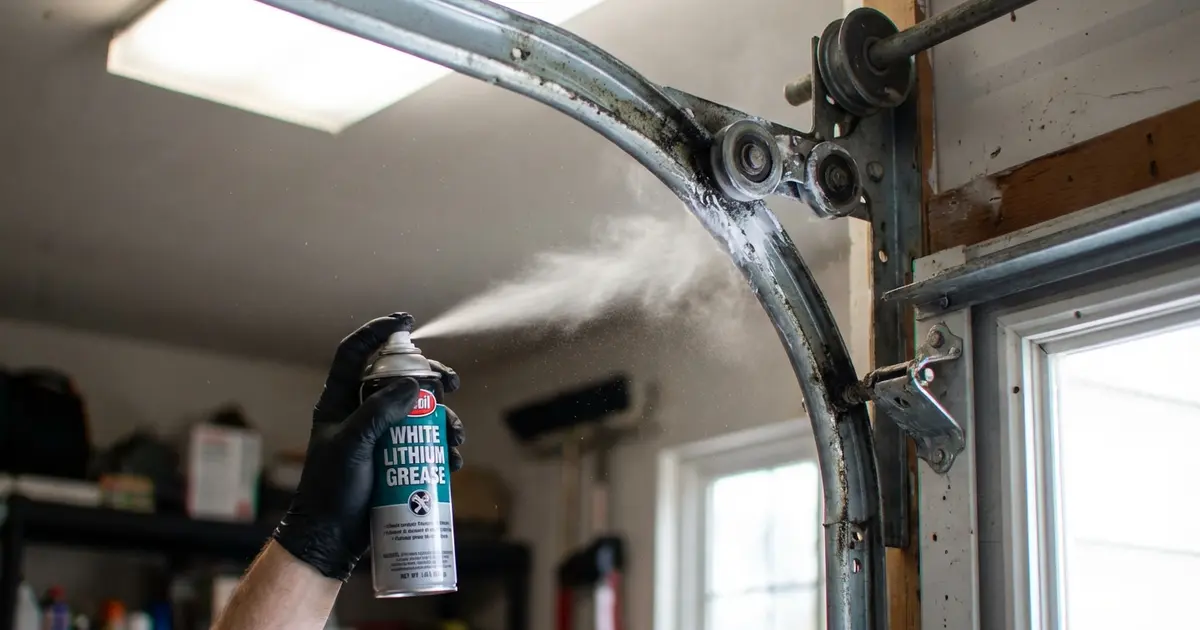
Why Garage Door Lubrication Matters
Your garage door is the largest moving mechanical component in most homes, operating on a system of springs, cables, rollers, and hinges that absorb significant stress every cycle. A typical garage door opens and closes 3–5 times per day — that's over 1,500 cycles per year, each one putting load on every joint and pivot point in the system.
Without lubrication:
- Metal surfaces wear against each other — friction accelerates wear on roller bearings, hinge pins, and spring coils
- Springs fatigue faster — dry springs develop micro-fractures from friction between coils, shortening their lifespan from 10,000 cycles to significantly fewer
- Noise increases — squeaking, grinding, and scraping sounds indicate metal-on-metal contact without adequate lubrication
- The opener works harder — a dry door creates more resistance, increasing the motor load on your opener and shortening its life
- Corrosion accelerates — bare, dry metal surfaces oxidize faster, especially in humid or coastal environments
Conversely, a properly lubricated door runs quietly, moves smoothly, and puts minimal stress on every component. Spending 15 minutes and $15 twice a year can realistically extend the life of a $300–$400 spring set, $250–$400 in rollers, and a $500–$800 opener by years.
What You Need Before Starting
Tools
- Step ladder or step stool (to reach springs and upper hinges)
- Clean rag or old towel (to wipe off excess lubricant)
- Flashlight (helpful for inspecting hinges and rollers)
- Work gloves (optional but recommended — lubricant is messy)
Supplies
- White lithium grease spray — for metal components (springs, hinges, roller stems, opener chain/screw)
- Silicone spray lubricant — for plastic components (nylon rollers, plastic tracks, weatherstripping)
- A dry cloth to clean the tracks before lubrication
You can get away with just one product if you buy a "garage door lubricant" aerosol (most are formulated for mixed metal/plastic use). Look for: 3-IN-ONE Garage Door Lube, WD-40 Specialist White Lithium Grease Spray, CRC White Lithium Grease, or similar products explicitly labeled for garage door use. These typically cost $8–$18 at any hardware or home improvement store.
Time Required
15–20 minutes for a complete lubrication. Add another 15–30 minutes if you're inspecting and cleaning the tracks for the first time in a while.
Best Lubricants for Garage Doors
| Lubricant Type | Best For | Avoid On | Approx. Cost |
|---|---|---|---|
| White lithium grease spray | Springs, hinges, roller stems, chain drives, screw drives | Rubber components, belt drives | $8–$15 |
| Silicone spray | Nylon rollers, plastic parts, weatherstripping, lock cylinders | Chain drives (too thin) | $8–$12 |
| Dedicated garage door lubricant spray | All components (formulated for mixed use) | Nothing — designed for full door use | $10–$18 |
| Dry graphite spray | Lock cylinders and keyed locks | Metal moving parts (too light) | $6–$12 |
| Chain/cable lubricant (oil) | Opener chains on heavy-duty commercial openers | Residential springs and hinges | $8–$14 |
Products to Avoid
| Product | Why to Avoid |
|---|---|
| Standard WD-40 (penetrant formula) | Too thin, evaporates quickly, attracts dirt and grit |
| Motor oil / 3-in-1 oil | Attracts debris, creates sticky paste over time, can damage plastic |
| Petroleum-based grease (axle grease) | Too thick, doesn't penetrate into coil gaps, collects grit heavily |
| Cooking oils / household sprays | Will go rancid, attract pests, leave sticky residue |
| Penetrating rust removers (PB Blaster) | Penetrant only — no lasting lubrication |
⚠️ Warning: Never use WD-40 — it's a solvent, not a lubricant. It evaporates and leaves residue that attracts grit. Use white lithium grease or a silicone-based garage door lubricant spray.
What NOT to Lubricate (Important)
This is as important as knowing what to lubricate. Applying lubricant to the wrong places causes problems:
❌ The Tracks
This is the most common mistake. Many homeowners assume that if parts move along the tracks, the tracks should be slippery. Wrong. The rollers are designed to roll along the track — if the track surface is lubricant-coated, rollers can slide instead of roll, causing binding, jerky operation, and increased wear on the roller bearings. Clean the tracks but leave them dry.
❌ Belt Drive Opener Belts
Rubber drive belts on belt-drive openers should not be lubricated. Oil-based lubricants degrade rubber, causing swelling and premature failure. The belt itself is a no-lubrication zone. You can lubricate the trolley (the carriage that moves along the rail) and the rail channel if specified in your opener's manual, but not the belt itself.
❌ The Door Lock (With Standard Grease)
Avoid using oil or grease on keyed lock cylinders — in cold climates, oil in a lock can freeze the cylinder. Use dry graphite spray for locks instead.
❌ The Nylon Roller Wheels (With Lithium Grease)
Nylon rollers don't need lubrication on the wheel surface itself — only on the metal stem/axle that the roller rotates on. Applying heavy grease to the nylon wheel surface can actually attract abrasive particles that increase wear on the track. Use silicone spray on nylon rollers if needed; lubricate the stem with white lithium grease.
Step-by-Step Garage Door Lubrication Guide
Perform this process with the garage door in the closed position for springs and bottom hinges. You'll need to raise the door partially to access the upper hinges and rollers. Work safely on a ladder — never stand on the door panels or lean against the tracks.
Step 1: Lubricate the Hinges
Hinges are one of the primary noise sources on a garage door. There are typically 10–12 hinges on a single-car door and 16–18 on a double-car door, connecting the horizontal panels together and allowing the door to bend as it follows the curved track section.
What to Lubricate on Each Hinge
Focus on the hinge pin (the small metal pin that the hinge pivots on) and the stem socket (the hole on the side of the hinge bracket where the roller stem inserts). These are the two wear points. You don't need to coat the entire hinge — just these pivot points.
How to Do It
- Spray a small amount of white lithium grease directly onto the hinge pin and the hinge joint pivot point.
- Also spray where the hinge bracket meets the door panel's edge — the steel at that junction can develop friction over time.
- After lubricating all hinges, manually flex each panel slightly (or operate the door) to work the lubricant into the pin.
- Wipe off any excess that drips onto the door panels — lubricant on painted surfaces can stain over time.
Work from bottom to top, moving up the door. The bottom hinges are the most accessible with the door closed; you'll need to open the door partway to access mid and upper hinges comfortably.
Signs of Hinge Wear
While lubricating, inspect each hinge for: cracked or broken hinge body, elongated holes (the hinge pin hole has worn oval), missing or loose bolts, or rust through the metal. Worn hinges should be replaced — a damaged hinge can compromise the door's structural integrity. Individual replacement hinges cost $3–$15 each.
Step 2: Lubricate the Rollers
Rollers run in the tracks along both sides of the door. They take significant load — each roller bears a fraction of the door's weight (a double-car steel door can weigh 130–200 lbs) plus dynamic forces during operation.
Steel Rollers vs Nylon Rollers
Most doors have either steel rollers or nylon rollers:
- Steel rollers: Louder but durable. Lubricate the roller stem (the metal axle that protrudes through the hinge bracket) with white lithium grease. Also apply a small amount to the roller bearing if accessible.
- Nylon rollers: Quieter and preferred for noise-sensitive applications. Lubricate the metal stem only — use white lithium grease on the stem, silicone spray if you want to apply anything to the nylon wheel itself. Do not apply heavy grease to the nylon wheel surface.
How to Lubricate Rollers
- Spray white lithium grease on the roller stem where it inserts into the hinge bracket — this is the main wear point.
- For rollers with accessible bearing assemblies (sealed bearings), a light spray along the edge of the bearing is sufficient.
- Avoid spraying lubricant directly into the track — remember, the track surface stays dry.
- Operate the door 2–3 cycles after lubrication to distribute the product into the bearing surfaces.
When to Replace Rollers Instead of Lubricating
Lubrication helps maintain good rollers — but it can't fix worn-out ones. Replace rollers when you see: significant wobble as the roller moves along the track, flat spots on the roller surface, visible cracks in nylon rollers, or if the roller bearing has seized (roller doesn't rotate but instead slides along the track). A complete set of 10–12 rollers costs $30–$80 depending on type (nylon rollers with sealed bearings cost more but last longer and are much quieter). Roller replacement is a DIY-accessible task for most homeowners.
Step 3: Lubricate the Springs
Springs store and release energy to counterbalance the door's weight. They're under enormous tension and will eventually break — lubrication extends their service life by reducing friction between coils and inhibiting rust formation.
Types of Springs and Where to Find Them
- Torsion springs: Large horizontal spring(s) mounted on a metal shaft above the door opening, running parallel to the top of the door. Most common on modern doors.
- Extension springs: Smaller springs mounted horizontally above the horizontal door tracks, one on each side. Common on older doors and lower-cost systems.
How to Lubricate Springs Safely
Safety note: Lubrication is safe to perform by homeowners. Do NOT attempt to adjust, tighten, loosen, or replace springs — this work requires specialized tools and training, and improperly handled springs can cause serious injury. Lubrication only requires spraying the surface; no unwinding or adjustment is involved.
- With the door in the closed position, spray white lithium grease along the length of the spring coils. For a torsion spring, spray along the top of the spring from one end to the other. For extension springs, spray along the coil surface.
- Avoid saturating the spring — a light even coat along the coils is sufficient.
- Open and close the door 3–4 times to work the lubricant between the individual coils.
- Wipe any drips from the wall, door, or header with a cloth.
What to Inspect While Lubricating Springs
While you have a good view of the springs, check for:
- A visible gap in the spring coil — a telltale sign of a broken spring (it will look like the spring is split into two pieces)
- Heavy rust or corrosion — a rusted spring is weakened and may be near failure
- Fraying on extension spring safety cables (the thin wire that runs through the extension spring as a safety backup)
If a spring looks damaged or broken, do not try to operate the door — call a professional. Broken springs are the most common major garage door repair. See our spring replacement guide for what to expect on cost and process.
Step 4: Clean the Tracks (Do NOT Lubricate)
The tracks should be cleaned — not lubricated. Dirty tracks reduce roller efficiency and can accelerate wear, but lubricant on tracks creates a worse problem than dirt.
How to Clean the Tracks
- With the door fully open (so you can access the vertical track sections), wipe the inside channel of the tracks with a clean damp cloth.
- Remove built-up grease, grit, and dirt from the track channel — this is often a black paste of old lubricant and metal particles.
- For stubborn grime, a small amount of automotive brake cleaner or mineral spirits on a cloth works well. Allow to dry fully before operating the door.
- Leave the track surface clean and dry.
Track Inspection
While cleaning, inspect the tracks for: visible bends or dents in the track channel, gaps between the track mounting brackets and the wall (should be tight), and rust or pitting on the track surface. Minor bends can sometimes be carefully straightened with pliers, but significant track damage warrants professional attention — a bent track can cause the door to bind or come off track entirely. For track repair guidance, see our garage door off-track guide.
Step 5: Lubricate the Opener Drive System
Your garage door opener's drive system — chain, belt, or screw — also requires periodic lubrication, though the specific approach differs by drive type.
Chain Drive Openers (Most Common)
The chain (similar to a bicycle chain) runs along the top rail of the opener and should be lightly lubricated. Apply white lithium grease spray along the entire length of the chain, including both sides of the chain links. Wipe off excess — an over-lubricated chain will drip and attract more debris than a properly lubricated one. Lubricate the chain 2–4 times per year.
Belt Drive Openers
Do not lubricate the rubber belt. The rail trolley (the carriage that moves along the rail) and the rail channel may benefit from a light application of silicone spray — check your opener's specific manual. The belt itself should remain clean and dry. Belt drive openers are the lowest maintenance option in terms of lubrication.
Screw Drive Openers
Screw drive openers use a threaded steel rod. Apply white lithium grease along the threads of the screw — not heavily, just a light coating. Many screw drive manufacturers recommend lubricating the drive screw annually. Consult your opener's manual for brand-specific guidance (some newer screw drives have sealed self-lubricating systems).
Direct Drive / Jackshaft Openers
These typically have minimal lubrication requirements for the drive mechanism itself. Lubricate the door components (hinges, rollers, springs) per the normal procedure; consult your specific opener's manual for motor unit guidance.
Step 6: Lubricate the Locks and Hardware
Door Locks
The door lock (if your door has a keyed or handle lock) should be lubricated with dry graphite spray — not oil or grease. Insert the graphite spray nozzle into the keyhole and spray briefly, then work the key in and out several times to distribute it. Graphite doesn't freeze in cold weather, which is critical for lock cylinders in northern climates.
Cable Drums and Cable Pulleys
The cable drums (mounted on the torsion spring shaft) and the pulley wheels on extension spring systems can be lightly lubricated with white lithium grease. Focus on the drum's contact surfaces and the pulley axle. Do not attempt to lubricate or adjust the cables themselves under tension — if cables look frayed, have visible strands breaking, or look kinked, that's a professional repair.
Door Arm and Opener Bracket
The curved door arm that connects the opener trolley to the door has pivot points at each end. Apply a light spray of white lithium grease to each pivot joint. This prevents the arm from binding as the door travels through its arc.
Step 7: Lubricate the Opener Rail and Trolley
The rail is the metal channel that runs from the opener motor unit to the front of the garage. The trolley (carriage) moves back and forth on this rail every time the door operates.
- Apply a light coat of white lithium grease or silicone spray to the rail channel — the inside surfaces where the trolley slides.
- On chain drive and screw drive openers, this rail lubrication is part of the overall chain/screw lubrication process.
- On belt drive openers, check the manufacturer's guidance — some rail types benefit from silicone spray, others should remain dry.
Final Step: Test and Wipe
After completing all lubrication steps:
- Operate the door through 3–4 complete cycles (open and close fully each time) to distribute lubricant across all contact surfaces.
- Listen for any remaining squeaks or grinding — if specific noises persist, re-apply to the component that's still noisy.
- Wipe any lubricant drips from door panels, walls, and the floor — dried lubricant attracts grit and is harder to remove later.
How Often to Lubricate Your Garage Door
| Usage / Environment | Recommended Frequency |
|---|---|
| Average home (1–3 cycles/day), moderate climate | Twice per year (spring and fall) |
| Heavy use (4+ cycles/day, e.g., commercial home with frequent traffic) | Every 3–4 months |
| Coastal / humid environments (salt air, high moisture) | Every 3–4 months |
| Very cold climate (heavy freeze-thaw cycles) | Before winter + in fall |
| New door or recently serviced door | After 1 month of operation, then normal schedule |
The best time to remember lubrication: do it when you change your smoke detector batteries (typically spring and fall). This creates a natural maintenance habit that's easy to remember.
Diagnosing Specific Garage Door Noises
Not all noise has the same root cause. This table helps you pinpoint what's causing your specific sound:
| Noise Type | Most Likely Cause | Solution |
|---|---|---|
| Squeaking during operation | Dry hinges or roller stems | Lubricate hinges and roller stems |
| Grinding at top of door travel | Dry torsion spring or drum | Lubricate spring and drums |
| Rattling (metal-on-metal) | Loose nuts/bolts or worn rollers | Tighten hardware; replace worn rollers |
| Banging when opening or closing | Extension spring cables out of adjustment or broken | Professional inspection |
| Scraping sound from track area | Bent track or roller out of track | Inspect track and roller alignment |
| Clicking from opener area | Opener chain or drive loose | Lubricate chain; adjust chain tension if loose |
| Vibration throughout operation | Loose opener mounting brackets | Tighten all mounting hardware |
| Slapping sound at door bottom | Loose or damaged bottom seal | Replace bottom weatherstrip |
If lubrication doesn't resolve the noise, check our complete guide to garage door noises for advanced diagnosis. For maintenance beyond lubrication, our full maintenance schedule guide covers the complete 15-point inspection routine.
DIY Lubrication vs Professional Tune-Up
✅ DIY — Completely Appropriate
Garage door lubrication is one of the most homeowner-friendly maintenance tasks available. It requires no specialized tools, no adjustment of tensioned components, and no technical expertise beyond knowing what product to apply where (which this guide covers). Almost any homeowner can safely and effectively lubricate their garage door.
Professional Tune-Up: What You Get Beyond DIY Lubrication
A professional garage door tune-up (typically $75–$150) includes lubrication plus:
- Inspection and adjustment of spring tension and cable tension
- Balance test (the door should stay in place when raised to waist height — if it falls or rises, spring tension needs adjustment)
- Auto-reverse force testing and adjustment
- Track alignment inspection and adjustment
- Hardware tightening (nuts, bolts, lag screws)
- Roller inspection and replacement recommendation
- Safety sensor testing
When to Call a Pro Instead of DIYing
- After lubrication, the door still makes grinding or scraping noises — this suggests a component needs adjustment or replacement, not just lubrication
- You notice a visible gap in a spring (broken spring) — do not operate the door
- The door won't stay in place when held open at waist height (imbalanced door)
- The door appears to be running unevenly (one side higher than the other)
- You haven't had the door professionally inspected in 3+ years — a full tune-up is good insurance
Cost Breakdown: DIY vs Professional
| Service | DIY Cost | Professional Cost |
|---|---|---|
| Basic lubrication (supplies only) | $10–$20 | N/A — included in tune-up |
| Full professional tune-up (includes lubrication) | $0 extra (DIY) | $75–$150 |
| Roller replacement (set of 10–12) | $30–$80 (parts only) | $130–$250 (parts + labor) |
| Hinge replacement (per hinge) | $3–$15 (parts only) | $75–$150 minimum service call |
Regional Professional Tune-Up Costs
| Region | Tune-Up Cost Range |
|---|---|
| Northeast (NY, MA, NJ, CT) | $100–$175 |
| Southeast (FL, TX, GA, NC) | $75–$130 |
| Midwest (IL, OH, MI, IN) | $80–$135 |
| West Coast (CA, OR, WA) | $95–$160 |
| Mountain / Southwest (CO, AZ, NV, UT) | $80–$145 |
For context on broader repair costs, see our complete garage door repair cost guide.
Find a Garage Door Maintenance Pro Near You
If you'd prefer a professional to handle lubrication and a full tune-up, local technicians can do the complete job — lubrication, balance check, hardware tightening, and safety testing — typically in a single service visit.
- Find trusted garage door pros in San Antonio
- Find trusted garage door pros in Las Vegas
- Find trusted garage door pros in Charlotte
- Find trusted garage door pros in Indianapolis
- Find trusted garage door pros in Boston
Or browse all cities to find technicians in your area.
Frequently Asked Questions
What is the best lubricant for a garage door?
White lithium grease and silicone spray are the two best options for garage doors, and which you use depends on the component. White lithium grease (in spray or tube form) is ideal for metal-on-metal contact points: springs, hinges, roller stems, and the opener chain or drive screw. It's thick enough to stay in place and doesn't attract as much dirt as heavier greases. Silicone spray is best for plastic components (nylon rollers, plastic tracks), weatherstripping, and anywhere you want a clean, dry lubricant. Both are sold in aerosol spray form for easy application — look for products specifically labeled "garage door lubricant" or white lithium grease spray (3-IN-ONE, WD-40 Specialist, CRC White Lithium are all reliable brands). Avoid using standard WD-40, petroleum-based grease, or motor oil — these attract and hold dirt and grit, which worsens wear over time.
Can I use WD-40 on my garage door?
Standard WD-40 (the blue-and-yellow can) is not recommended for garage door lubrication. WD-40 is primarily a penetrant and water displacer — it's excellent at loosening rusted bolts or displacing moisture, but it's too thin to provide lasting lubrication and it leaves a residue that attracts dirt and grit. The exception: WD-40 makes specialty products specifically for garage doors, including "WD-40 Specialist White Lithium Grease" — this is a different formulation and is appropriate for garage door lubrication. When in doubt, look for products labeled specifically as "white lithium grease" or "garage door lubricant" rather than the standard WD-40 penetrant. The wrong lubricant can actually cause more wear over time by turning into an abrasive paste when mixed with dust and metal particles.
How often should you lubricate a garage door?
Lubricate your garage door twice a year as a minimum — spring and fall are ideal because you're servicing it just before the extreme temperatures of summer and winter. If your garage door is used heavily (3+ times per day), if you live in a coastal area (salt air accelerates corrosion), or if your climate has extreme temperatures, lubricate quarterly. You should also lubricate immediately after any season with heavy use or after the door has been serviced or had parts replaced. A well-lubricated door is noticeably quieter, moves more smoothly, and experiences significantly less wear on springs, rollers, and hinges. A garage door tune-up including lubrication is one of the highest-ROI maintenance tasks a homeowner can do — the $15 cost of a can of lubricant can add years to the life of a $400 spring or a $250 opener.
Do you lubricate the garage door tracks?
No — the tracks should not be lubricated. This is one of the most common garage door maintenance mistakes. The rollers roll along the inside surface of the tracks; if the tracks are slippery with lubricant, the rollers can slide rather than roll, reducing their effectiveness and potentially causing the door to bind or come off track. The tracks should be kept clean — wipe them with a dry or slightly damp cloth to remove built-up dirt, grit, and old lubricant — but leave them dry. Only lubricate the roller stems (the axle/shaft part that connects the roller to the hinge bracket), not the roller wheels themselves, and definitely not the track surface.
How do I stop my garage door from squeaking?
A squeaking garage door almost always means insufficient lubrication — and the noise gets louder as components wear. To eliminate squeaking: (1) Lubricate the hinges where the hinge pin meets the bracket — this is the most common squeak source. (2) Lubricate the roller stems (the metal shaft, not the wheel). (3) Lubricate the torsion or extension springs. (4) Check the opener chain or drive mechanism and lubricate per manufacturer guidance. Apply lubricant, then operate the door 3–4 complete cycles to distribute it, then wipe off excess. If the squeak persists after lubrication, inspect for a worn or cracked roller, a loose hinge, or a bent track — worn rollers in particular can produce squeaking or grinding that lubrication alone won't fix. Replacing all rollers (a set of 10–12 typically costs $30–$80) is a cost-effective fix for persistent noise on older doors.
What parts of the garage door should not be lubricated?
Three things to avoid lubricating: (1) The tracks — lubricated tracks cause rollers to slide instead of roll, which can make the door jumpy or cause binding. Clean tracks but leave them dry. (2) The lock mechanism — lubricating the door lock can cause the lubricant to freeze in cold weather, locking you out. If the lock is stiff, use a dry graphite lubricant specifically designed for locks. (3) Belt-drive opener belts — rubber drive belts should not be lubricated; oil-based lubricants degrade rubber over time. Belt-drive openers typically need no lubrication on the drive system (just the trolley rail). Check your opener manufacturer's guidance for model-specific recommendations.
How do I lubricate a garage door spring safely?
Torsion springs (the large spring mounted horizontally above the door) and extension springs (mounted along the sides of the door) both benefit from lubrication, but safety is essential. Garage door springs are under extreme tension — 150–200+ foot-pounds on torsion springs. Never attempt to adjust, replace, or work on the wound portions of springs. For lubrication only: with the door in the closed position, apply white lithium grease spray along the length of the spring coils — you can spray directly onto the spring. The door does not need to be opened or springs unwound for this. Close the door, apply lubricant, operate the door a few times to distribute. That's it. Do not attempt to adjust spring tension or replace springs — this work requires specialized tools and training, and spring failures cause serious injuries every year. If a spring is broken, call a professional.