Why Is My Garage Door So Loud? Noise Causes and Fixes
A quiet garage door should open and close with a smooth mechanical hum — maybe 60 to 70 decibels at most. When it starts rattling the walls, grinding like gravel, or screeching loud enough to wake the neighbors, something is wrong. And unlike a subtle malfunction, noise is a useful diagnostic signal: different sounds mean different problems, and most of them are fixable without replacing the entire door or opener.
This guide breaks down every noise type, identifies the most likely cause, and walks you through the fix — from a $5 can of lubricant to knowing when a worn component needs replacement.
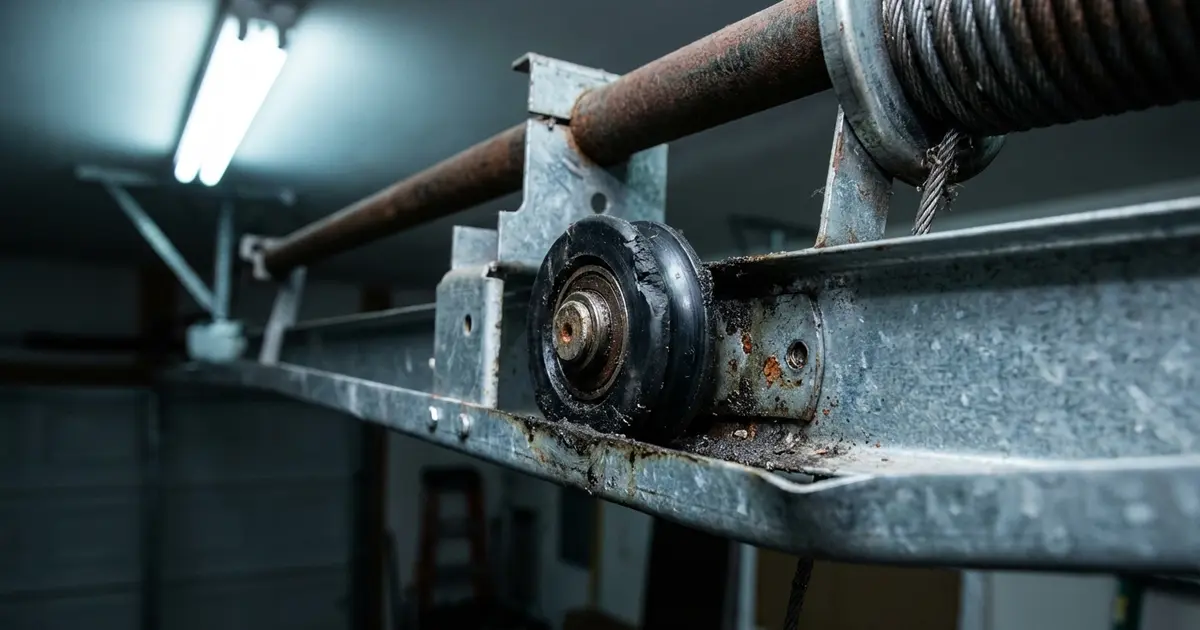
Quick Noise Diagnosis Guide
Use this table to match your garage door sound to the most likely cause before reading the detailed sections:
| Sound | Most Likely Cause | Urgency |
|---|---|---|
| Rattling / vibrating | Loose hardware (nuts, bolts, brackets) | Low — but fix soon |
| Grinding (metal-on-metal) | Worn metal rollers, dry hinges | Medium — causes accelerating wear |
| Squealing / screeching | Dry hinges, dry springs, dry rollers | Low — lubrication usually fixes it |
| Loud bang or pop (spring area) | Broken or failing torsion spring | HIGH — stop using door immediately |
| Bang when door closes | Limit switch off, door slamming floor | Medium — adjust force/limit settings |
| Clicking / rhythmic pop | Worn roller bearing, loose hinge pin | Medium — replace the component |
| Chain slapping | Loose or unlubricated chain | Medium — tension and lube the chain |
| Vibration through ceiling | Opener not vibration-isolated | Low — add anti-vibration pads |
| Grinding from opener head | Stripped drive gear in opener | HIGH — opener near failure |
| Rumbling from walls | Loose wall-mounted hardware | Low — retighten mounting bolts |
Now let's go through each noise type in detail — what it means and how to fix it.
Rattling and Vibrating: Loose Hardware
A general rattling or vibrating sound — especially one that seems to be coming from the walls, ceiling, or the door itself rather than a specific component — is almost always caused by loose hardware. This is the easiest garage door noise to fix and the one most homeowners put off the longest.
What Gets Loose Over Time
A garage door goes through 3–5 cycles per day on average. Over a year, that's 1,000–2,000 open-close cycles, each one vibrating every bolt, nut, and screw in the system. Over years, hardware backs out:
- Hinge bolts — the bolts holding the hinges to the door panels. Loose hinge bolts cause panels to rattle against each other and create excess play in the hinge pin.
- Track mounting bolts — the hardware holding the horizontal and vertical track sections to the wall. When these loosen, the entire track can vibrate and transmit noise into the wall structure.
- Opener mounting brackets — the hardware mounting the opener motor to the ceiling joists. A slightly loose opener mount turns the motor's vibration into a whole-ceiling rattle.
- Roller brackets — the L-shaped brackets holding each roller in the track. Loose roller brackets create an erratic rattling during door travel.
- Bottom bracket — the reinforced bracket at each lower corner of the door where the cable attaches. These experience more stress than any other bracket and tend to develop looseness over time.
- Rail junction bolts — where the horizontal overhead rail connects to the vertical header bracket at the top of the door frame.
The Fix: Full Hardware Tightening
This job takes 20–30 minutes and requires only a socket wrench set (3/8" and 7/16" are the most common sizes for garage door hardware).
- Open the door fully and work from top to bottom on each side.
- Tighten all visible bolts on the door panels (hinge bolts on both the door side and the roller bracket side).
- Check every point where the track brackets mount to the wall — give each bolt a quarter turn if loose.
- Check the overhead rail bracket where it connects to the wall above the door opening.
- Check the opener mounting hardware on the ceiling.
- Close the door and check the bottom bracket bolts on each side of the door.
Important: Do NOT tighten the bolts on the bottom bracket if the cables are visibly under tension — these should only be adjusted when the spring system is relaxed or by a professional. For all other hardware, tighten until snug plus a quarter turn. Do not over-tighten bolts through the door panels — the panel aluminum or steel can strip.
If Bolts Won't Stay Tight
For hardware that continually backs out, apply a small amount of thread-locking compound (Loctite Blue — the removable type, not the permanent red version) to the bolt threads before tightening. This prevents vibration loosening while still allowing future removal with tools.
Grinding and Scraping: Worn Rollers and Dry Hinges
A metal grinding or scraping sound during door operation is one of the most important noises to address promptly. Grinding means metal components are contacting each other without adequate lubrication — and the longer this continues, the faster both components wear.
Worn Metal Rollers
The rollers are the wheel-shaped components that ride inside the track on both sides of the door. Standard residential doors use either:
- Metal (steel) rollers — hard steel wheels, often with ball bearings inside. They're durable but loud and wear the track over time.
- Nylon rollers — polymer wheels with ball bearings. Much quieter, gentler on tracks, but the nylon can crack in extreme cold.
Metal roller ball bearings wear flat over time. When they do, the roller wobbles in the track instead of rolling smoothly — creating the characteristic grinding sound. You can often diagnose this by running your finger along the roller wheel (door disconnected from opener): a worn roller wheel will feel rough, flat-spotted, or seized.
Worn Hinges
Door hinges have a pin that passes through two loops of sheet metal. Over years of cycling, the pin bores can enlarge and the hinge develops play — the pin rattles around the bore rather than sitting snugly in it. A worn hinge often makes a metal-on-metal grinding or squeaking sound specifically at the point in the door's travel where the section bends around the curve from vertical to horizontal (the pivot point for that hinge).
Run your hand along the hinges while someone else slowly operates the door (manually). You'll feel vibration or hear a localized grind when you reach the worn hinge.
The Fix
- Lubricate first — apply garage door lubricant to the rollers (into the bearing area) and hinge pins. This immediately addresses dry-metal grinding. If the noise goes away or significantly reduces, lubrication was the issue. If grinding continues, the component is worn beyond what lubrication can fix.
- Replace worn rollers — if the rollers are worn, replacement is the fix. See the detailed roller section below. A full set of nylon rollers for a standard 2-car door runs $40–$80 in parts.
- Replace worn hinges — hinge replacement is straightforward. Standard hinges (Type 1 through Type 5, which indicate which section junction they're used at) are available at home centers for $3–$8 each. Replace the worn hinge with one of the same type number. The job requires a drill and socket wrench; most technicians do it in 5 minutes per hinge.
Squealing and Screeching: The Lubrication Problem
Squealing and screeching are the classic sounds of metal-on-metal friction without lubrication. In a garage door, virtually every moving metal part requires periodic lubrication to operate quietly:
Components That Cause Squealing When Dry
- Torsion springs — the coils rub against each other slightly during winding/unwinding. Dry springs make a high-pitched metallic screech. Lubricated springs are nearly silent.
- Hinges — the pin-in-bore friction when the hinge flexes. This is the #1 source of squealing on most residential doors.
- Rollers — the ball bearings inside metal rollers need lubrication. Sealed nylon rollers need less, but still benefit from occasional lubrication at the bearing seal.
- Bearing plates — the round plates on each side of the spring shaft where it passes through the header. Dry bearing plates create a high-pitched whine or squeal as the shaft rotates.
- Pulleys — for extension spring systems (most common in garages with low headroom), the cable runs over pulleys. Dry pulleys squeal as the cable moves over them.
The fix for squealing in almost every case is proper lubrication. See the dedicated lubrication section below for the step-by-step process.
When Squealing Persists After Lubrication
If you've lubricated all moving parts and the squeal persists, the component is worn past what lubrication can solve. Specifically:
- A squealing hinge that doesn't improve after lubrication has a worn pin bore — replace the hinge
- A squealing roller that doesn't improve has worn bearings — replace the roller
- A squealing bearing plate that doesn't improve needs replacement — a technician should handle this as it's adjacent to the spring system
⚠️ Warning: A single loud bang (like a gunshot) followed by the door hanging crooked or failing to move is a broken spring. Stop using the door immediately and call a professional — do not attempt to open or close it.
Banging and Popping: The Most Serious Noises
Loud banging and popping sounds from a garage door range from mildly concerning to emergencies that require immediately stopping use of the door.
The Loud Bang from the Ceiling Area: Broken Spring
A single loud bang — like a gunshot or a heavy object falling — coming from the ceiling area of the garage is the signature of a broken torsion spring. If this just happened:
- Do NOT attempt to open or close the door manually or with the opener
- Look at the spring bar above the door — you should see a gap in the spring coil where it broke
- Call for professional repair — spring replacement is not a safe DIY job
This is covered in detail in our emergency garage door repair guide.
Popping Sounds (Repeated, Less Dramatic)
Repeated popping sounds — heard rhythmically as the door travels — usually indicate:
- Worn roller bearing: the bearing skips as it rotates in the track. Typically heard every rotation of the roller (you can count the pops per foot of travel).
- Tight spots in the track: a slight bend or debris bump in the track causes the roller to pop as it passes through. You can feel the corresponding vibration in the door at that point in its travel.
- Extension spring tension: extension spring systems (found on single-car doors and low-clearance garages) can pop as they extend and contract. This is typically louder in cold weather when the metal is stiffer.
Banging When the Door Closes
A door that slams shut loudly at the end of its travel has a limit switch or force setting problem in the opener. The door is not stopping its downward motion gradually — it's hitting the floor hard. To fix this:
- Locate the "down limit" adjustment on your opener (usually a knob or screw labeled "Down Limit" or "Close Limit" on the side or back of the motor unit)
- Adjust the limit slightly (typically one-quarter turn at a time) in the direction that shortens the down travel
- Test the door — it should stop within an inch of the floor, making gentle contact
Refer to your opener's manual for the specific adjustment procedure as it varies by brand and model.
Clicking and Snapping: Worn Rollers and Hinge Pins
A rhythmic clicking sound that occurs once or a few times per door cycle (not continuously) often points to a specific worn component rather than a general lubrication issue.
Diagnosing Rhythmic Clicking
The clicking happens at a specific point in the door's travel — either a specific location (the same spot on the track every time) or at the beginning and end of the cycle. To isolate it:
- Disconnect the opener and slowly raise the door manually (with a helper if possible)
- Listen and feel for where the click or snap occurs
- Stop the door at that point and inspect the roller(s) and hinge(s) at that location
Common causes of location-specific clicking:
- A roller with a flat spot — the roller rotates unevenly and clicks as the flat portion meets the track
- A hinge with a loose pin — the pin is jumping in and out of position as the section bends
- A bent track section — the roller pops as it moves through a section where the track has been slightly bent inward
- A loose retaining clip on the roller stem — the clip that keeps the roller in the bracket can work loose and click as it moves
Clicking at Beginning or End of Cycle
A click specifically when the door begins opening (immediately after pressing the button) or when it first starts closing is often the opener trolley disengaging or re-engaging. Some play in the trolley coupling is normal. If the click is very loud (metal-on-metal clang), the trolley needs lubrication or the carriage coupling is worn.
Chain Slapping: Chain Drive Opener Noise
A chain drive opener that makes a loud slapping or flapping sound — like a bicycle chain hitting a frame — has a chain tension problem. The chain is sagging and slapping against the drive rail during operation. This is especially common in older openers and in garages that go through extreme temperature swings (heat makes chains sag more).
How to Adjust Chain Tension
- Close the garage door and disconnect the opener from power (unplug it)
- Locate the chain tension adjustment bolt — it's typically located on the drive trolley (the part that slides along the rail). It looks like a threaded rod with two nuts.
- Check current slack: the chain should have approximately 1/2 inch of slack (measured at the midpoint of the rail span). More than 1/2 inch means it's too loose.
- Turn the adjustment nut to reduce slack, working in small increments (1/4 turn at a time)
- Re-check slack after each adjustment. Do not over-tighten — a chain with no slack binds the drive system and accelerates gear wear.
- Restore power and test the door
After tensioning, lubricate the chain with a proper chain lubricant (available at hardware stores — not WD-40, not oil). This reduces both noise and wear simultaneously.
Still Loud After Tensioning?
If the chain is properly tensioned and lubricated but the opener is still very loud, you have a few options:
- Add anti-vibration pads between the opener bracket and the ceiling — these absorb motor vibration before it resonates into the ceiling structure
- Consider a belt drive upgrade — belt drive openers operate at roughly 1/3 the noise level of chain drives. A quiet belt drive opener (LiftMaster 3255, Chamberlain B730) runs $250–$400 installed and is a legitimate upgrade if opener noise is disrupting sleep or living spaces above the garage
⚠️ Warning: Never use WD-40 on garage door hardware — it evaporates fast and leaves residue that attracts grit. Use a dedicated white lithium grease or silicone-based garage door lubricant.
How to Lubricate a Garage Door Properly
Proper lubrication is the #1 preventive maintenance task for a quiet, long-lasting garage door. It takes 10–15 minutes and should be done every 6–12 months.
What to Use
- Best choice: White lithium grease spray (available at auto parts stores for $5–$8). Excellent for springs, hinges, and bearing plates.
- Also good: Silicone-based garage door lubricant spray. Works well on hinges and rollers, and doesn't attract as much dirt.
- Do NOT use: WD-40 (degreaser, not lubricant — strips existing grease), motor oil, cooking spray, or axle grease (too thick, attracts dirt and debris).
What to Lubricate (and What NOT To)
| Component | Lubricate? | Where to Apply |
|---|---|---|
| Torsion springs | ✅ Yes | Along the coils — spray while slowly coating the full length |
| Hinges | ✅ Yes | At the hinge pin and the pivot point |
| Rollers (metal) | ✅ Yes | Into the bearing area at each end of the roller wheel |
| Rollers (nylon with sealed bearings) | Lightly | Just around the bearing seal — they don't need much |
| Bearing plates | ✅ Yes | Spray around the center where the shaft passes through |
| Pulleys (extension spring systems) | ✅ Yes | Around the pulley wheel and axle |
| Tracks | ❌ No | Clean tracks with a damp cloth — do not lubricate |
| Chain or screw (opener drive) | ✅ Yes | Apply chain lubricant — not grease |
| Belt drive (opener) | ❌ No | Rubber belts do not need lubrication |
| Outside of springs | No | Only lubricate the coil-to-coil contact surfaces, not the exterior |
Step-by-Step Lubrication Process
- Open the door fully. With door open, the torsion spring is under reduced tension making it safe to approach.
- Spray lubricant along the torsion spring coils — use a sweeping motion to coat as much of the coil length as possible. Cycle the door a few times (manually, opener disconnected) so the lubricant works into the coils.
- Lubricate each hinge — focus on the hinge pin and the moving joint where the two hinge halves pivot.
- Lubricate each roller — spray into the end of the roller wheel where the bearing is located (the stem end).
- Lubricate the bearing plates on each end of the spring shaft.
- Wipe any drips off the track (you don't want lubricant on the roller track surface).
- Reconnect the opener and run the door through 2–3 complete cycles. The lubricant will distribute through all moving parts.
- Check for any spots you may have missed — you'll hear the difference on the second cycle.
Roller Replacement: The Most Impactful Noise Fix
If your door has original metal rollers that have never been replaced, upgrading to nylon rollers is the single most effective noise reduction upgrade you can make. The difference is dramatic — most homeowners describe it as transformative.
Understanding Roller Types
- Standard metal (steel) rollers — 10-ball bearing, $3–$6 each. Serviceable but loud. Common on original builder-grade garage doors.
- Nylon rollers with steel bearings — $5–$12 each. The ideal upgrade. The nylon wheel absorbs vibration; the steel ball bearings provide smooth operation. 10-ball and 13-ball variants available — more balls = smoother.
- Nylon rollers with sealed bearings — $8–$15 each. Best option. Sealed bearings require minimal lubrication and last 10–15 years under normal use.
How Many Rollers Does a Standard Door Have?
- Single-car door (8' or 9' wide): typically 10 rollers
- Double-car door (16' or 18' wide): typically 10–12 rollers
- Each roller has a 4" stem that fits into the roller bracket — verify the stem length before ordering (most residential doors use a 4" stem, some older doors use 7")
DIY Roller Replacement
Replacing most rollers is a DIY-accessible job. The process for each roller:
- With the door closed, use a C-clamp or locking pliers to hold the door at the top of the bottom section (prevents door from rising)
- Loosen (do not fully remove) the mounting bolts on the hinge that holds the roller bracket
- Pry the track slightly outward at the roller location with locking pliers (just enough to allow the roller to come out)
- Slide the old roller out of the bracket and track
- Insert the new roller into the bracket stem hole
- Guide the roller into the track and tighten the hinge bolts
- Move to the next roller
Important exception: The bottom rollers are part of the bottom bracket assembly, which is connected to the lift cables under spring tension. Do NOT attempt to replace bottom rollers yourself — leave those to a professional.
Roller Replacement Cost
| Option | Parts | Labor (professional) | Total |
|---|---|---|---|
| Basic metal rollers (full set) | $25–$50 | $75–$120 | $100–$170 |
| Nylon rollers (full set) | $50–$120 | $75–$120 | $125–$240 |
| Nylon rollers, sealed bearing (premium) | $80–$150 | $75–$120 | $155–$270 |
Spring Noise: What Your Springs Are Telling You
The torsion spring — mounted horizontally above the door — is one of the noisiest components when not properly maintained, but also one of the most important to listen to carefully because it can signal serious trouble ahead.
Normal Spring Sounds vs. Warning Signs
| Sound | Meaning | Action |
|---|---|---|
| Soft metallic hiss or whisper | Normal spring coil movement (dry) | Lubricate springs — noise will go away |
| High-pitched metallic screech | Severely dry spring coils | Lubricate immediately |
| Creaking under load | Spring losing tension (aging) | Have spring tension checked by a pro |
| Loud single bang | Spring has broken | Stop use immediately, call for repair |
| Popping during travel | Spring coil binding or corrosion pitting | Lubricate; if persistent, inspect for corrosion |
When to Proactively Replace Springs
Torsion springs are rated for 10,000 cycles (standard) or 20,000–30,000 cycles (high-cycle springs). At 3–4 cycles per day, a standard spring lasts approximately 7–10 years. If your springs are:
- Making noise that lubrication doesn't fix
- Visibly corroded or have rust scaling on the coils
- Older than 7–8 years on a regularly-used door
- Making popping or binding sounds under load
...it's worth having a professional assess the remaining tension and spring life. Proactive replacement costs $175–$400 and prevents an emergency. A spring that fails with your car inside costs the same to fix plus the inconvenience of a stuck vehicle.
Read more in our complete guide to garage door spring replacement.
Opener Noise: Chain vs Belt vs Screw Drive
The garage door opener itself contributes significantly to total noise — and the type of drive system determines your baseline noise floor regardless of how well-maintained everything else is.
Opener Drive Type Noise Comparison
| Drive Type | Relative Noise Level | Loudest Sound | Best For |
|---|---|---|---|
| Chain drive | Loudest (70–80 dB at door) | Chain rattle + motor hum | Detached garages where noise isn't an issue |
| Screw drive | Medium (65–75 dB) | Grinding thread noise | Low-maintenance preference; moderate noise tolerance |
| Belt drive | Quiet (55–65 dB) | Soft motor hum only | Attached garages, living spaces above garage |
| Direct drive | Quietest (50–60 dB) | Near-silent motor movement | Maximum quiet, highest budget |
Reducing Chain Drive Noise Without Replacement
- Check and adjust chain tension (1/2" slack maximum)
- Lubricate the chain with dedicated chain lubricant
- Install rubber anti-vibration pads at the ceiling mounting points
- Check that the opener mounting bracket bolts are fully tight
- Consider a drive rail dampener (some aftermarket kits include rubber isolators for the rail-to-header bracket connection)
Screw Drive Squealing
Screw drive openers use a threaded metal rod to drive the trolley. They require lubrication on the screw threads every 3–6 months — more frequently in cold climates. Use a lubricant specifically labeled for screw drive openers (many brands include this in their maintenance kits). A dry screw drive creates a distinctive grinding/squealing combination as the trolley nut rides the dry threads.
When the Opener Itself Is Making Grinding Sounds
If the opener motor runs but the drive isn't engaging properly and there's a grinding sound from the motor head unit (rather than from the door), the internal drive gear has likely stripped. This is a mechanical failure of the opener itself. The nylon drive gear can be replaced as a standalone repair ($40–$80 DIY, $100–$175 with labor), but if the opener is 10+ years old, replacement often makes more financial sense. See our opener repair vs replace guide for the full cost-benefit analysis.
Reducing Structural Vibration and Noise Transfer
Even a well-maintained door can transfer noise and vibration into the home structure — particularly in attached garages where the door walls and ceiling are shared with living spaces. Here are targeted solutions for structural noise transfer:
Anti-Vibration Pads for the Opener
The opener motor generates vibration during operation. If the motor unit is rigidly bolted to the ceiling joists, that vibration couples directly into the structure — you can hear and feel it in rooms above. Anti-vibration mounting pads (rubber or neoprene isolators installed between the bracket and the ceiling) break the vibration coupling. These pads cost $15–$30 and install in minutes. The noise reduction in rooms above the garage is often substantial.
Track Mounting Buffers
The tracks are typically mounted directly to wall studs via steel L-brackets. Installing rubber grommets or neoprene washers between the track bracket and the wall reduces the amount of vibration transmitted into the wall structure during door travel. This is a DIY modification that takes about an hour and costs $10–$20 in materials.
Garage Door Insulation
A steel door without insulation is essentially a giant metal panel that acts as a sounding board — it amplifies mechanical noises. Adding insulation panels (sold in kits for $50–$200) not only adds thermal value but also adds mass to the door, which absorbs vibration rather than resonating it. A heavier door is inherently quieter. See our complete garage door insulation guide for options and R-values.
Weatherstripping and Seals
Deteriorated weatherstripping around the door frame and at the door bottom can cause noise in two ways: the door makes more noise during travel as it contacts dried-out seal material, and gaps in the seal allow outside noise in (and inside noise out). Replacement weatherstripping is $20–$60 for a full set and dramatically affects both noise and energy efficiency.
Repair Costs for Noisy Garage Door Fixes
| Fix | DIY Cost | Professional Cost | Expected Noise Reduction |
|---|---|---|---|
| Lubrication (full door) | $5–$12 | $75–$125 (service call) | Moderate–High |
| Hardware tightening | $0 (time only) | $75–$125 (service call) | Moderate |
| Roller replacement (nylon) | $50–$120 | $125–$240 | High |
| Hinge replacement (one) | $5–$12 | $75–$125 | Low–Moderate |
| Hinge replacement (full set) | $40–$80 | $125–$200 | Moderate–High |
| Chain tension adjustment | $0 (time only) | $75–$125 | Moderate |
| Anti-vibration pads (opener) | $15–$30 | $75–$125 | Moderate |
| Spring replacement (torsion) | Not recommended | $175–$400 | Moderate |
| Belt drive opener upgrade | $180–$350 (self-install) | $250–$500 | Very High |
| Full tune-up (all of the above except opener) | $100–$200 | $150–$350 | Very High |
Regional Cost Variation
| Region | Tune-Up / Lube Service | Full Roller Replacement |
|---|---|---|
| Northeast (NY, NJ, MA) | $100–$175 | $175–$300 |
| Southeast (FL, GA, NC) | $75–$135 | $125–$230 |
| Midwest (IL, OH, MI) | $80–$145 | $130–$240 |
| South/Texas (TX, OK) | $75–$130 | $125–$225 |
| Mountain West (CO, AZ) | $85–$150 | $135–$245 |
| Pacific Coast (CA, WA, OR) | $95–$165 | $150–$275 |
DIY vs Calling a Professional for Noisy Door Fixes
✅ Excellent DIY Projects (Even for Beginners)
- Lubricating springs, hinges, rollers, and bearing plates
- Tightening loose hardware (bolts, nuts, track brackets)
- Adjusting chain tension on a chain drive opener
- Installing anti-vibration pads on the opener mounting
- Replacing hinges (except bottom hinges near cable attachment)
- Replacing rollers (except bottom rollers — those involve cable tension)
- Cleaning track sections
⚠️ Call a Professional For
- Any work near the torsion spring or spring shaft — spring tension adjustment and replacement require specialized winding bars and experience
- Bottom roller replacement (involves bottom brackets connected to lift cables under spring tension)
- Cable inspection or replacement — cables run under tension through pulleys and drums
- Track realignment — if a track section is badly bent or out of plumb, realigning it requires measurement tools and experience to avoid creating door travel problems
- Opener drive gear replacement (if you're not comfortable with disassembling small mechanical units)
- Any noise issue you cannot identify — a technician can diagnose in 10 minutes what might take you an hour of searching
For a comprehensive maintenance schedule that prevents noise from developing in the first place, see our annual garage door maintenance guide.
Find a Garage Door Technician Near You
If the DIY fixes above haven't solved your noisy door, or you want a professional tune-up, browse local pros in your area:
- Find trusted garage door pros in Los Angeles
- Find trusted garage door pros in Charlotte
- Find trusted garage door pros in Minneapolis
- Find trusted garage door pros in Kansas City
- Find trusted garage door pros in Las Vegas
- Find trusted garage door pros in Austin
Or browse all cities to find technicians in your area.
Frequently Asked Questions
What does it mean when a garage door makes a grinding noise?
Grinding noises most commonly indicate metal-on-metal contact where lubrication has failed or a component has worn beyond its service life. The most likely culprits are: (1) worn metal rollers — the steel ball bearings inside them wear flat over time, creating a grinding sensation as the roller moves along the track; (2) worn or binding hinges — particularly the bottom hinges near the floor which take the most stress; (3) the opener drive gear — if your opener makes a grinding noise while the door barely moves or doesn't move at all, the nylon drive gear inside the opener may be stripped. A grinding opener that isn't moving the door effectively is on the verge of complete failure. Address grinding sounds promptly — they indicate active wear that is accelerating damage.
Why is my garage door so loud when opening but quiet when closing?
Directional noise differences usually point to the spring system or the opener drive. When the door is opening, the opener motor is working against gravity (before the spring fully takes over), and the springs are unwinding — more stress on both systems means more sound. A loud pop or bang specifically when opening often indicates a spring that is losing tension and needs replacement soon. Alternatively, if the opener is chain-driven, chain slap (the chain sagging and hitting the rail) tends to be worst during the opening direction when motor torque peaks. If the noise is worse closing, it often indicates the door is landing hard (limit switch or force setting adjustment needed) or that the weatherstripping at the bottom is catching or dragging.
How often should I lubricate my garage door?
Lubricate your garage door springs, hinges, rollers, and bearing plates every 6–12 months. In climates with extreme temperature swings, high humidity, or coastal salt air, every 6 months is better. The lubrication process takes 10–15 minutes and costs $5–$10 in lubricant. Use a garage door-specific lubricant (white lithium grease spray or silicone-based spray are best) — do NOT use WD-40, which is a solvent/degreaser, not a lubricant, and will strip existing grease and cause more wear over time. Do not lubricate the tracks — tracks should be clean and dry, not oiled. Lubricating tracks causes buildup that can jam rollers.
My garage door squeals when it moves. What causes that?
Squealing or screeching sounds are almost always a lubrication problem — metal components that should be gliding smoothly are instead grinding against each other without adequate lubrication. The most common squeal sources are: hinges (especially mid-door hinges under constant flex), rollers (particularly metal rollers), and the torsion spring (a dry spring makes a high-pitched screech as it coils and uncoils). A full lubrication of all moving parts — springs, hinges, rollers, bearing plates, pulleys — with a proper lubricant will typically eliminate squealing within one operation cycle. If the squeal persists after lubrication, the component (usually a hinge or roller) has worn past the point where lubrication can help and needs replacement.
Will replacing metal rollers with nylon rollers actually make my door quieter?
Yes — significantly. Nylon rollers are one of the most effective noise-reduction upgrades available. Metal rollers contact the steel track directly and transmit vibration throughout the door assembly. Nylon rollers have a polymer wheel that absorbs vibration rather than transmitting it. The difference is immediately noticeable — most homeowners report that nylon roller replacement reduces door noise by 50–70% compared to metal rollers in similar condition. The best nylon rollers also have sealed ball bearings inside for smoother operation and longer life. A full set of nylon rollers (10–12 for a standard door) costs $30–$80 in parts and can be self-installed in 2–3 hours, or professionally installed for $100–$180 total.
Can I make my chain drive opener quieter without replacing it?
Chain drive openers are inherently louder than belt drive models, but you can significantly reduce their noise. First, ensure the chain is properly tensioned — a loose chain slaps the rail and generates major noise. There is a chain tension adjustment bolt on the trolley; the chain should have about 1/2 inch of slack and no more. Second, lubricate the chain with garage door chain lubricant (not regular oil or WD-40). Third, install anti-vibration pads between the opener motor unit and the ceiling mounting hardware — these absorb motor vibration before it resonates through the ceiling. Finally, replace worn metal rollers with nylon rollers, since most chain drive noise is amplified by the metal-on-metal transfer from track to door assembly. If after all these measures the noise is still unacceptable, a belt drive replacement opener starts at $200 installed and will dramatically reduce noise.
Is a loud garage door a sign that something is about to break?
Often, yes — though it depends on the sound. A sudden new loud noise, or a noise that has been progressively worsening, is a meaningful signal. Grinding sounds indicate accelerating metal wear. A rhythmic popping or clicking usually means a worn roller bearing or a hinge pin that is starting to bind. A sharp metal bang from the ceiling area is frequently a warning sign of a spring that is starting to lose tension — this type of spring will typically fail completely within weeks to months. A vibrating or rattling sound from the opener often indicates a loose mounting bracket or a drive system component nearing failure. Ignoring progressive noise is one of the most common reasons homeowners are caught off-guard by garage door emergencies. Treat new or worsening sounds as diagnostic signals and address them before they become emergency repairs.