Garage Door Tune-Up Checklist: 15-Point Inspection Guide
A proper garage door tune-up takes about 45–60 minutes and can prevent hundreds — sometimes thousands — of dollars in repair costs. Most garage door failures don't happen without warning: a loose bolt, a fraying cable, or a spring with a few hundred cycles left all show telltale signs if you know what to look for.
This checklist covers every component you need to inspect and service, in order. Bookmark it, print it, and run through it once a year. It's the same inspection that a professional technician does on a service call — now you can do it yourself.
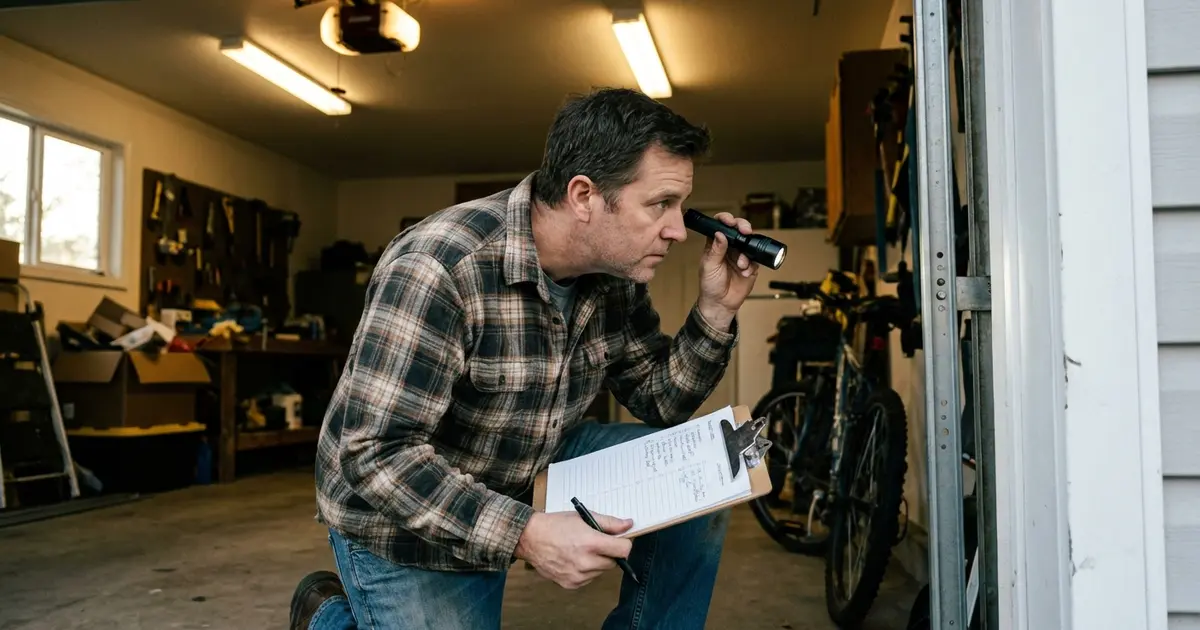
⚠️ Warning: Unplug the opener before performing any hardware inspections. This prevents accidental activation while your hands are near moving parts.
Before You Start: Tools and Safety
Tools You'll Need
- Step ladder (6-foot minimum for a standard 7-foot door)
- Socket wrench set or adjustable wrench (½" and 9/16" are the most common bolt sizes)
- Flat-head and Phillips screwdrivers
- White lithium grease spray (for metal components)
- Silicone spray (for plastic/rubber components)
- Clean rags or paper towels
- Flashlight or headlamp
- 2×4 board approximately 2 feet long (for the auto-reverse test)
Safety Rules Before You Begin
- Never work on torsion springs. The horizontal spring(s) above the door are under extreme tension — 150–200+ foot-pounds. Inspection (looking and noting condition) is fine. Do not touch, adjust, or attempt to modify them.
- Never work on cables under tension. Cables connect to the bottom of the door and run up to the spring drums. If a cable looks frayed or broken, note it and call a pro — don't try to fix it yourself.
- Disconnect the opener when working near moving parts. Use the manual release cord or unplug the opener before any hands-on inspection.
- Don't place your hands between panels or in the track while the door is moving.
- Make sure no children or pets are in the garage during inspection.
Most of this checklist is safe for homeowners. The few items that aren't are clearly marked with a ⚠️ symbol indicating you should call a pro if problems are found.
✅ Key Takeaway: Running this checklist twice a year prevents the most common $300–$600 emergency repairs: spring failure, cable wear, roller binding, and track misalignment.
The 15-Point Checklist at a Glance
| # | Inspection Point | Category | DIY Safe? |
|---|---|---|---|
| 1 | Visual Inspection of Panels | Structure | ✅ Yes |
| 2 | Check All Nuts, Bolts, and Screws | Hardware | ✅ Yes |
| 3 | Inspect and Clean the Tracks | Hardware | ✅ Yes |
| 4 | Inspect the Springs | Springs & Cables | ⚠️ Inspect only |
| 5 | Inspect the Lift Cables | Springs & Cables | ⚠️ Inspect only |
| 6 | Check the Rollers | Hardware | ✅ Yes |
| 7 | Lubricate All Moving Parts | Lubrication | ✅ Yes |
| 8 | Test Door Balance | Safety | ✅ Yes |
| 9 | Test Auto-Reverse (Force Setting) | Safety | ✅ Yes |
| 10 | Test Safety Sensors (Photo Eyes) | Safety | ✅ Yes |
| 11 | Inspect Weatherstripping and Bottom Seal | Weatherproofing | ✅ Yes |
| 12 | Test the Manual Release | Safety | ✅ Yes |
| 13 | Inspect Opener Hardware and Wiring | Opener | ✅ Yes |
| 14 | Test All Remotes and Keypads | Opener | ✅ Yes |
| 15 | Check the Exterior for Wear and Damage | Structure | ✅ Yes |
Time estimate: 45–60 minutes for a full inspection and tune-up. If you find issues requiring repair (springs, cables, bent tracks), add professional repair time separately.
Check 1: Visual Inspection of Panels
Start from the outside of the door with it in the closed position. Walk the full width of the door looking for:
- Dents and dings — cosmetic dents from hail or minor impact are common and usually only affect appearance. Large dents (over 2 inches deep) can compromise the panel's structural integrity and affect how the door seals at panel joints.
- Cracks or splits — steel doors don't typically crack under normal conditions; cracks or splits suggest impact damage or material fatigue. Wood doors may develop splits from moisture cycling.
- Rust — surface rust on steel doors is usually cosmetic if caught early; rust-through (holes or soft spots) is a warranty claim and a structural issue. Light surface rust can be treated with rust converter and repainted.
- Delamination — on steel doors with polyurethane foam insulation, look for bubbling or separation of the steel skin from the foam core along panel edges. This is a manufacturing defect on newer doors.
- Panel gaps — when the door is fully closed, gaps between horizontal panels (where panels overlap) indicate that a panel is misaligned, bent, or that hardware is loose. Air and water infiltration through panel gaps wastes energy and encourages rust.
Pass condition: Panels are structurally sound, no rust-through, no significant gaps between panels when closed. Minor cosmetic dents are acceptable.
Fail action: Significant rust, cracks, or large dents → assess whether panel replacement is warranted; document for warranty claim if recent.
Check 2: Tighten All Nuts, Bolts, and Screws
This is one of the most commonly skipped maintenance steps — and one of the most valuable. Vibration from thousands of open/close cycles gradually loosens hardware throughout the door system. A loose bolt becomes a wobbling hinge; a wobbling hinge becomes wear; wear becomes failure.
Work systematically from the bottom of the door to the top, checking every hinge bolt, the bolts connecting the bottom bracket (where the cable attaches) to the bottom door panel, the roller stem brackets, the vertical track brackets mounted to the door frame, and the horizontal track brackets hanging from the ceiling. Use a socket wrench — hand tight isn't enough after years of use.
Common problem areas:
- Bottom brackets — The steel brackets at the very bottom corners of the door (where the lift cables connect) take enormous force with every cycle. These bolts need to be snug. If a bottom bracket is loose or pulling away from the panel, this is a serious issue — the cable could come off under load.
- Top fixture brackets — The L-bracket or similar bracket at the very top of the door where the cable attaches to the drum. Check for cracks or bending.
- Track mounting bolts — The bolts that hold the vertical track to the door frame and the horizontal track to the ceiling bracket. Loose track mounting causes misalignment.
Pass condition: All visible hardware is snug with no wobble or movement under load.
Fail action: Tighten any loose hardware with socket wrench. If bolts are stripped or holes are elongated (bolt spins freely without tightening), note for professional repair.
Check 3: Track Inspection and Cleaning
The tracks guide the rollers as the door travels up and down. They need to be clean, straight, and properly aligned — but they should never be lubricated (rollers are designed to roll, and slippery tracks cause sliding instead).
What to Inspect
- Alignment — The gap between the track and the door panel should be uniform and consistent (typically ¼–⅜ inch for the vertical section). Hold a level or straight edge against the track; there should be no visible bend or bow. Minor gaps less than ⅛ inch can usually be corrected by loosening the track mounting bolts and tapping the track back into position. Significant bends require track replacement.
- Debris and buildup — Wipe the inside groove of both tracks with a damp cloth or a shop rag sprayed lightly with a degreaser. Built-up grit, spider webs, and old lubricant (if someone previously lubricated the tracks incorrectly) create a grinding, abrasive environment for the rollers.
- Rust — Light surface rust can be sanded off and the track wiped clean. Significant pitting or rust-through on the track surface damages rollers and should be addressed by track replacement ($120–$300 per track, installed).
Pass condition: Tracks are clean, straight, and free of significant rust or debris. Consistent gap between track and door panel.
Fail action: Clean debris; for bent tracks, see the garage door off-track repair guide; for significantly misaligned or damaged tracks, call a pro. ⚠️
Check 4: Spring Inspection ⚠️ (Inspect Only — No Touching)
Springs are the most safety-critical component on your garage door. Torsion springs (mounted horizontally above the door on a metal shaft) and extension springs (running along the sides of the door, parallel to the horizontal track) are under enormous tension. Your job here is only to look — never touch, tap, or attempt to adjust a loaded spring.
What to Look For
- Gap in the coils — A broken torsion spring will have a visible gap in the coil where the break occurred. The spring may also sag or hang lower than the other side. A broken spring means the door should not be used until replaced.
- Rust or corrosion — Surface rust on spring coils accelerates fatigue and reduces cycle life significantly. Some light rust is normal on older springs; heavy rust with visible flaking suggests the spring is near the end of its useful life.
- Elongated or spread coils — Coils that have stretched apart indicate a worn or weakened spring that may be approaching failure.
- Uneven winding — On torsion springs, if the spring looks unevenly wound or kinked, that's a sign of previous improper adjustment.
- Extension spring safety cables — Extension springs (the type along the sides of the door) should always have a safety cable running through the center of the spring. This cable catches the spring if it breaks violently. If your extension springs lack safety cables, this is a serious safety deficiency that should be corrected immediately by a professional.
Pass condition: Springs have no visible gaps, minimal rust, evenly wound coils, and (for extension springs) safety cables present.
Fail action: Any broken spring = call a pro immediately. See our garage door spring replacement guide for cost estimates and what to expect. ⚠️
Check 5: Lift Cable Inspection ⚠️ (Inspect Only)
The two steel lift cables run from the bottom brackets of the door up and over the cable drums at the ends of the torsion spring shaft. They bear the full weight of the door during travel and work in tandem with the springs to balance the load.
What to Look For
- Fraying or unraveling — Cable strands that are broken, unraveling, or visibly separated from the main cable body mean the cable is approaching failure. A fraying cable can snap with the door under load.
- Kinks or crimps — Sharp bends in the cable (from it coming off the drum and being improperly re-seated) create weak points.
- Rust — Light surface rust is common; heavy rust that pits the cable significantly weakens it.
- Slack — One cable significantly looser than the other indicates that cable has slipped off its drum or has stretched. The door will move unevenly, potentially coming off-track.
- Proper seating on drums — With the door closed, check that each cable sits neatly in the groove on its drum (the cylindrical spool at each end of the torsion spring shaft). Cables that have jumped a groove will re-coil incorrectly on the next cycle.
Pass condition: Both cables have intact strands, no kinking, similar tension, and properly seated on their drums.
Fail action: Fraying or broken cable = stop using the door and call a pro. Cable replacement typically costs $150–$300 (both cables) including labor. ⚠️
Check 6: Roller Inspection
Most residential garage doors have 10–12 rollers (5–6 per side) that run in the tracks. They're small but critical — worn rollers cause noise, increased stress on the opener, and can contribute to the door coming off-track.
What to Look For
- Cracks or chips in the wheel — Nylon roller wheels crack and chip over time, especially in temperature extremes. A cracked roller creates a bumpy, grinding ride through the track.
- Worn or damaged ball bearings — Sealed-bearing rollers shouldn't wobble or make grinding sounds. Spin each roller wheel by hand and feel for roughness or hear for grinding — a roller with failed bearings needs replacement.
- Loose roller stems — Grab each roller stem (the metal axle through the hinge bracket) and wiggle it. There should be minimal play. A stem loose enough to wobble indicates a worn hinge hole or a loose mounting bolt.
- Bent or deformed stems — A bent roller stem forces the wheel to run at an angle in the track, causing accelerated wear on both the roller and track.
Standard steel rollers cost $3–$6 each; nylon rollers with sealed bearings run $6–$15 each. A complete set for a double-car door (12 rollers) costs $36–$80 in parts. If you're replacing even a few rollers, consider replacing the full set — the labor is the majority of the cost and it's efficient to do them all at once.
Pass condition: Rollers spin smoothly, wheels are intact, stems have minimal play.
Fail action: Replace cracked, chipped, or grinding rollers. See our roller replacement guide for step-by-step instructions.
Check 7: Lubrication
Lubrication is the single highest-ROI maintenance task on a garage door. It reduces noise, decreases wear, and protects against corrosion — all for $15 and 15 minutes. See our complete garage door lubrication guide for detailed step-by-step instructions. Summary:
Lubricate These Components
- Torsion/extension springs — Apply white lithium grease spray along the full length of the coils
- Hinges — Spray the pivot pin and stem socket on each hinge
- Roller stems — The metal axle shaft (not the wheel itself) on each roller
- Opener chain or screw — Per manufacturer guidance (chain drives get white lithium grease; screw drives get the manufacturer's specific lubricant)
- Top rail of the opener — The trolley carriage that slides along the opener rail
Do NOT Lubricate These
- The track interior surfaces — Clean them, but leave them dry
- Belt drive opener belts — Rubber belts should not be oiled
- Nylon roller wheel surfaces — Only the metal stem, not the nylon wheel
After lubricating, run the door through 3–4 complete cycles to distribute the lubricant, then wipe excess from any panels or surfaces where it has dripped.
Pass condition: Door runs noticeably quieter after lubrication; all metal components coated.
Fail action: Noise that persists after full lubrication usually indicates worn rollers, a damaged hinge, or a track alignment issue — investigate further.
Check 8: Balance Test
The balance test is the most diagnostic test a homeowner can perform — it reveals the condition of your springs and tells you whether the springs are doing their job properly.
How to Perform the Balance Test
- Close the garage door completely.
- Pull the red emergency release cord (it hangs from the opener trolley) to disconnect the door from the automatic opener. The door can now be moved by hand.
- Manually lift the door to about 3–4 feet off the ground (waist height) and release it.
- Observe what happens:
- ✅ Pass: The door stays in position with minimal drift, or moves only slightly (less than 1 foot) in either direction before stopping.
- ⚠️ Falls quickly: Springs are under-tensioned or worn — they're not providing enough counterbalance. The opener is compensating, which wears it out prematurely.
- ⚠️ Rockets upward: Springs are over-tensioned — they're pushing the door open harder than needed. This strains the opener and poses a hazard if the door opens unexpectedly.
- Also test: with the door fully open, release it and confirm it stays up. A door that falls from the fully-open position is a safety hazard that requires immediate professional attention.
Pass condition: Door holds at mid-height with minimal drift.
Fail action: Failed balance = spring tension adjustment needed. This requires a professional with winding bars — do not attempt yourself. ⚠️
Check 9: Auto-Reverse Test
The auto-reverse safety feature is federally mandated on all garage door openers sold in the US since 1993. It makes the door reverse if it encounters an obstacle while closing. Testing it takes two minutes and could save a child's life.
The Board Test (Force Reverse)
- Lay a flat 2×4 board flat on the garage floor in the path of the door, centered under where the door will close.
- Using the opener, close the door. When the door contacts the board, it should automatically reverse direction within 2 seconds and return to the open position.
- If the door does not reverse, or reverses very slowly (more than 2 seconds of pressure before reversing), the opener's downforce sensitivity needs to be adjusted. Check your opener manual for the force adjustment controls — usually small dials or buttons on the motor unit labeled "down force" or similar.
Sensitivity Notes
The force setting should be calibrated so the door reverses on moderate resistance — not so sensitive that it reverses from light wind resistance, and not so insensitive that it requires significant pressure before reversing. If you cannot get the adjustment right, a technician can recalibrate the opener properly.
Pass condition: Door reverses within 2 seconds of contact with the 2×4.
Fail action: Adjust force settings per manual; if still failing, schedule professional opener service. A failing auto-reverse is a safety-critical issue.
Check 10: Safety Sensor (Photo Eye) Test
The two infrared photo-eye sensors mounted near the floor on each side of the door create an invisible beam. If anything breaks the beam while the door is closing, the door reverses. These sensors are easy to test and relatively easy to realign yourself if they've been bumped out of position.
Testing the Sensors
- Confirm the sensors are receiving power — both units should have a solid LED (one unit transmits, one receives; the receiver's LED should be solid green when the beam is clear).
- Command the door to close.
- Wave your hand or foot through the beam's path (at floor level) while the door is closing. The door should immediately reverse.
- If the door doesn't reverse, check: are the sensors pointed directly at each other? Is there dirt on the lenses? Is one LED blinking (indicates misalignment)?
For detailed realignment steps, see the safety sensor troubleshooting guide. Sensor realignment is a DIY-safe fix that takes under 10 minutes.
Pass condition: Door reverses immediately when beam is broken.
Fail action: Clean lenses, realign sensors. If sensors are damaged, replacement units cost $20–$50 and are typically DIY-installable.
Check 11: Weatherstripping and Bottom Seal
Weatherstripping keeps cold air, hot air, rain, wind, pests, and dust out of your garage. Damaged weatherstripping wastes energy and invites water damage. This is one of the most DIY-friendly repairs on the whole door.
What to Inspect
- Bottom seal — The rubber or vinyl seal along the bottom of the door. Close the door and look at it from outside: is there visible daylight under any portion? Do you see cracking, tearing, or sections that have detached from the retainer channel? Bottom seals take the most abuse and typically need replacement every 5–8 years.
- Side and top stop molding — The rubber seal running along both sides and the top of the door frame. With the door closed, press against it from inside — you should feel resistance and see no light gaps. Cracked or compressed side seals allow wind and water infiltration.
- Panel-to-panel weatherstripping — Some door designs include rubber strips along the top and bottom edges of each horizontal panel. Check for cracking or deformation on older doors.
Bottom seal replacement is a straightforward DIY task on most doors — the seal slides out of a retainer channel and a new one slides in. A replacement seal costs $15–$40. Full bottom seal replacement guide is available in the weatherstripping guide.
Pass condition: No visible daylight gaps with door closed; seals are supple and intact.
Fail action: Replace damaged seals — it's cost-effective DIY work.
Check 12: Manual Release Test
The emergency manual release allows you to operate the door manually during a power outage or opener failure. It's critical that this mechanism works properly — a jammed or broken release can trap you inside during an emergency.
How to Test It
- With the door closed, pull the red emergency release cord hanging from the opener trolley. You should hear a click and feel the carriage release from the drive mechanism.
- Manually lift the door — it should move freely without the opener engaged. A properly balanced, well-maintained door should be liftable by one person (you may need two hands and a firm grip — it's not effortless, but it shouldn't require significant struggle).
- To re-engage the opener after testing: pull the release cord toward the door (or use your opener remote while the door is closed) — you'll hear the carriage re-engage. Then test the opener operates normally.
Pass condition: Door disengages and moves freely; re-engages cleanly with the opener.
Fail action: If the door is extremely difficult to lift manually (even after lubrication), the springs likely need adjustment. If the release mechanism doesn't disengage, the opener trolley may need service.
Check 13: Opener Hardware and Wiring
The opener itself needs a visual inspection. With the unit powered, look at:
- Mounting hardware — The bolts or straps holding the opener to the ceiling should be snug. Vibration from thousands of cycles can loosen them. An opener that sways or rattles significantly during operation should be re-secured.
- Drive mechanism condition — On a chain drive, inspect the chain for proper tension (slight sag is normal — about ½ inch; a very loose chain slapping against the rail needs adjustment). On a screw drive, look for stripped grooves. Belt drives should have a taut, clean belt with no cracks.
- Wiring — Inspect the wiring from the opener to the wall button, safety sensors, and the outlet. Look for fraying, pinching, or connections that have pulled loose. Damaged wiring is a fire hazard.
- Motor sounds — Run the door a full cycle and listen. A motor that strains, hesitates, or sounds different from normal may be nearing failure. Also check the opener indicator lights and any error codes on smart openers.
Pass condition: Opener is securely mounted, drive system in good condition, wiring intact, motor sounds normal.
Fail action: Tighten loose mounting; for drive or motor issues, consult the opener repair vs replace guide.
Check 14: Remotes and Keypads
Test every remote control and keypad that's paired to your opener:
- Operate the door from maximum expected range (end of driveway, top of street)
- Test the keypad in outdoor conditions (moisture, cold) if possible
- Replace batteries in any remote that seems sluggish or has reduced range — CR2032 or AA batteries depending on model, typically $2–$5
- If a remote has stopped working entirely, try a battery swap before assuming it needs replacement or reprogramming
If you need to reprogram a remote after a battery swap or replacement, see the opener manufacturer's app or owner's manual. For a full walkthrough, the keypad troubleshooting guide covers all major brands.
Pass condition: All remotes and keypads operate the door reliably at expected distances.
Fail action: Replace batteries; reprogram if needed; replace broken remotes ($20–$60 for OEM replacements).
Check 15: Exterior Condition Check
The final check takes you back outside for a final look at the door's overall condition from a curb-appeal and structural perspective:
- Paint and finish — Touch-up paint on steel doors prevents rust. Small chips or scratches should be addressed with matching paint within the season.
- Hardware alignment — With the door fully closed from outside, step back and look at the overall symmetry. Are both sides even? Does the door sit squarely in the opening without obvious tilt?
- Signs of pest intrusion — Check around the door frame and bottom seal for rodent activity. Gnaw marks, droppings, or an unusually compromised bottom seal can indicate a pest issue to address.
- Drainage around the garage floor — Water pooling against the bottom of the door accelerates seal deterioration and promotes rust. Make sure the driveway slopes away from the garage or that drainage is adequate.
Pass condition: Door looks structurally sound, well-aligned, painted, and weathertight from outside.
Fail action: Address paint, seal, or alignment issues per findings above.
DIY vs Professional Tune-Up
| Task | DIY Difficulty | DIY Cost | Pro Cost | Recommendation |
|---|---|---|---|---|
| Visual inspection (all checks) | Easy | $0 | Included in tune-up | DIY — do this yourself |
| Hardware tightening | Easy | $0 | Included in tune-up | DIY |
| Track cleaning | Easy | $0–$5 | Included in tune-up | DIY |
| Full lubrication | Easy | $10–$18 | Included in tune-up | DIY |
| Balance test | Easy | $0 | Included in tune-up | DIY to diagnose; Pro to fix |
| Auto-reverse test | Easy | $0 | Included in tune-up | DIY |
| Sensor alignment | Easy–Medium | $0 | $50–$100 | DIY |
| Weatherstrip replacement | Easy–Medium | $15–$40 | $80–$150 | DIY |
| Roller replacement | Medium | $40–$80 | $120–$200 | DIY if comfortable on a ladder |
| Spring adjustment/replacement | Dangerous | Not recommended | $150–$350 | Always hire a pro |
| Cable replacement | Dangerous | Not recommended | $150–$300 | Always hire a pro |
| Track realignment | Medium–Hard | $0–$50 | $150–$300 | Minor: DIY; Major: Pro |
Tune-Up Cost Breakdown
DIY Tune-Up Costs
| Item | Cost | Where to Buy |
|---|---|---|
| White lithium grease spray | $8–$15 | Home Depot, Lowe's, Amazon |
| Silicone spray (optional) | $8–$12 | Home Depot, Lowe's, Amazon |
| Dedicated garage door lubricant | $10–$18 | Home Depot, Lowe's, Amazon |
| Replacement remote batteries | $2–$8 | Any hardware or grocery store |
| Bottom seal (if needed) | $15–$40 | Home Depot, Lowe's, Amazon |
| Total DIY (no parts needed) | $10–$25 | — |
| Total DIY (with seal replacement) | $25–$65 | — |
Professional Tune-Up Costs by Region
| Region | Basic Tune-Up | Full Service (incl. minor repairs) |
|---|---|---|
| Northeast (NY, MA, CT) | $100–$150 | $175–$300 |
| Mid-Atlantic (VA, MD, PA) | $85–$130 | $150–$275 |
| Southeast (FL, GA, SC) | $75–$120 | $130–$250 |
| Midwest (OH, IL, MI) | $75–$115 | $130–$240 |
| South Central (TX, OK, LA) | $75–$110 | $125–$230 |
| Mountain/West (CO, AZ, NV) | $85–$130 | $150–$275 |
| West Coast (CA, OR, WA) | $95–$150 | $165–$300 |
When to Schedule Your Tune-Up
The best time to do a full tune-up is in spring or fall — you're servicing the door before the extreme temperatures of the next season. Torsion springs perform differently in heat vs. cold (metal contracts in winter, which changes effective spring tension), and lubricants last longer if applied at moderate temperatures.
Tune-Up Frequency by Household Use
| Daily Cycles | Household Type | Recommended Frequency |
|---|---|---|
| 2–3 per day | Single-car, low-use | Once per year |
| 4–6 per day | Standard family home | Once per year |
| 6–10 per day | High-use household / home office | Twice per year |
| 10+ per day | Light commercial use | Quarterly |
Also perform an unscheduled check any time you notice: new noise, hesitation or uneven movement, a door that reverses unexpectedly, or visible damage from weather or impact. Many expensive failures could have been avoided with a 10-minute inspection after the first warning sign appeared.
For a deeper dive into what normal maintenance looks like across the full year, see the complete garage door maintenance schedule guide.
Find Trusted Garage Door Pros Near You
If your tune-up uncovers issues requiring professional service — springs, cables, track alignment, or opener repair — find a qualified local technician:
Frequently Asked Questions
How much does a professional garage door tune-up cost?
A professional garage door tune-up typically costs $75–$150 for a standard residential door. This usually includes inspection of all major components, lubrication, hardware tightening, safety sensor alignment, and a written report of any issues found. Some companies offer tune-up specials for $49–$99 as a loss-leader to build customer relationships — these can be good deals if the company is reputable. Be wary of very cheap "$29 tune-up" offers from companies you don't know, as these can be a foot-in-the-door tactic for upselling unnecessary repairs. A thorough DIY tune-up using this checklist costs $15–$25 in supplies (lubricant, replacement weatherstripping if needed) and takes about 45 minutes to 1 hour.
How often should you tune up your garage door?
The industry-standard recommendation is once per year, ideally in spring (before summer heat) or fall (before winter cold). However, the right frequency depends on use: a door that opens and closes 2 times per day needs less frequent attention than one used 6–8 times daily. High-use households should consider a tune-up every 6 months. Additionally, always perform a quick inspection after any unusual event — a hard impact, a storm, or a time when the door started behaving strangely. Many issues that become expensive repairs started as small problems that were caught too late. The 15-point checklist in this guide can be completed as a DIY inspection any time you think something might be off.
What does a garage door tune-up include?
A comprehensive garage door tune-up includes: visual inspection of all panels and hardware for damage, checking and tightening all bolts and nuts on hinges, brackets, and tracks, lubricating springs, hinges, roller stems, and the opener drive system, testing the opener force settings (auto-reverse), testing safety sensors (photo eyes) for alignment and function, checking cable condition and proper seating on drums, inspecting the bottom seal and weatherstripping for gaps or damage, testing the manual release cord, checking the balance of the door (disconnect the opener and manually lift — it should hold position at halfway open), and inspecting the opener for proper travel limits. Some professional tune-ups also include tightening the door lock, checking panel integrity, and testing the keypad and remote.
What are the signs my garage door needs a tune-up?
Signs your door needs attention: (1) It makes more noise than usual — squeaking, grinding, or banging sounds indicate dry components or wear. (2) The door moves unevenly or hesitates — one side lagging behind the other suggests cable, roller, or track issues. (3) The door reverses unexpectedly — the opener force settings may need adjustment. (4) The door feels heavy or won't hold position when disconnected from the opener — the springs may be losing tension. (5) The door vibrates significantly during operation — worn rollers are the typical culprit. (6) Visible rust, cracks, or looseness on hinges, cables, or springs. (7) The opener runs longer than usual or struggles on cold mornings. (8) You notice light coming in around the sides or bottom of the door when it's closed — weatherstripping has failed. Any of these symptoms warrants a full inspection.
Can I do a garage door tune-up myself?
Yes — most of the inspection and maintenance tasks in a garage door tune-up are safe and straightforward for a homeowner. Lubricating components, tightening bolts, cleaning tracks, testing safety sensors, and checking weatherstripping are all DIY-friendly. The balance test (disconnecting the opener and lifting the door manually to see if it holds position) is also safe and very informative. What you should NOT do yourself: adjusting spring tension or replacing springs (extreme danger from stored energy), adjusting cable tension on drums, and straightening significantly bent tracks. These tasks require specialized tools and training. If your inspection reveals spring or cable issues, call a professional — the repair cost is worth the safety benefit. See our guide on how to fix a garage door off track for what's DIY-safe versus what requires a pro.
How do I test if my garage door is properly balanced?
The balance test is the most important diagnostic you can do on your own. Here's how: (1) Make sure the door is fully closed. (2) Pull the red emergency release cord hanging from the opener trolley — this disconnects the door from the automatic opener. (3) Manually lift the door to about halfway (waist height) and let go. A properly balanced door should stay in that position (or drift only slightly). If it falls quickly, the springs are under-tensioned — the opener is compensating, but the springs are worn or incorrectly sized. If it rockets open (springs over-tensioned), that's also wrong and puts stress on the opener. Both situations require professional spring adjustment. (4) Lift the door fully open and let go — it should stay up without assistance. A door that falls from the fully-open position is dangerous. Do not attempt to adjust spring tension yourself. If the door fails this test, schedule a spring inspection promptly.
What lubricant should I use for a garage door tune-up?
Use white lithium grease spray for metal components: torsion or extension springs (the full length of the coils), hinge pins and pivot points, roller stems (the metal shaft — not the wheel), and the opener's chain or screw drive. Use silicone spray for nylon roller wheels, plastic track surfaces if present, and weatherstripping (silicone keeps rubber flexible and prevents cracking). Avoid: standard WD-40 penetrant (too thin, attracts dirt), petroleum grease (too thick, collects grit), motor oil, and cooking oils. A dedicated "garage door lubricant" spray (like 3-IN-ONE Garage Door Lube or WD-40 Specialist White Lithium) handles most components and costs $10–$18. Never lubricate the inside surface of the metal tracks — they should stay clean and dry so the rollers roll rather than slide.