Emergency Garage Door Repair: What to Do When You're Stuck
It's 11 PM and your garage door just made a loud bang — now it's hanging at an angle and won't budge. Or it's 7 AM and you need to get to work, but the door refuses to open and your car is inside. Garage door emergencies happen without warning, and knowing exactly what to do in the next 10 minutes can mean the difference between a safe, controlled situation and a dangerous one.
This guide covers every type of garage door emergency, what's actually happening mechanically, what you should and shouldn't do right now, and how to find qualified help fast — including what after-hours repair actually costs.
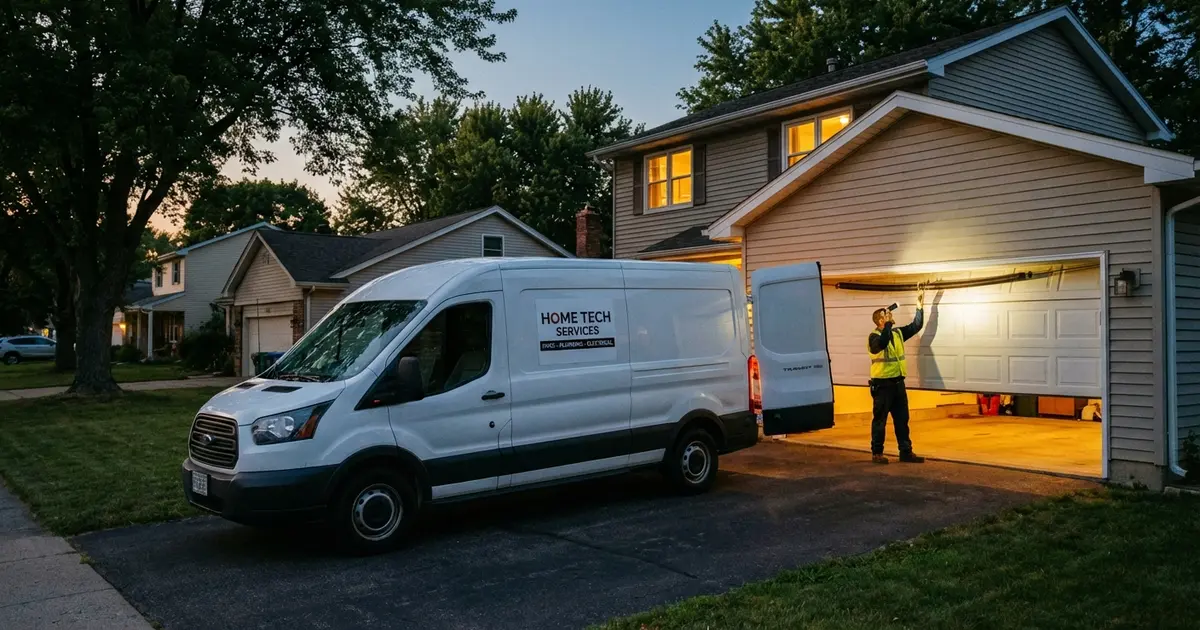
Step 1: Assess the Situation Safely
Before doing anything else, take 60 seconds to assess. Garage door emergencies can look alarming but often the immediate danger is less severe than it seems — or, in the case of a broken spring, more dangerous than it appears. Here's what to check:
Immediate Safety Checks
- Is anyone hurt or at risk? If the door struck a person, animal, or is blocking medical access — this takes priority over everything. Call emergency services first.
- Is the door stable? A door that is partly off-track and hanging at an angle can fall. Clear the area under and around it immediately. Keep children and pets away.
- Is there a loud bang or cable on the floor? This is the signature of a broken torsion spring. Do NOT touch the door. See the broken spring section below.
- Is the door stuck open? Assess the security risk. Is it late at night? Is the garage attached to your house? Your home is exposed — address this as a priority alongside the repair.
- Is there any structural damage? A door struck by a vehicle or storm may have bent panels, cracked rails, or a compromised header. Don't operate a structurally damaged door.
Once you've confirmed the immediate area is safe and no one is in danger, identify which emergency type you're dealing with from the sections below.
⚠️ Warning: If you hear a loud bang and see cable on the floor, assume a broken spring. Do NOT operate the opener or attempt to lift the door — it's now dead weight of 150–400 lbs.
Broken Torsion Spring Emergency
A broken torsion spring is the most common garage door emergency — and the most dangerous to handle incorrectly. Torsion springs are mounted horizontally above the door opening, under extreme tension. They counterbalance the weight of the door (150–400 lbs for a typical residential door). When one breaks, you'll typically hear:
- A very loud bang (sometimes loud enough to startle neighbors) — like a gunshot or large firecracker
- A metallic rattling or coiling sound as the spring unwinds
How to Identify a Broken Torsion Spring
Look at the horizontal metal bar above the door opening (the torsion bar). The spring is coiled around it. A broken spring will show a visible gap in the coil — you'll see where the spring has separated, usually in the middle or near one end. If the spring is still intact but the door won't open smoothly, the spring may be worn or losing tension rather than fully broken.
What to Do Immediately
- Do NOT attempt to operate the door — not manually, not with the opener. A door without a functioning spring is dangerously heavy.
- Disconnect the opener from the door by pulling the red emergency release cord hanging from the opener carriage. This prevents the opener from engaging if someone triggers it remotely.
- Leave the door in its current position. If it's down (closed), leave it. If it's open, see the section below on securing an open door.
- Call for emergency repair. Spring replacement requires professional tools and training — specifically, a spring winding tool (winding bars) and knowledge of spring sizing for your door's weight. This is not a safe DIY job.
- Use the side door or back door to access your vehicle if needed. If you absolutely must move a vehicle and cannot wait, some technicians will do emergency same-day service — this is the correct solution, not attempting to lift the door manually.
⚠️ Broken Spring Safety Warning
Do not attempt to manually lift a garage door with a broken spring. The door weighs 150–400 lbs. Without counterbalance, it requires full body effort to lift and cannot be held safely by one person. If the door slips while you or someone else is underneath it, the consequences can be fatal. This is the #1 garage door injury scenario. Wait for a professional.
Spring Replacement Cost
Torsion spring replacement costs $175–$400 for a standard single-car door and $200–$500 for a double-car door, including parts and labor. Emergency/after-hours service adds a premium of $50–$150 on top. Springs typically come in pairs — reputable technicians replace both springs simultaneously so the older spring doesn't fail shortly after.
Door Off Track Emergency
A garage door that has come off its tracks is a serious situation — the door becomes unstable and can fall. Off-track incidents are caused by:
- A broken cable that was holding one side, causing that side to drop off the track
- A vehicle bumping or striking the door or track
- A bent or damaged track section that caused the rollers to jump
- Accumulated debris in the track (rust, dirt, ice) that caused a roller to skip out
- A door that was forced open when the opener was locked or the spring was broken
Immediate Actions
- Stop operating the door immediately. Pressing the opener button when a door is off-track can worsen the damage and cause the door to fall.
- Clear the area. Keep everyone away from under and around the door until it is stabilized or repaired.
- If the door is partially open and you need to secure it, do not try to force it down. Use C-clamps or locking pliers on the tracks below the lowest roller position to prevent the door from dropping further.
- Assess the cable. Look for the lift cables (they run from the bottom of the door up to the drum above). If one cable is lying on the floor or is visibly broken, this is typically what caused the off-track situation. Do not try to rethread cables yourself.
Can You Re-Track a Door Yourself?
Minor off-track situations — where a single roller has jumped out of the track and the door is otherwise intact and stable — can sometimes be corrected by a capable DIYer. The process involves: opening the track slightly with pliers at the point of derailment, carefully guiding the roller back into the track, and then closing the track opening. However, if a cable is broken, the door is significantly bent, or multiple rollers are involved, this is not safe to DIY.
For most off-track emergencies, professional repair is the correct call. An experienced technician can re-track a door in 1–2 hours. Cost ranges from $125–$300 for a simple re-track to $300–$600+ if cables, rollers, or track sections also need replacement.
Learn more in our complete garage door off-track repair guide.
Door Won't Open — Car Trapped Inside
Your opener runs but the door doesn't move — or the door moves a few inches and stops. Your car is inside and you need to leave. Here's how to work through this systematically.
Check the Opener First
- Listen to the opener motor. Is it running at all when you press the button? If yes but the door doesn't move, the drive system (chain, belt, or trolley) may have broken. If the motor makes no sound, check the power outlet — circuit breakers trip in garages more often than people realize.
- Try the wall button. If your remote doesn't work but the wall button does, you have a remote problem, not a door problem.
- Look at the trolley. The trolley is the sliding carriage that connects the opener to the door. If the red release cord has been pulled (disconnecting the door from the opener), the opener will run freely without moving the door.
Use the Emergency Release
Every garage door opener has a manual emergency release — the red rope hanging from the ceiling carriage. Pulling this rope disconnects the door from the opener, allowing you to operate the door manually. Once released:
- If the spring is intact, the door should feel relatively light and balanced — you should be able to lift it with moderate effort (30–50 lbs of actual lifting force).
- Lift the door by gripping the handle at the bottom or the lower panel edge and pulling upward. Move slowly and steadily.
- The door should stay up on its own once raised (the spring holds it). If it falls back down when you release it, the spring is broken or severely weakened — do not continue attempting to use the door manually.
Important: After using the emergency release, re-engage the opener before resuming automatic operation. To re-engage most openers: with the door in the fully closed position, press the opener button — the trolley will automatically re-engage on the carriage. On some models, you must manually slide the trolley lever back into the locked position.
If the Door Still Won't Move Manually
A door that won't open even manually (after confirming the spring is intact) usually has one of these problems:
- A broken or jammed track section (look for a bent section of track that's physically stopping the rollers)
- A bottom bracket that has failed (the attachment point at the bottom corner of the door)
- A door that is frozen to the ground in winter (pour warm water along the bottom seal — do not use the opener to force it)
- Extreme debris or ice in the tracks
Door Won't Close — Home Left Unsecured
A garage door that won't close is an immediate security emergency, especially if the garage is attached to the house. The most common causes are:
- Safety sensor problem — The most frequent cause. Something is blocking or misaligning the photo eye sensors. See our sensor troubleshooting guide for a complete walkthrough.
- Opener limit setting — The opener thinks the door is already down. This is a settings adjustment, not an emergency.
- Broken cable — If one lift cable has snapped, the door may be askew and refusing to travel.
- Physical obstruction in track — A dent, debris, or damaged roller is preventing the door from traveling down.
Force-Close Using the Wall Button (Emergency Mode)
If the issue is a sensor problem and you need to close the door immediately for security, most openers allow a "forced close" in emergency mode: hold the wall button continuously (don't release it) while the door travels down. This overrides the sensor input and closes the door as long as you maintain button contact. This is intended for temporary emergency use only — do not use this as a workaround for a sensor that needs repair.
Temporary Security Measures
If the door absolutely will not close and you cannot get a technician immediately:
- Use a C-clamp on the track to hold the door in the down position if it can be partially lowered
- Loop a padlock or cable lock through the door's track holes
- If the garage connects to the house, lock the interior door and place a temporary security bar under the exterior door handle
- Contact a security monitoring service or local locksmith for temporary solutions if the situation will last overnight
Door Struck by a Vehicle
Vehicle strikes are one of the most dramatic garage door emergencies — and also one of the most covered by insurance. Whether you backed into your own door, or another vehicle struck it, here's the response sequence:
- Stop the vehicle immediately and do not attempt to back up or drive through the door. Attempting to drive through a damaged door can make the damage catastrophically worse and cause injury.
- Assess structural integrity. A door struck by a vehicle may have panels that are bent inward but the door is otherwise intact — or the entire assembly including tracks, springs, and header may be compromised. Look up at the spring assembly: if the torsion bar is bent or the brackets are pulled from the wall, do not attempt to operate the door at all.
- Check that no one was behind the door when the strike occurred.
- Document the damage thoroughly with photos and video before any repair work begins — you'll need this for insurance claims.
- Contact your insurance provider. Vehicle-caused garage door damage is typically covered under homeowners insurance (if your vehicle struck it — file under your auto policy as a collision or comprehensive claim depending on your policy language) or the at-fault driver's auto insurance.
- Do not operate a structurally compromised door. If the tracks are bent, spring bracket is loose, or the door frame is damaged, operating the door risks it falling.
Replacement costs for a vehicle-damaged door typically run $600–$3,000+ depending on whether panels can be replaced individually or the entire door needs replacement. Panel replacement costs are covered in our garage door panel replacement guide.
Power Outage Emergency
A power outage renders your automatic opener useless — but your garage door can still be operated manually, and most outages are resolved within hours. Here's what you need to know:
Opening the Door During a Power Outage
- Locate the red emergency release rope hanging from the opener trolley on the ceiling track.
- Pull the rope firmly — you'll feel a click or hear a pop as the door disconnects from the trolley.
- Lift the door manually by its handle or bottom panel edge. With functioning springs, this requires 30–50 lbs of lifting force for a standard door.
- The door will stay up on its own if the springs are properly tensioned. If it falls back down, the springs need attention — call a professional before using the door.
- When exiting with your vehicle, pull the door back down manually from outside (many doors have an exterior handle or a keyed bottom bracket for this purpose).
Closing and Securing the Door
Most modern garage doors can be locked from the outside using a key cylinder mounted in the bottom panel or track. This is the manual lock — use it when power is out and you need to leave. The opener re-engages automatically once power is restored (on most models, pressing the opener button reconnects the trolley).
Extended Power Outages
If power will be out for 12+ hours, consider:
- Leaving the car inside and using an alternative exit if security is a concern
- Using a battery backup unit if your opener has that option (LiftMaster's 485LM battery backup is a common aftermarket add-on)
- Some newer "smart" openers (LiftMaster 87504, Chamberlain B4613T) include built-in battery backup — if you're on an older unit, this may be worth upgrading for future outages
For a complete walkthrough, see our guide to manually opening a garage door during power outages.
Temporary Security Measures While Waiting for Repair
Waiting hours for an emergency technician is stressful when your garage is unsecured. These temporary measures provide meaningful security while you wait:
If the Door Is Stuck Open
- C-clamps on the tracks: Clamp C-clamps (2" or larger) to the vertical track sections just below the bottom rollers. This prevents the door from being manually lifted from outside. Use two clamps, one on each track side.
- Track padlock: Many garage door tracks have pre-punched holes. A padlock through a track hole prevents the door from rising.
- Interior door lock: Lock the door from the garage to the interior of your home, and consider placing a door bar or wedge under it for additional security.
- Visible deterrents: Leaving garage lights on and making the space look occupied reduces opportunistic break-in risk during the wait period.
If the Door Is Partially Down but Won't Close Fully
- Manually push the door to its lowest accessible position
- Clamp the tracks at the lowest roller position to prevent it from being raised
- Secure any accessible door handle with a padlock or zip tie to prevent it being grabbed from outside
Home Security During Extended Outages
If the repair cannot happen same-day and you'll be sleeping with a compromised garage door, contact a local locksmith — they can often install a temporary keyed padlock setup for $50–$100 that provides overnight security. Some 24-hour security guard services offer single-night property watches for $100–$200.
Finding Emergency Repair Help Fast
Not all garage door companies offer true 24/7 emergency service. Here's how to find one quickly and avoid scams:
How to Find a Legitimate Emergency Technician
- Search specifically for "emergency garage door repair [your city]" — this filters for companies advertising after-hours service.
- Call, don't text or email. In an emergency, call directly and ask: "Do you have a technician available tonight?" and "Can you give me a ballpark quote before you arrive?"
- Ask for a price range before committing. Legitimate companies can give a rough estimate over the phone based on your description of the problem.
- Check Google reviews quickly — look for recent reviews (last 3 months) mentioning after-hours or emergency service. A company with 4.5+ stars and 50+ reviews is a much safer bet than an unreviewed listing.
- Ask if the company is licensed and insured. Most states require garage door companies to carry general liability insurance. A reputable company will answer this without hesitation.
Red Flags: Emergency Garage Door Scams
Emergency garage door repair is unfortunately a common scam vector. Watch for these warning signs:
- Extremely low advertised prices ($29, $39 service calls) that balloon massively once the technician arrives and starts itemizing parts
- Pressure to approve work immediately before getting a written quote or itemized list
- Claims that your springs are "commercial grade" or "high cycle" and need premium replacements costing 3–5x normal prices
- Technicians who cannot name the brand of parts they're installing or refuse to show you the old parts
- No physical business address or license number when asked directly
The national average for most emergency garage door repairs (spring replacement, cable repair, re-tracking) falls between $200–$600. If a quote is dramatically higher, get a second opinion even if it means securing the door temporarily and waiting until morning.
Emergency Garage Door Repair Costs
Emergency service costs more than daytime scheduled repairs due to the after-hours premium charged by technicians. Here's what to expect:
| Repair Type | Standard Daytime | Emergency / After-Hours |
|---|---|---|
| Service call fee | $75–$150 | $100–$250 |
| Broken torsion spring (single) | $150–$300 | $200–$400 |
| Broken torsion spring (both) | $200–$400 | $275–$550 |
| Broken cable repair | $100–$250 | $150–$325 |
| Door off track (labor only) | $100–$200 | $150–$300 |
| Off track + cable + rollers | $200–$450 | $275–$600 |
| Opener motor failure | $150–$350 | $200–$450 |
| Door panel replacement (per panel) | $150–$400 | $200–$500 |
Regional Emergency Cost Variation
| Region | Emergency Service Call | Spring Replacement (Emergency) |
|---|---|---|
| Northeast (NY, CT, MA, NJ) | $150–$275 | $275–$550 |
| Mid-Atlantic (PA, MD, VA, DC) | $125–$225 | $250–$475 |
| Southeast (FL, GA, SC, NC) | $100–$200 | $200–$400 |
| South/Texas (TX, LA, OK) | $100–$195 | $200–$390 |
| Midwest (IL, OH, MI, IN, WI) | $110–$210 | $220–$425 |
| Mountain West (CO, UT, AZ, NM) | $110–$215 | $225–$435 |
| Pacific Coast (CA, WA, OR) | $130–$250 | $250–$500 |
Holiday emergencies (Christmas, Thanksgiving, New Year's) typically command the highest premiums — 50–100% above standard emergency rates in some markets. If the situation is not immediately dangerous, delaying until the next morning or after the holiday can save $100–$300.
Does Insurance Cover Emergency Garage Door Repair?
Homeowners Insurance
Standard homeowners insurance covers garage door damage caused by sudden, accidental events classified as covered perils:
- ✅ Vehicle collision (another vehicle backing into your door)
- ✅ Storm damage (wind, hail, falling tree limb)
- ✅ Fire damage
- ✅ Vandalism or break-in damage
- ✅ Theft of the opener or door components
- ❌ Mechanical failure from normal wear (broken springs, worn cables) — not covered
- ❌ Damage from neglect or lack of maintenance — not covered
Auto Insurance
If you backed your own vehicle into your garage door:
- Comprehensive auto coverage may cover the vehicle damage; the garage door damage would fall under your homeowners policy
- Collision coverage applies to your vehicle damage from hitting the door
- Contact both your auto and homeowners insurers — you may file claims under both
Filing a Claim: What You Need
- Photos and video of all damage before repair begins
- A written repair estimate from the technician (on company letterhead or via email)
- Documentation of the cause (police report if applicable, weather service records for storm damage, etc.)
- Your policy number and the claims hotline number (typically on your insurance card or app)
Most homeowners claims for garage door damage have a deductible of $500–$2,500. For a $400 emergency spring replacement, filing a claim is rarely cost-effective. For a $2,000+ vehicle strike requiring full door replacement, it almost always is.
What You Can vs. Cannot Do Yourself in a Garage Door Emergency
✅ Safe Emergency DIY Actions
- Using the emergency release rope to manually operate the door
- Clearing obstructions from sensor beam path to get a door to close
- Applying C-clamps to tracks for temporary security
- Manually relocking the door's keyed cylinder from outside
- Checking and resetting circuit breakers for the opener outlet
- Re-engaging the opener trolley after a power outage
- Cleaning sensor lenses to restore a stuck-open situation
- Realigning safety sensors to close a door that refuses to travel down
- Guiding a single roller back into the track (minor derailment only, if door is otherwise stable)
⛔ Never Attempt in an Emergency
- Removing or adjusting torsion springs — this requires specialized winding bars and training. Improperly handled springs under tension cause severe injuries.
- Rethreading lift cables — cables run over drums and through pulleys under spring tension. Incorrect cable routing can cause immediate failure when the door is next operated.
- Welding or cutting damaged track — proper track alignment requires measurement tools and experience.
- Forcing a door open or closed with a pry bar or vehicle — this causes exponentially more damage and injury risk.
- Using the opener to force a stuck or damaged door — burning out the motor is the best-case outcome; door collapse is the worst.
For a complete breakdown of which repairs are safe DIY projects vs. require professional service, see our DIY vs professional garage door repair guide.
Preventing the Next Emergency
Most garage door emergencies are predictable — they follow years of gradual wear that goes unaddressed. The best time to prevent an emergency is when the door is working normally. Key preventive measures:
Annual Maintenance Checklist
- Lubricate the springs, hinges, and rollers with a garage door-specific lubricant (not WD-40) every 6–12 months. This extends spring life significantly.
- Inspect the cables visually twice a year. Fraying cables — where you can see individual wire strands beginning to separate — should be replaced proactively. A fraying cable is 6–18 months from failing.
- Test the auto-reverse by placing a 2x4 under the door and pressing close. The door should reverse immediately. Adjust force settings if it doesn't.
- Check balance manually by disconnecting the opener and lifting the door to the halfway point, then releasing it. A properly balanced door holds in place. A door that falls or rises quickly has spring tension that needs adjustment.
- Service the springs every 7–10 years (or 10,000–20,000 cycles) proactively, before they break.
A full maintenance schedule is in our annual garage door maintenance guide.
Find Emergency Garage Door Repair Near You
Need a technician fast? Browse local pros in your area:
- Find trusted garage door pros in Houston
- Find trusted garage door pros in Miami
- Find trusted garage door pros in Denver
- Find trusted garage door pros in Indianapolis
- Find trusted garage door pros in Milwaukee
- Find trusted garage door pros in Detroit
Or browse all cities to find emergency technicians in your area.
Frequently Asked Questions
What counts as a true garage door emergency?
A true garage door emergency is any situation where the door poses an immediate safety risk or leaves your home unsecured. This includes: a broken torsion spring (the door becomes dangerously heavy and can fall), a door that is stuck open and cannot be closed (leaving your home exposed), a vehicle trapped inside or outside a non-functional door when urgent travel is needed, a door that has come completely off its tracks and is hanging at an angle, or a door that has been struck by a vehicle and is structurally compromised. Situations like a slow opener, a noisy door, or a remote that needs reprogramming are problems — but not emergencies.
How much does emergency garage door repair cost after hours?
Emergency and after-hours garage door repair typically costs 25–75% more than standard daytime service. Expect a base service call fee of $100–$250 for after-hours, weekend, or holiday visits (compared to $75–$150 during business hours). Repair costs are added on top: broken spring replacement runs $200–$400 after hours, cable repair $150–$300, and off-track repair $175–$350. Total emergency repair bills commonly run $250–$600 depending on the issue, region, and time of call. Get a specific quote before authorizing work.
Is it safe to manually open my garage door if the spring is broken?
No — and this is critical. A garage door with a broken torsion spring is extremely heavy (often 150–400 lbs for a two-car door). The spring system counterbalances that weight. Without it, attempting to manually lift the door requires enormous force and creates a serious crush risk if the door slips. You should NOT attempt to manually operate a door with a broken torsion spring unless it is a genuine emergency (fire, medical) — and even then, have someone hold the door while you move under it quickly. Never leave a door propped open without the spring, as there is no safe way to hold it.
Can I temporarily secure my garage if the door won't close?
Yes — several options work for temporary security while waiting for a repair. For a door stuck open that will not move at all: use C-clamps or locking pliers clamped onto the tracks just below the bottom rollers to prevent the door from being lifted from outside. You can also use a padlock through the track holes near the bottom of the door. For a door with a working opener but stuck in up position: many openers have a manual lock bar that can be engaged. For a broken door that can be partially lowered: get it as low as possible and secure with clamps, then call a locksmith or security service for overnight coverage if needed.
What should I NOT do when my garage door has a broken spring?
Several things to strictly avoid with a broken spring: (1) Do NOT try to use the automatic opener — forcing the motor to lift a 200–400 lb door without spring counterbalance can burn out the motor and create a runaway door risk. (2) Do NOT attempt to remove or adjust the broken spring yourself — torsion springs are under extreme tension (hundreds of foot-pounds) and can cause severe injury or death if improperly handled. (3) Do NOT prop the door open with objects like ladders or boxes — these can shift or tip. (4) Do NOT try to reconnect the opener trolley and use the door normally while waiting for repair — this is how opener motors get destroyed. Call a professional, use the side door if you have one, and wait.
How long does emergency garage door repair typically take?
Most emergency garage door repairs take 45 minutes to 2 hours once a technician arrives. A broken spring replacement (the most common emergency) takes 45–90 minutes. Off-track repairs take 1–2 hours depending on severity. Cable replacements take 30–60 minutes. Door struck by a vehicle or with structural damage may take longer and require follow-up visits for parts. Emergency response time — how long until a technician arrives — varies by company and region. Many companies advertise 1–3 hour response times for emergencies, but in practice, rural areas or peak times (storms, holidays) can mean 4–6 hour waits.
Does homeowners insurance cover emergency garage door repair?
It depends on the cause. Homeowners insurance typically covers garage door damage from: a vehicle collision (whether yours or someone else's), storm damage (wind, hail, falling tree), fire damage, vandalism, or break-in damage. It typically does NOT cover damage from: worn springs or cables breaking from age, mechanical failure from lack of maintenance, or accidental damage you caused. If the cause is a covered peril, file a claim — but weigh it against your deductible. A $500 deductible on a $400 emergency repair makes filing pointless. Comprehensive auto insurance may also apply if your own vehicle struck the door.