Garage Door Dent Repair: DIY vs Professional Options
A dented garage door panel is one of the more frustrating home damage scenarios — it's usually visible from the street, it happened fast (a stray basketball, a shopping cart, an accidental back-up), and it's almost never covered by manufacturer warranty. The good news: depending on the size, depth, and material of the dent, you may be able to fix it yourself in under an hour with $20 worth of supplies.
This guide covers every dent repair option from DIY techniques that actually work to professional paintless dent repair (PDR), panel replacement, and when to consider full door replacement — with honest cost data and clear guidance on what's worth attempting yourself versus calling a pro.
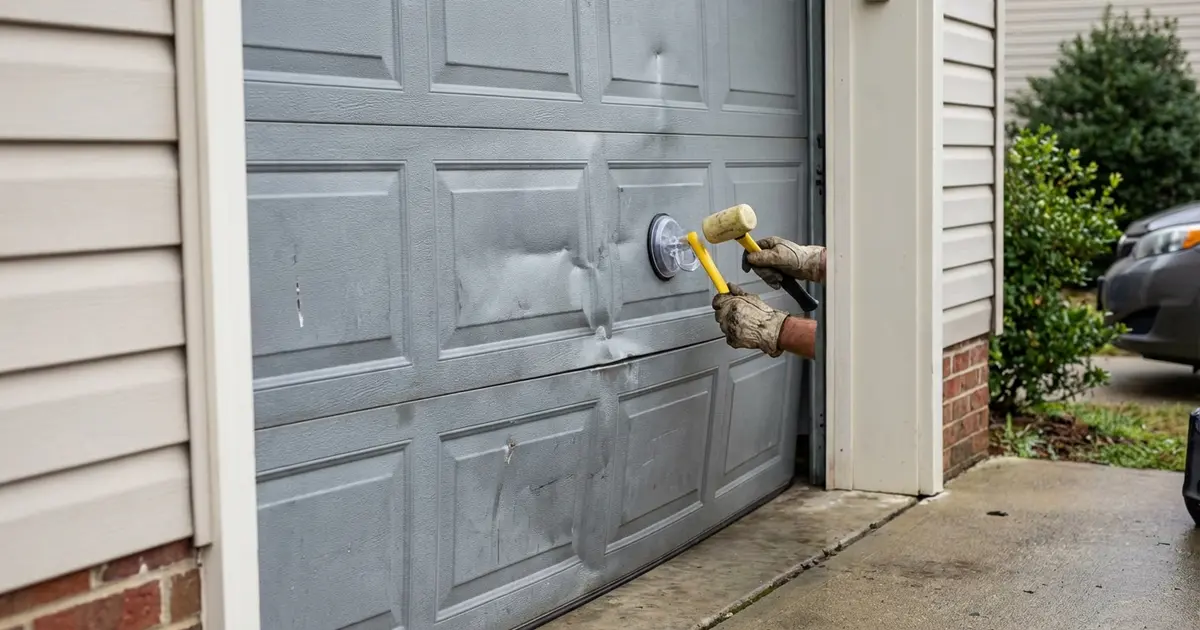
Step 1: Assess the Damage Before Doing Anything
Before grabbing tools or calling a pro, take 5 minutes to properly evaluate the dent. The assessment determines which repair path makes sense — and attempting the wrong method on the wrong type of dent wastes time and money.
Questions to Answer During Assessment
1. What material is the panel?
Look at the edge of the door panel and consider the door's overall style and weight:
- Steel: Most common residential material. Heavy, magnetic. Steel responds well to heat/cold techniques. Can dent but is harder to push out from behind.
- Aluminum: Lighter, non-magnetic. More malleable — easier to pull dents out with suction, but also easier to crease. Boiling water is effective on aluminum.
- Wood: No DIY dent repair applies. Wood dents don't "pop" — wood fibers compress and don't spring back. Damaged wood panels need filling, sanding, and repainting, or replacement.
- Fiberglass/composite: Less common. Can sometimes be repaired with body filler and paint; severely cracked composite panels usually need replacement.
2. How deep and large is the dent?
- Minor (< 2 inches wide, shallow): High DIY success rate with suction or heat/cold
- Moderate (2–6 inches wide, no crease): DIY possible; PDR professional is reliable option
- Large (> 6 inches, or dent with a visible crease): PDR is difficult; panel replacement often more practical
- Severe (structural, panel bowed, affects door operation): Panel replacement required
3. Is the paint intact?
Check carefully under bright light or use your phone's flashlight:
- Paint intact (just a dimple): DIY methods can restore appearance without repainting
- Paint cracked or chipped at the dent: Even if you pop the dent out, you'll need touch-up paint — and the cracked paint has exposed bare metal to rust risk
- Rust visible at dent: The damage has progressed — repair is unlikely to hold long-term; consider panel replacement
4. Can you access the back of the panel?
Some dent repair techniques require pushing from the back. Garage door panels are typically accessible from the interior side — but you need to be able to reach the specific panel. Bottom panels are usually easiest to access from inside. Higher panels may require disassembling part of the door system to access — a job for professionals.
5. Does the dent affect the door's operation?
Open and close the door. If the dent has caused the panel to bind in the tracks, gap at the seams, or if the door no longer opens/closes smoothly — this is a functional issue, not just cosmetic. Functional damage typically requires panel replacement regardless of dent size.
💡 Pro Tip: For small dents under 4 inches, try the boiling water trick first: pour hot water over the dent, then push from the inside. Heat makes steel more pliable and many minor dents pop out without tools.
DIY Dent Repair Methods
There are four viable DIY approaches for garage door dents, each suited to specific situations. Start with the most gentle method appropriate for your dent type.
Method 1: Heat and Cold Technique (Steel Panels)
This is the most effective DIY method for moderate dents in steel garage door panels. It works by exploiting thermal expansion: heating the metal makes it expand, and rapid cooling causes it to contract sharply — a cycle that can pop a dent back to its original position.
What You Need
- Heat source: heat gun (preferred, ~$25–$60) or hair dryer on highest setting
- Cooling agent: compressed air (in a can) held upside down, OR dry ice with protective gloves
- Protective gloves when handling dry ice
- Clean cloth
Step-by-Step Instructions
- Clean the dented area. Wipe with a clean damp cloth and let dry. Surface contaminants can affect heat transfer.
- Heat the dented area. Hold the heat gun or hair dryer 2–4 inches from the surface. Move in slow circular motions, covering the entire dent plus 1–2 inches around the perimeter. Heat for 30–60 seconds — the metal should feel very warm (not hot enough to burn but significantly warm to the touch from 6 inches away). Do not linger in one spot or you risk damaging the paint.
- Apply cold immediately. Without delay: take compressed air, turn the can upside down, and spray the center of the dent for 10–15 seconds. Alternatively, press dry ice (wrapped in a cloth) against the dent center. The goal is rapid thermal contraction.
- Listen and watch. You may hear a satisfying "pop" as the metal snaps back. Many dents require 2–4 cycles of heat/cold to fully restore.
- Repeat if needed. Allow the panel to return to ambient temperature between cycles (5–10 minutes). Then repeat the heat/cold sequence.
- Evaluate the result. After 3–4 cycles with no improvement, this technique likely won't resolve the dent — the crease or shape may be too severe for thermal cycling alone.
Tips for Better Results
- Works best in air temperatures above 50°F — cold ambient temps reduce the effectiveness of heating
- Most effective on dents without paint cracking and without sharp creases
- If the panel is textured (wood-grain embossing is common on steel doors), the technique still works — just be careful not to overheat embossed areas which can cause paint lift
Method 2: Boiling Water (Aluminum Panels)
Aluminum garage door panels have a lower stiffness than steel and respond particularly well to heat softening. Boiling water softens the aluminum enough that the panel can be pushed back into shape from behind — or with hand pressure from the front on shallower dents.
What You Need
- A pot of boiling water
- Heat-resistant gloves or oven mitts
- A blunt push tool (wooden dowel, rubber mallet, or a hockey puck)
- Optional: suction cup dent puller
Step-by-Step Instructions
- Bring water to a full boil.
- Put on heat-resistant gloves.
- Carefully pour boiling water directly over the dented area on the exterior surface of the panel. Pour slowly and steadily to avoid splashing.
- Immediately reach inside the garage and push the dent outward from behind using your gloved hand or a blunt push tool. On shallow dents, you may be able to push from the exterior side during the 20–30 seconds the aluminum is most pliable.
- Work quickly — aluminum cools fast. You have approximately 20–30 seconds of maximum pliability.
- Repeat as needed. Each application of boiling water gives you another window to work the dent.
Important: Do not use this method on steel panels — boiling water doesn't make steel significantly more pliable, and it can damage paint. Also avoid on wood or composite panels.
Method 3: Suction Cup Dent Puller
Suction cup dent pullers — the same tools used in automotive dent repair — work on smooth sections of garage door panels. They're most effective on round or bowl-shaped dents without sharp creases.
Tool Options
- Single suction cup ($10–$25): Works on small dents (2–3 inches). Available at any auto parts store.
- Bridge puller / multi-cup puller ($30–$80): Multiple suction points with a central pull screw. Better control and more even force for larger dents (3–6 inches).
- Glue-on dent tab kit ($30–$60): Uses adhesive tabs and a slide hammer or pull bridge. Works on both smooth and textured surfaces where suction cups can't get a seal.
How to Use a Suction Cup Dent Puller
- Clean the dented area thoroughly — dirt or wax prevents a seal.
- Slightly warm the panel surface with a heat gun on low (not required but improves suction seal on cold days).
- Press the suction cup firmly against the center of the dent, ensuring full contact around the cup's perimeter.
- Pull steadily and gradually — avoid jerking. Apply constant outward pressure for 10–15 seconds.
- For larger dents, work from the edges of the dent toward the center in multiple pulls, rather than pulling once from the center.
- Release, reposition, and repeat as needed.
Limitations
Suction works well on aluminum but can struggle on heavily textured steel surfaces where a complete seal is hard to achieve. For textured steel doors, glue-on tabs are more reliable than suction cups. Neither suction nor glue tabs can reverse a sharp crease — these tools work on dents, not folds.
Method 4: Auto Body Filler (Cosmetic Fix for Remaining Imperfections)
If you've partially resolved a dent but a shallow indentation remains — or if you're dealing with a dent in a steel panel where heat/cold didn't fully work — auto body filler (commonly called Bondo) can produce a smooth, paintable surface.
This is a cosmetic fix, not a structural repair. Body filler adds no structural strength. It's appropriate for small remaining surface imperfections after the main dent is addressed.
Materials Needed
- Automotive body filler (e.g., Bondo All-Purpose Putty, ~$15–$25)
- Plastic spreader / putty knife
- 80-grit, then 220-grit sandpaper
- Primer spray paint
- Matching touch-up paint (if available) or close-color exterior paint
Process
- Sand the dented area down to bare metal (if paint is damaged) using 80-grit sandpaper. Clean thoroughly and let dry.
- Mix body filler per instructions and apply with a spreader in thin, even coats. Slightly overfill the dent — you'll sand it flush.
- Allow to cure fully (usually 20–30 minutes depending on temperature and product).
- Sand flush with 80-grit, then finish with 220-grit for a smooth surface.
- Apply automotive primer, let dry.
- Paint to match. Note: matching paint exactly on a weathered garage door is difficult — the entire panel often needs to be painted for a seamless look.
✅ Key Takeaway: Replace the panel when the dent has cracked the paint through to bare metal, buckled multiple panel sections, or broken the structural integrity. Cosmetic dents on a solid panel are always repairable.
When DIY Won't Work: Know Your Limits
DIY dent repair is not appropriate in these situations:
- Sharp creases or folds — Once metal has been creased (a visible fold line), the molecular structure has changed. Heat/cold and suction cannot reverse this. PDR professionals have more advanced tools but even they often cannot fully restore creased panels.
- Structural damage — If the horizontal reinforcement strut inside the panel is bent, or the panel's edges don't line up with adjacent panels, DIY methods won't fix the underlying problem.
- Large dents (over 8 inches) — The physics of thermal or mechanical dent removal become very difficult at this scale for a DIYer without professional tools.
- Wood panels — No DIY thermal or suction method applies. Wood fibers compress and cannot be "popped" back.
- Multiple panels — If 2+ panels are damaged, the economics of DIY repair often don't favor the time and effort versus professional panel replacement or a new door.
- Damage affecting door operation — If the door won't open/close normally, call a pro. The dent repair is secondary to restoring safe operation.
Professional Paintless Dent Repair (PDR)
Paintless dent repair is a professional technique where a technician uses specialized metal rods, hooks, and light boards to push dents out from the interior side of a panel — without removing paint or using filler. PDR is the same technique used for hail damage on cars and is highly effective when the right conditions are met.
When PDR Works on Garage Doors
- Steel or aluminum panels
- Dents up to approximately 8–10 inches where the panel can be accessed from behind
- Paint is intact (no cracking or chipping at the dent site)
- No sharp creases or folds (though skilled PDR technicians can sometimes work creased areas)
- Dent is not at the very edge of a panel (edge dents are harder to access with PDR tools)
The PDR Process
A technician uses a combination of:
- Flexible rods: Inserted through openings in the door structure to reach the back side of the dented panel and apply upward pressure
- LED light reflection boards: Used to visualize the dent's surface accurately — reflections reveal exactly where the metal is still low or high
- Knockdown tools: Rubber or plastic tools used from the front to tap down any high spots created by the pushing process
A skilled PDR technician can restore a panel to near-original condition — often indistinguishable from undamaged panels — on moderate dents. Results are typically better than body filler and paint because the original factory paint finish is preserved.
PDR Cost
| Dent Size / Type | Typical PDR Cost |
|---|---|
| Small dent (under 2 inches) | $75–$125 |
| Medium dent (2–4 inches) | $100–$200 |
| Large dent (4–8 inches) | $150–$300 |
| Multiple dents (hail pattern) | $200–$600 total |
| Service call / minimum | $75–$100 |
Note: PDR technicians who specialize in automotive work can often service garage doors. Search for "PDR technician" or "paintless dent removal" in your area, not just "garage door repair" — PDR specialists often charge less for garage door work and have better technique.
Panel Replacement: When Repair Isn't Enough
When a dent is too severe, creased, or has compromised the paint and metal's integrity, replacing the damaged panel is the most reliable fix. A garage door panel replacement restores full structural integrity and curb appeal.
How Panel Replacement Works
A garage door technician will:
- Identify the exact panel model and order a matching replacement (this can take a few days to a few weeks depending on availability)
- Disconnect the garage door opener and disengage the springs (the door must be depressurized to safely work on individual panels)
- Remove hinges and hardware from the damaged panel and adjacent panels
- Slide out the damaged panel and slide in the replacement
- Re-attach all hardware, re-connect the door system, and test operation
The Matching Problem
Matching panels is one of the main challenges of panel replacement. Key factors:
- Brand and model must match exactly — Panel dimensions, profile shape, and hardware mounting positions vary by manufacturer and product line
- Color matching — Paint fades over time. A new panel in the original color will often be noticeably brighter than weathered existing panels. Some homeowners paint all panels after replacement for a uniform look.
- Discontinued models — If your door model is no longer manufactured (older than 15–20 years), replacement panels may be unavailable or require a custom order, which is expensive
Panel Replacement Costs
| Panel Type | Parts Cost | Labor Cost | Total Range |
|---|---|---|---|
| Standard steel panel | $80–$300 | $75–$200 | $150–$500 |
| Insulated steel panel | $150–$400 | $75–$200 | $225–$600 |
| Aluminum panel | $100–$350 | $75–$200 | $175–$550 |
| Wood panel | $150–$600 | $100–$250 | $250–$850 |
| Carriage-style decorative panel | $200–$700 | $100–$250 | $300–$950 |
Regional Cost Variations
| Region | Single Panel Replacement (Installed) |
|---|---|
| Northeast (NY, MA, CT, NJ) | $250–$650 |
| Southeast (FL, GA, NC, TX) | $175–$500 |
| Midwest (IL, OH, MI, MN) | $200–$520 |
| West Coast (CA, OR, WA) | $250–$650 |
| Mountain / Southwest (CO, AZ, NV) | $200–$550 |
Full Door Replacement: When It's Actually the Right Call
In some cases, full door replacement makes more financial sense than attempting to repair or source panels for an older door. Consider full replacement when:
- Two or more panels are damaged (repair cost approaches new door cost)
- The door model is discontinued and matching panels cost $500+ or are simply unavailable
- The door is more than 20 years old and showing other signs of wear (worn springs, old opener, inefficient insulation)
- You want to upgrade to a more energy-efficient or visually updated door anyway
- The door's frame or track system was also damaged in the incident that caused the dent
Full Door Replacement Costs
| Door Type (Single 9x7) | Cost Installed |
|---|---|
| Basic steel, no insulation | $700–$1,400 |
| Steel, insulated (R-12 to R-16) | $900–$2,000 |
| Steel, premium (high-R, full view) | $1,500–$3,500 |
| Double door (16x7), basic steel insulated | $1,400–$3,000 |
| Wood or wood composite | $1,800–$5,000+ |
For a comprehensive pricing guide, see our complete garage door repair cost guide.
Complete Dent Repair Cost Comparison
| Repair Method | Typical Cost | Best For | DIY Possible? |
|---|---|---|---|
| Heat/cold technique | $0–$80 (supplies) | Moderate steel panel dents, paint intact | Yes |
| Boiling water method | $0 (no supplies needed) | Aluminum panels, moderate dents | Yes |
| Suction cup dent puller | $10–$80 (tool cost) | Small to medium smooth-surface dents | Yes |
| Auto body filler + paint | $30–$100 (supplies) | Cosmetic touch-up on steel panels | Yes (basic skill needed) |
| Professional PDR | $75–$300 | Moderate dents, paint intact, access available | No |
| Panel replacement (single) | $150–$950 | Severe dents, creases, structural damage | Not recommended |
| Full door replacement | $700–$5,000+ | Multiple damaged panels, discontinued door | No (professional installation) |
Does Homeowners Insurance Cover Garage Door Dent Repair?
Many homeowners don't realize their garage door damage may be covered by insurance — particularly for sudden, accidental causes. Here's what's typically covered and what's not:
Usually Covered (Subject to Deductible)
- Hail damage — A hailstorm that dents multiple panels across a large area is generally covered under your dwelling (homeowners) policy
- Vehicle impact — If someone drove into your garage door, it's typically covered (check whether auto or home insurance applies based on whose vehicle)
- Fallen tree or branch — Sudden storm-related impacts are generally covered
- Vandalism — Intentional damage by others is typically covered under homeowners insurance
Usually NOT Covered
- Gradual wear and tear dents from normal use
- Minor cosmetic dents where repair cost is below your deductible
- Your own accidental impact (check your policy — some cover accidental damage to your own property; many don't)
- Rust or corrosion damage
Filing Tips
- Document the damage with photos immediately after the event
- Get a repair estimate before filing — if repair is $300 and your deductible is $500, filing is counterproductive
- For hail damage, check whether the damage pattern affects the full door (multiple panels of evenly-spaced dents) — this strengthens a claim
- Note the date and cause of damage for the claims report
How Door Material Affects Dent Repairability
| Material | DIY Repairability | PDR Success Rate | Best Repair Approach |
|---|---|---|---|
| Standard steel (24-gauge) | Good — heat/cold works well | Good for moderate dents | Heat/cold DIY, then PDR if needed |
| Thicker steel (25-gauge+) | Fair — stiffer, harder to pop | Moderate — requires more skill | PDR professional or panel replacement |
| Aluminum | Excellent — boiling water + suction effective | Very good | Boiling water + suction DIY, PDR for larger dents |
| Wood | Poor — no thermal or suction methods apply | N/A | Body filler + repaint, or panel replacement |
| Fiberglass/composite | Fair — body filler works on minor damage | Limited | Filler + paint (minor), panel replacement (major) |
DIY vs Professional: Decision Guide
✅ Try DIY First If:
- The dent is small to moderate (under 4 inches) and the paint is intact
- The door is steel or aluminum (not wood)
- The dent is round or bowl-shaped — no sharp crease
- The door still opens and closes normally
- You have 30–60 minutes and $20–$50 to spend on supplies
📞 Call a Professional When:
- The dent is larger than 4–5 inches, or has a visible crease
- The door's operation is affected (binding, misalignment, doesn't close fully)
- The paint is cracked or you see bare metal or rust at the dent site
- The dent is in a wood panel
- Multiple panels are damaged
- You've tried DIY and the dent is only partially improved
- The door is new or under warranty — professional repair preserves warranty claims
🔄 Panel Replacement Is the Answer When:
- The dent has structural implications (the panel is bent, the door gaps at seams)
- PDR cannot achieve acceptable cosmetic results
- The panel is rusted through at the dent site
- The dent is in a critical section (bottom panel near the weatherstrip, or top section panel)
For more context on garage door repairs generally, see our panel replacement guide and maintenance schedule to avoid future damage from deferred care.
Find a Garage Door Repair Pro Near You
If DIY repair hasn't resolved the dent, or if the damage is severe enough to warrant professional attention, local technicians can assess the panel and provide an accurate repair or replacement quote — typically at no charge for the estimate.
- Find trusted garage door pros in Houston
- Find trusted garage door pros in Miami
- Find trusted garage door pros in Denver
- Find trusted garage door pros in Portland
- Find trusted garage door pros in Chicago
Or browse all cities to find technicians in your area.
Frequently Asked Questions
Can a dented garage door panel be repaired without replacing it?
Yes — but it depends on the severity and material of the dent. Small to medium dents in steel garage doors can often be repaired using DIY methods (heat/cold technique, boiling water, suction cups) or professional paintless dent repair (PDR). Shallow dents in aluminum doors also respond well to suction or PDR. However, large dents, dents with creased or cracked paint, dents in wood panels, or structural damage to the panel frame typically cannot be fully restored — panel replacement becomes necessary. If a dent has caused the panel to bow out of the track plane or created a gap in the door seal, repair without replacement is usually not viable.
How much does garage door dent repair cost?
Costs vary widely by method and severity. DIY repair supplies (dry ice, heat gun, suction cup dent puller) run $15–$80. Professional paintless dent repair (PDR) costs $75–$250 per dent for small to medium damage. If a panel needs to be replaced, expect to pay $150–$600 for a single steel panel (parts + labor), $200–$700 for aluminum, or $300–$900 for a wood panel. If the door model is discontinued and matching panels are unavailable, or if multiple panels are damaged, full door replacement ($700–$4,000 depending on material and size) may be more cost-effective than attempting to source and replace individual panels.
Does homeowners insurance cover garage door dent repair?
It depends on the cause. Most homeowners insurance policies cover sudden, accidental damage — if a hailstorm, fallen tree, or vehicle impact dented your garage door, the damage is likely covered under your dwelling coverage (subject to your deductible). However, wear-and-tear dents or minor cosmetic damage from everyday bumps typically are not covered. File a claim only when the damage repair cost exceeds your deductible; otherwise it usually isn't worth the potential premium impact. For hail damage specifically, document the damage with photos immediately, and check whether the dent pattern is consistent with hail (multiple small, evenly-spaced dents across a horizontal section of the panel).
What is the heat and cold dent repair method for garage doors?
The heat/cold method works specifically on steel garage door panels by exploiting the metal's thermal expansion and contraction. Here's how it works: First, apply heat to the dented area using a heat gun or hair dryer on high setting for 30–60 seconds — heat the entire dent plus about 2 inches around the perimeter. Immediately after, apply cold to the center of the dent using a can of compressed air held upside-down (so the propellant sprays as a cold liquid) or by pressing dry ice directly against the panel. The rapid temperature change causes the metal to contract sharply, which can pop the dent back out. You may need to repeat 2–3 times. This method works best on moderate-sized dents (2–6 inches) in standard-gauge steel panels and is most effective when the paint is undamaged.
When should I replace a dented panel vs repair it?
Replace the panel when: (1) The dent is severe enough that it has bent the internal horizontal strut of the panel, causing the panel to be structurally compromised. (2) The paint is cracked, chipped, or peeling across the dented area — this means the steel's galvanized coating is also compromised and rust will follow. (3) The dent is near the bottom or top edge of the panel, affecting how it sits in the track or seats against adjacent panels. (4) You've attempted repair and the panel won't sit flush. (5) Multiple panels are dented — at that point, the math often favors a new door. Repair is appropriate when the dent is cosmetic, the paint is intact, and the panel's structural function is unaffected.
Can I use a suction cup dent puller on a garage door?
Yes, suction cup dent pullers can work on garage door panels — but with caveats. They work best on smooth, unpainted sections of aluminum doors and on painted steel doors with textured surfaces that allow a good seal. Standard automotive suction cup tools work for single-cup pulling. For larger dents, a bridge puller (a tool with multiple suction cups and a central pulling mechanism) provides more even force and better results. The technique: ensure the panel surface is clean and slightly warm (room temperature or warmer), apply the suction cup firmly, and pull with steady, gradual pressure — avoid jerking. Don't expect suction alone to fully restore a sharp crease; suction works best on round, bowl-shaped dents. For creased dents, combine with light tapping from behind the panel if accessible.
How long does professional garage door dent repair take?
For professional paintless dent repair (PDR), most single-panel dent jobs take 30 minutes to 2 hours depending on the size and complexity of the dent. PDR technicians use specialized rods and tools to carefully push and massage the dent from behind while monitoring progress from the front. For panel replacement, expect 1–3 hours for a single panel — time includes disconnecting relevant hardware, removing the old panel, installing the new one, and re-connecting and testing the system. If the door is an older or discontinued model and parts need to be sourced, there may be an additional 1–2 week lead time before the repair appointment.