Garage Door Roller Replacement: Types, Costs, and How-To
Garage door rollers are small components that do enormous work — every time your door cycles, each roller absorbs a share of the door's weight and guides it along the track. When rollers wear out, you'll hear it (grinding, scraping, rattling) and eventually see it (door wobbling, binding, or coming off track entirely).
This guide covers everything you need to know: the different roller types, what worn rollers look like, realistic replacement costs broken down by region, a step-by-step DIY guide, and a clear framework for when to call a professional instead.
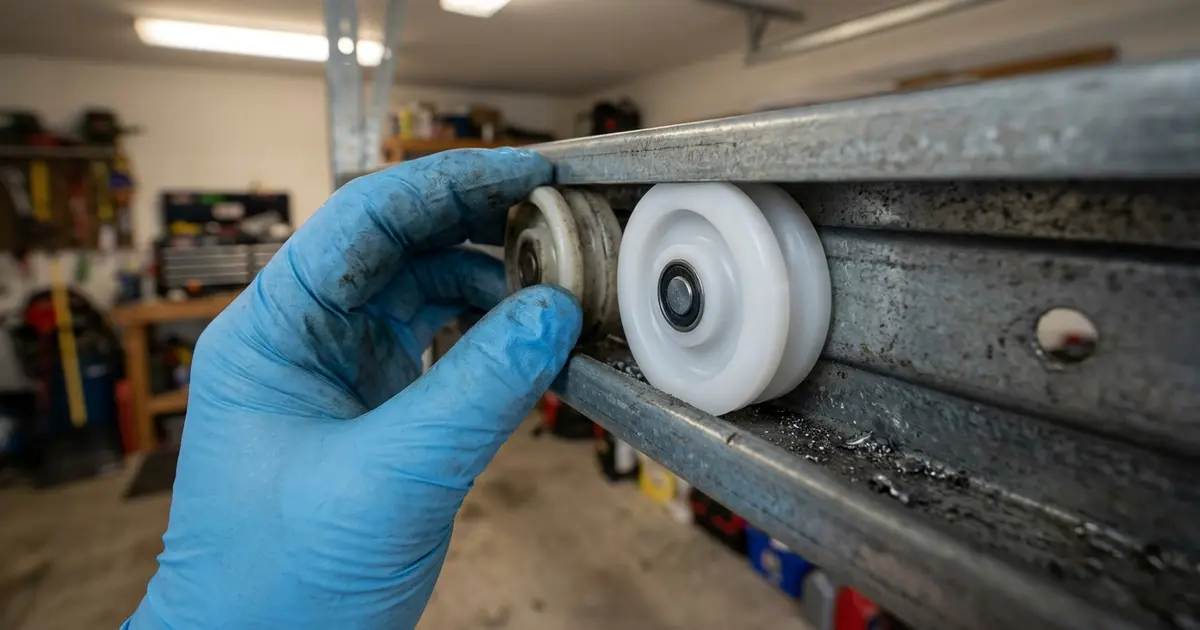
What Garage Door Rollers Do
Rollers are the small wheel-and-stem assemblies that allow your garage door panels to travel along the metal tracks mounted on either side of the garage opening. Each roller has two parts: the stem (a metal shaft that inserts through a hinge bracket or bottom bracket, holding the roller in position) and the wheel (which rolls along the inside channel of the track as the door moves up and down).
A standard single-car door has 10 rollers — one at the bottom of each side, then additional rollers at each hinge junction moving up the door. A double-car door typically has 16–18. Together, they distribute the door's weight and guide its travel along a precise path from fully closed to fully open.
The physics here matter: a two-car steel insulated door can weigh 150–200 pounds. Each roller bears a fraction of that weight plus dynamic forces from acceleration and deceleration. That's why roller condition directly affects everything else — worn rollers create vibration that loosens hardware, puts extra stress on the opener motor, and over time can distort or damage tracks.
💡 Pro Tip: When replacing rollers, upgrade to 13-ball nylon rollers. They cost $4–$8 each vs $2–$3 for basic steel, but they're much quieter and last 50% longer. Worth it every time.
Types of Garage Door Rollers
Steel Rollers (Open Bearing)
Steel rollers are the standard on older and builder-grade doors. They have a steel wheel with an open (unsealed) ball bearing assembly. The open bearing design makes them susceptible to contamination from dust, metal particles, and debris over time. Steel rollers are inexpensive and durable under ideal conditions, but they are significantly louder than nylon alternatives — the steel-on-steel contact produces grinding and rattling sounds that worsen as the bearing degrades.
- Cost: $2–$5 per roller
- Lifespan: 5,000–10,000 cycles (~5–10 years)
- Noise level: High
- Best for: Detached garages where noise isn't a concern, very low budgets
Nylon Rollers (Standard)
Standard nylon rollers replace the steel wheel with a nylon or plastic wheel that rolls much more quietly against the steel track. The reduced metal-to-metal contact makes a noticeable noise difference — often the difference between a door that rumbles through the house and one that's barely audible. Standard nylon rollers still often use an open bearing, which limits their lifespan relative to sealed-bearing versions.
- Cost: $3–$8 per roller
- Lifespan: 8,000–12,000 cycles (~8–12 years)
- Noise level: Low
- Best for: Attached garages, quieter operation at moderate cost
Nylon Rollers with Sealed Ball Bearings (Premium)
The best option for most homeowners. These combine a nylon wheel with a sealed ball bearing assembly inside the roller hub. The sealed bearing keeps out contaminants, dramatically extending service life. The nylon wheel maintains the quiet operation advantage. Premium sealed-bearing rollers cost more upfront but offer a significantly lower cost per cycle than basic steel rollers, and they're the quietest option available for residential applications.
- Cost: $8–$20 per roller
- Lifespan: 15,000–20,000+ cycles (~15–20+ years)
- Noise level: Very low
- Best for: Attached garages, anyone prioritizing quiet operation and longevity
3-Inch vs 2-Inch Rollers
Standard residential rollers have a 2-inch wheel diameter. Some heavy-duty residential and commercial systems use 3-inch rollers, which distribute load over a larger contact area, roll more smoothly, and typically last longer. If your door is larger than standard (18+ feet wide, 8+ feet tall) or particularly heavy, check whether 3-inch rollers are specified — the larger size provides meaningful benefits on heavy doors.
| Roller Type | Cost Per Roller | Set of 10 Cost | Lifespan | Noise |
|---|---|---|---|---|
| Steel (open bearing) | $2–$5 | $20–$50 | 5–10 years | High |
| Nylon (standard) | $3–$8 | $30–$80 | 8–12 years | Low |
| Nylon (sealed bearing) | $8–$20 | $80–$200 | 15–20+ years | Very Low |
| 3-inch steel | $5–$12 | $50–$120 | 8–15 years | Medium |
| 3-inch nylon sealed | $12–$25 | $120–$250 | 20+ years | Very Low |
Signs Your Garage Door Rollers Need Replacement
Noise Symptoms
- Grinding or scraping: Metal-on-metal sound as the door moves — worn steel roller bearings or a seized roller sliding rather than rolling
- Rattling or vibrating: Loose or worn rollers with excess play in the bearing
- Squeaking despite lubrication: If you've recently lubricated rollers and noise persists, the bearing itself is worn out
- Sudden new noise on a previously quiet door: One roller has failed while others are still OK — but check all of them
Visual Symptoms
- Visible flat spots or chips on the roller wheel: The wheel is no longer round and will cause bouncing, vibration, and uneven track wear
- Cracked nylon: Nylon rollers develop radial cracks as they age and dry out; a cracked nylon roller can shatter under load
- Heavy rust or corrosion: Rusted rollers have degraded bearing surfaces and will fail sooner
- Wobble visible during operation: The roller is not staying centered in the track channel
- Roller not turning: A seized roller (one that's sliding rather than rolling) creates visible drag marks inside the track
Operation Symptoms
- Door feels heavier or harder to lift manually: Increased friction from worn rollers creates resistance the opener has to overcome
- Door vibrates heavily during movement: Asymmetric wear across multiple rollers creates oscillation
- Door comes off track: A severely worn or broken roller can exit the track — this is a safety issue requiring immediate attention
- Opener straining: If your opener is working harder than normal or reversing prematurely, worn rollers may be increasing the mechanical resistance beyond the opener's force threshold
✅ Key Takeaway: Replacing all rollers at once (typically $100–$200 for full set including labor) costs less than separate service calls for individual rollers. If one is worn, the others are close behind.
Garage Door Roller Replacement Cost
Total cost depends on whether you DIY or hire a professional, the type of rollers you choose, and local labor rates. Here's a realistic breakdown:
DIY Cost (Parts Only)
| Job Scope | Steel Rollers | Standard Nylon | Premium Nylon (Sealed) |
|---|---|---|---|
| Single-car door (10 rollers) | $20–$50 | $30–$80 | $80–$200 |
| Double-car door (16–18 rollers) | $32–$90 | $48–$144 | $128–$360 |
| Replace bottom 2 rollers only | $4–$10 | $6–$16 | $16–$40 |
Professional Replacement Cost (Parts + Labor)
| Job Scope | With Basic Rollers | With Nylon Upgrade |
|---|---|---|
| Single-car door (10 rollers) | $100–$180 | $150–$280 |
| Double-car door (16–18 rollers) | $150–$250 | $200–$375 |
| Single roller replacement only | $75–$150 (min. service call) | $85–$165 |
| Roller replacement + tune-up | $175–$300 | $225–$425 |
Key insight on labor: For professional replacement, labor is typically $75–$150 per service call regardless of how many rollers are replaced. This means replacing all 10–12 rollers at once adds only $30–$150 in parts over replacing just one or two — but saves you from paying another service call fee in 3–6 months when the next roller fails.
Regional Cost Variations
Labor rates for garage door service vary significantly by geography. Parts costs are roughly similar nationwide (online pricing has normalized this), but service call and labor rates differ:
| Region | Service Call / Labor Rate | Single-Car Full Replacement (Professional) |
|---|---|---|
| Northeast (NY, NJ, MA, CT) | $100–$175 | $175–$325 |
| Mid-Atlantic (DC, MD, VA, PA) | $90–$155 | $160–$290 |
| Southeast (FL, GA, NC, SC, TN) | $75–$130 | $120–$240 |
| South Central (TX, LA, OK, AR) | $75–$125 | $115–$225 |
| Midwest (IL, OH, MI, WI, MN) | $80–$140 | $130–$255 |
| Mountain (CO, UT, AZ, NV, ID) | $85–$145 | $135–$265 |
| West Coast (CA, OR, WA) | $95–$170 | $155–$305 |
High-cost metro areas (San Francisco Bay Area, New York City, Seattle, Boston) can push labor rates 20–30% above the regional ranges above. Rural areas often fall at or below the low end of ranges.
DIY vs Professional Roller Replacement
✅ When DIY Makes Sense
- You're replacing middle and upper rollers only (not the bottom bracket rollers)
- You're comfortable working on a ladder and with basic hand tools
- You can follow instructions carefully and work methodically
- The door is balanced and all springs are intact (test: raise the door to waist height and let go — it should stay in place or move only slightly)
- You want to save the $75–$150 labor cost on a straightforward job
⚠️ When to Call a Professional
- Bottom rollers need replacement — these are attached to the bottom bracket, which is under cable tension. Incorrect disassembly can cause cables to snap or whip (a significant injury risk)
- The door has come off track — putting a door back on track while also replacing rollers requires knowing how to handle cable tension and spring balance
- A spring is broken — never work on a door with a broken spring; the door is unbalanced and dangerous
- You see frayed cables — cables should be replaced at the same time, which requires professional spring tension management
- The tracks look bent or misaligned — track adjustment should be done by a pro to ensure correct alignment
- The door is heavy (200+ lbs) or a high-lift system — more complex geometry and higher component tension
DIY Time Estimate
Replacing all mid and upper rollers (not bottom brackets) on a single-car door: 30–45 minutes for an experienced DIYer, 60–90 minutes for a first-timer. Double-car door: 45–75 minutes. Factor in additional time if rollers are heavily corroded and require penetrant and extra force to remove.
Step-by-Step Garage Door Roller Replacement (DIY)
Before you start: Confirm all springs are intact and the door is balanced. Test balance by disconnecting the opener (pull the red release cord) and lifting the door manually to waist height — it should stay there without rising or falling more than a few inches. If it crashes down or rockets up, call a professional: the springs need adjustment before roller work.
Tools and Materials
- Replacement rollers (correct diameter and stem length — measure or bring an old one to match)
- 2 C-clamps or locking pliers (to secure the door while you work)
- Step ladder
- Flathead and Phillips screwdrivers
- Socket wrench set (typically 7/16" or 1/2" for hinge bolts)
- Needle-nose pliers
- White lithium grease spray (for the new rollers)
- Work gloves and safety glasses
Step 1: Secure the Door
Close the door fully. Clamp a C-clamp or locking pliers onto the track just above the bottom roller on each side — this prevents the door from moving unexpectedly while you work. Disconnect the opener from the door by pulling the red release cord. The door is now in manual mode.
Step 2: Start with the Middle Rollers
Work from the middle of the door outward rather than starting at the top or bottom. Each mid-door roller is held by a hinge bracket: two or three bolts attach the hinge bracket to the door panel, and the roller stem inserts through a hole in the bracket's side flange.
- Loosen (but don't fully remove) the hinge bolts with your socket wrench — you just need enough play to slide the roller stem out.
- Grip the roller stem with needle-nose pliers and wiggle/pull it out of the hinge bracket hole.
- Slide the new roller stem into the bracket hole. The stem should go in smoothly — if it's stiff, the hole may be slightly misaligned. Don't force it; adjust the bracket position slightly.
- Retighten the hinge bolts firmly (snug, not over-torqued).
- Apply a small amount of white lithium grease to the new roller stem where it contacts the bracket.
Step 3: Replace Upper Rollers
The upper rollers near the top of the door panels are accessed the same way as mid-door rollers. On taller doors (8-foot), you'll need the ladder to comfortably access the top hinge. Take care near the top of the door — you're working close to the torsion spring shaft (if your door has a torsion spring). Do not touch the spring, shaft, winding cones, or cables. Lubricate as you go.
Step 4: Upper Track / Curved Section Rollers
The top roller on each side of the door sits inside the curved section of the track where the vertical track transitions to horizontal. This roller can be more challenging to access. With the door fully closed, this roller is at or near the top of the vertical track section. Loosen the top hinge bracket bolts, slide out the old roller, install the new one, and retighten. Some top brackets also have a tensioner bolt for the horizontal track — don't adjust this unless you know what you're doing.
Step 5: Skip the Bottom Rollers (Unless You Know What You're Doing)
The bottom rollers on each side are mounted in the bottom brackets, which also anchor the lift cables. Replacing bottom bracket rollers requires managing cable tension. If you choose to proceed:
- Clamp the track above the bottom roller very securely — this is critical
- The cable must be carefully unhooked from the bottom bracket drum to release tension before disassembly
- This step involves spring tension and cable management that has real injury potential if done incorrectly
Most DIYers stop short of the bottom rollers and hire a pro for those two. The incremental cost is low and the risk reduction is meaningful.
Step 6: Test and Reconnect
- Remove the C-clamps from the tracks.
- Manually cycle the door up and down several times — it should move smoothly and quietly with the new rollers.
- Reconnect the opener by pulling the release cord again or pressing the trolley back onto the rail (depends on opener model).
- Run the opener through several full cycles, listening for any remaining noise.
- Wipe any excess lubricant off door panels and the floor.
A Note on Bottom Roller Replacement
The bottom bracket is the most dangerous component to work on without training. Here's why: the lift cables are anchored at the bottom bracket, and these cables are under 100–200+ foot-pounds of tension from the counterbalance springs. If the bottom bracket is released while the door is in the wrong position, the cable can snap back and cause serious lacerations or eye injuries.
Professional technicians replace bottom bracket rollers routinely and safely because they know how to manage the cable slack and work with the spring tension. For DIYers, the calculus is clear: the additional cost of having a pro replace the two bottom rollers (vs doing all rollers yourself) is typically $50–$100. That's a good deal for the injury risk reduction. Focus your DIY effort on the 8–10 middle and upper rollers where the work is genuinely straightforward.
Steel vs Nylon Rollers: Which Should You Choose?
If you're replacing rollers on an attached garage, the answer is almost always nylon rollers with sealed bearings. Here's the comparison:
| Factor | Steel Rollers | Nylon (Sealed Bearing) |
|---|---|---|
| Upfront cost (set of 10) | $20–$50 | $80–$200 |
| Expected lifespan | 5–10 years | 15–20+ years |
| Cost per cycle | Higher (shorter life) | Lower (longer life) |
| Noise level | Loud (metal-on-metal) | Very quiet |
| Maintenance needed | Frequent lubrication | Light lubrication 2x/year |
| Contamination resistance | Low (open bearing) | High (sealed bearing) |
| Best use case | Detached garages, budget replacements | Attached garages, quieter operation |
The $60–$150 premium for nylon sealed-bearing rollers over basic steel rollers typically pays for itself within the first few years through extended lifespan and reduced maintenance frequency. Unless you're on an extremely tight budget or replacing rollers on a detached garage where noise doesn't matter, choose nylon sealed-bearing rollers.
For more context on garage door components and what affects your overall system lifespan, see our complete garage door maintenance schedule.
How Long Do Garage Door Rollers Last?
Roller lifespan is primarily determined by three factors: roller type, lubrication frequency, and door balance.
Cycles Per Lifetime by Type
- Basic steel: 5,000–10,000 cycles
- Standard nylon: 10,000–15,000 cycles
- Premium nylon (sealed bearing): 15,000–20,000+ cycles
Converting Cycles to Years
| Daily Usage | Annual Cycles | Steel Roller Life | Nylon Sealed Bearing Life |
|---|---|---|---|
| 1–2 cycles/day (light) | ~500/year | 10–20 years | 30–40+ years |
| 3–4 cycles/day (average) | ~1,200/year | 4–8 years | 12–17 years |
| 5–8 cycles/day (heavy) | ~2,200/year | 2–4 years | 7–9 years |
These figures assume regular lubrication (twice per year). An unlubricated door will wear through rollers significantly faster — a dry steel roller may last only 2–3 years under average usage. Door balance also matters: a door that's not properly balanced puts uneven load on rollers, accelerating wear on the side that bears more weight.
Maintaining Your Garage Door Rollers
After replacement, a simple maintenance routine will maximize the lifespan of your new rollers:
- Lubricate every 6 months: Apply white lithium grease spray to each roller stem where it meets the hinge bracket. For nylon rollers, this is the only lubrication point — do not apply heavy grease to the nylon wheel surface. See our complete lubrication guide for full instructions.
- Inspect during lubrication: While you're lubricating, take 30 seconds to look at each roller. Catching a developing flat spot or crack early prevents a failed roller from causing track damage or a door-off-track situation.
- Check door balance annually: A balanced door puts even, correct load on rollers. Disconnect the opener and lift the door manually to waist height — it should stay in place. If it doesn't, have a pro adjust the spring tension.
- Keep tracks clean: Dirty tracks cause rollers to work harder. Wipe track channels with a clean dry cloth when you lubricate. Do not apply lubricant to the tracks themselves — only the rollers.
For a complete maintenance checklist, see our garage door maintenance schedule guide. If your door is experiencing other issues beyond roller wear, the garage door repair cost guide covers pricing for all common repairs.
Find a Garage Door Roller Replacement Pro Near You
If you'd prefer a professional to handle roller replacement — especially if you need the bottom rollers replaced or want a full door tune-up at the same time — local technicians can typically complete the job in under an hour during a single service visit.
- Find trusted garage door pros in Houston
- Find trusted garage door pros in Phoenix
- Find trusted garage door pros in Chicago
- Find trusted garage door pros in Denver
- Find trusted garage door pros in Atlanta
Or browse all cities to find technicians in your area.
Frequently Asked Questions
How do I know if my garage door rollers need to be replaced?
There are several clear signs that rollers are due for replacement. The most obvious is noise: grinding, squeaking, or scraping sounds during door operation often indicate worn roller bearings that can no longer be fixed with lubrication. Visually, inspect rollers for flat spots (the wheel is no longer round), cracks or chips in nylon rollers, significant wobble as the door travels, or rust and corrosion in steel rollers. If a roller is seized — meaning it slides along the track instead of rolling — it should be replaced immediately, as a sliding roller puts enormous stress on tracks and other components. Steel rollers typically last 5,000–10,000 cycles (5–10 years with average use); premium nylon rollers with sealed bearings can last 15,000–20,000 cycles or more with proper lubrication. Most professionals recommend replacing all rollers at the same time even if only one or two are visibly worn — the labor cost is the same, and the rest are typically near the end of their lifespan.
Can I replace garage door rollers myself?
Yes — for most rollers, this is a DIY-accessible task. The process involves: loosening the hinge bolts on the hinge bracket holding the roller, sliding the old roller stem out of the bracket, inserting the new roller, and retightening. The important exception is the bottom roller on each side of the door. The bottom roller sits inside the bottom bracket, which is also the attachment point for the lift cable. The cable is under significant tension from the door springs; disturbing the bottom bracket while the door is in a certain position can cause the cable to snap or whip. Most DIYers should replace all rollers except the two bottom ones and hire a professional for those. Total job time for a DIYer: 30–60 minutes. Nylon rollers with sealed bearings are slightly harder to install (they often require sliding the roller into the track rather than through a hinge) but are manageable with patience.
How much does it cost to replace garage door rollers?
The total cost to replace garage door rollers ranges from $100 to $250 for a professional replacement on a single-car door (10–12 rollers), or $150–$350 for a double-car door (16–18 rollers). This includes both parts and labor. The roller type significantly affects parts cost: basic steel rollers run $2–$5 each ($20–$60 for a full set), standard nylon rollers cost $3–$8 each ($30–$80 for a set), and premium nylon rollers with sealed bearings run $8–$20 each ($80–$240 for a set). Labor typically ranges from $75–$150 per service visit, which is often the dominant cost on basic steel roller jobs. If you DIY the replacement, your cost is parts only — a set of 10 standard nylon rollers with bearings typically runs $50–$100 in parts at a home improvement store.
What is the difference between steel and nylon garage door rollers?
Steel rollers are the most common type on older and builder-grade doors. They are durable and inexpensive but loud — the metal-on-metal contact between the steel roller and the steel track creates grinding or rattling sounds that get worse as the bearing wears. Steel rollers have an open bearing design that is more susceptible to contamination from dirt and debris. Nylon rollers have a nylon or plastic wheel that rolls much more quietly against the steel track, significantly reducing operational noise. Premium nylon rollers include sealed ball bearings in the roller hub, which dramatically increases their lifespan and keeps dirt out of the bearing. If noise is a concern — and it usually is, especially when the garage is attached to a living space — upgrading from steel to nylon sealed-bearing rollers at replacement time is one of the highest-impact, lowest-cost improvements you can make to your garage door. The price difference is modest (often $30–$80 more for a full set), but the noise reduction is dramatic.
How many rollers does a garage door have?
A standard single-car garage door (up to 9 feet wide) typically has 10 rollers: one on each side at the bottom, and then additional rollers spaced up each side of the door at the hinges. The exact count depends on the door height — a 7-foot door typically has 10 rollers, while an 8-foot door may have 12. A double-car door (up to 18 feet wide) has 16–18 rollers, as each side has more rollers to handle the wider, heavier door. Commercial or high-lift door systems may have additional rollers depending on track configuration. Most residential garages use 2-inch diameter rollers; some heavy-duty residential and commercial applications use 3-inch rollers, which roll more smoothly and last longer due to the larger contact surface.
How long do garage door rollers last?
Lifespan depends heavily on roller type and maintenance. Basic steel rollers: 5,000–10,000 cycles (roughly 5–10 years at 2–3 cycles/day). Standard nylon rollers: 10,000–15,000 cycles (10–15 years). Premium nylon rollers with sealed bearings: 15,000–20,000+ cycles (15–20+ years with proper lubrication). Factors that shorten roller lifespan include: lack of regular lubrication, a poorly balanced door (which puts uneven load on rollers), misaligned tracks, and extreme temperatures or high humidity environments. Lubricating your rollers every 6 months with white lithium grease on the stems is the single best thing you can do to maximize roller life. A door that's been running dry for years may wear through rollers in half the expected time.
Should I replace just one bad roller or all of them at once?
Replace all rollers at the same time whenever possible. The reasoning is straightforward: if one roller has failed, the rest are typically at a similar point in their wear curve — they've been running the same number of cycles under the same conditions. Replacing only the failed roller means you'll likely be doing the same job again in a few months as other rollers fail. More importantly, the labor cost is the main expense in professional roller replacement — a technician who replaces all 10–12 rollers in one visit charges roughly the same labor rate as for replacing just one or two. The additional parts cost for replacing all rollers instead of just the failed one is usually $30–$100. The exception: if your door is relatively new (under 5 years old) and only one roller has clearly failed due to a specific incident (e.g., something jammed in the track), replacing just the failed roller is reasonable.