Garage Door Rust Repair and Prevention: Complete Homeowner Guide
A little rust on your garage door can turn into a major structural problem fast — or it can be completely reversed with an afternoon of work. The key is knowing which situation you're dealing with. This guide walks you through the full process: identifying rust severity, DIY repair, professional options, costs, and long-term prevention.
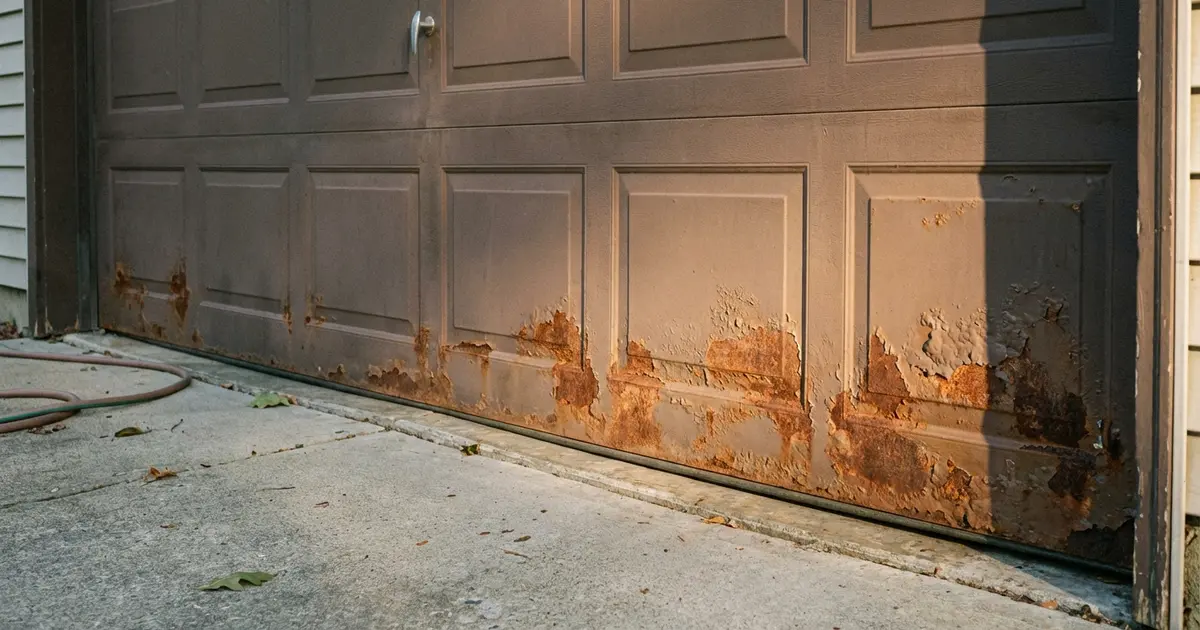
Why Garage Doors Rust — and Where It Starts
Most residential garage doors are made from galvanized steel — steel with a thin zinc coating applied during manufacturing. That zinc layer is what keeps water away from the underlying steel. When the coating is scratched, chipped, or worn away, bare steel is exposed. Moisture reacts with the iron in the steel to form iron oxide: rust.
Rust doesn't spread randomly. It almost always starts in predictable locations:
- Bottom edge of the door: Water collects here. The door contacts the floor seal constantly. The bottom rail and lowest panels take the most moisture exposure. This is where most rust begins.
- Panel corners and seams: Where panels join or overlap, water infiltrates the gap and stays. Rust in these seams is common even on well-maintained doors.
- Around hardware holes: Holes drilled for hinges, handles, and rollers break through the factory coating. Without proper sealing, these are rust initiation points.
- Scratches and dents: Any impact that chips paint or dents the panel deep enough to crack the coating becomes a rust start point within 1–3 years in humid climates.
- Tracks and hardware: Rust on the track itself causes rollers to wear faster. Rusty hinges and bolts seize up and can cause mechanical failure.
- Coastal exposure: Salt air accelerates corrosion dramatically. Doors near the ocean can develop rust in places with no visible damage to the coating — the salt penetrates microscopically.
Understanding where rust lives helps you inspect efficiently and catch problems before they require expensive repairs.
Assessing Rust Severity: 4 Levels
Not all rust requires the same response. Before doing anything, inspect your door carefully and categorize what you're seeing. Walk around and look at the bottom section, corners, seams, and hardware with a flashlight.
| Level | What You See | Depth | Recommended Action |
|---|---|---|---|
| Level 1: Surface | Light reddish-brown staining, no texture change | Coating only | DIY treatment and repaint |
| Level 2: Active | Flaking, bubbling paint; rough texture to touch | Into top steel layer | DIY repair + primer + paint |
| Level 3: Deep | Pitting, visible corrosion craters, thinned metal | Through steel layers | Professional repair or panel replace |
| Level 4: Structural | Holes, perforated metal, compromised frame or rail | Through-and-through | Panel or full door replacement |
The test: push your finger against the rusted area. If you feel solid resistance, you're at Level 1 or 2. If the metal flexes or feels thin, you're at Level 3. If you can push through or see light through the metal, that's Level 4 — the door section has no structural integrity remaining.
Don't Forget the Hardware
While assessing panels, also check:
- Bottom brackets: These heavy steel brackets attach the cable to the door. Rust here is serious — they're under high tension. A corroded bottom bracket can fail suddenly.
- Hinges: A rusty hinge that seizes can cause a panel to fold incorrectly during operation, jamming the door.
- Track mounting brackets: Rust here loosens the track gradually, affecting door alignment.
- Torsion bar and spring hardware: Surface rust on springs is cosmetic; scaling rust that pits the spring wire is a warning sign — springs under tension with pitted surfaces can fail unpredictably.
DIY Rust Repair: Step-by-Step
Level 1 and Level 2 rust on door panels is a manageable DIY repair. The process takes a full day when you account for drying time between coats. Budget a Saturday with good weather (above 50°F, no rain in the forecast for 24 hours).
Materials Needed
- Wire brush or wire wheel attachment for drill
- 80-grit sandpaper and 220-grit sandpaper
- Rust converter (phosphoric acid-based product such as Rust-Oleum Rust Reformer)
- Automotive body filler (Bondo) — for pitted areas
- Rust-inhibiting metal primer
- Exterior paint (spray or brush-on) matched to existing door color
- Painter's tape and plastic sheeting
- Rags, mineral spirits, gloves, eye protection
Step 1: Clean the Door Thoroughly
Wash the entire door with a mild detergent and rinse well. Let it dry completely. Any grease, mildew, or road film under your repair will prevent good adhesion. Pay extra attention to the bottom section.
Step 2: Remove Loose Rust
Using your wire brush or a wire wheel on a drill, aggressively remove all flaking rust, bubbling paint, and loose material. Work in small circles. You want to reach solid metal or tightly adherent rust — you don't need to get to shiny bare metal everywhere, but loose rust must go. Wear gloves and eye protection; rust fragments are sharp.
Step 3: Sand the Area
Feather the edges of the paint around the repair area with 80-grit sandpaper so there's no sharp transition between the bare metal area and surrounding paint. This prevents the repair from being visually obvious after painting. Follow with 220-grit for a smoother surface.
Step 4: Apply Rust Converter
Apply rust converter (phosphoric acid primer) to all areas where bare metal or remaining rust is visible. This product chemically reacts with iron oxide to form a stable black compound that can be painted over and that doesn't continue to corrode. Follow the product's drying time — typically 20–30 minutes for initial dry, 24 hours before topcoating.
Step 5: Fill Pits (If Present)
For Level 2 areas with surface pitting, use automotive body filler (Bondo) to fill the craters once the rust converter has dried. Mix per instructions, apply with a putty knife, and allow to cure (typically 20–30 minutes). Sand flat with 80-grit, then 220-grit. The goal is a smooth surface that matches the surrounding panel.
Step 6: Apply Rust-Inhibiting Primer
Apply two coats of a rust-inhibiting metal primer to all repaired areas, feathering onto surrounding paint by several inches. Allow each coat to dry per product instructions (usually 1–2 hours). This primer bonds to metal and forms the corrosion-resistant foundation for your topcoat.
Step 7: Paint
Apply exterior paint in your door's color in thin, even coats. Two to three coats typically achieve a good match and durability. Spray paint gives a smoother finish that better matches the factory texture; brush-on paint gives more coverage for larger areas. Allow full cure time (24–48 hours) before washing or moisture exposure.
Estimated DIY Material Cost
| Item | Typical Cost |
|---|---|
| Wire brush / wire wheel | $5–$20 |
| Rust converter | $10–$20 |
| Automotive body filler (if needed) | $10–$20 |
| Rust-inhibiting primer (spray) | $10–$15 |
| Exterior paint (matched color, spray) | $15–$30 |
| Sandpaper assortment | $5–$10 |
| Total | $55–$115 |
Find trusted garage door pros in Chicago, Seattle, Boston, Minneapolis, and Detroit.
When to Call a Professional
DIY rust repair makes sense for Level 1–2 surface rust on door panels. Call a professional when:
- 🚫 The bottom rail is rusted through. The bottom rail is structural — it's what the cable attaches to at the bottom corners. A rusted-through rail cannot safely support door operation and requires professional panel or rail replacement.
- 🚫 Any hardware shows deep pitting or scaling rust. Hinges, brackets, cable drums, and springs under tension with significant rust need professional evaluation. A failed bottom bracket under load can cause serious injury.
- 🚫 The door has holes or perforated areas. Level 4 rust means the metal has no structural integrity. Panel replacement is required.
- 🚫 Rust spans more than 30% of the door surface. At this point, the economics shift toward door replacement rather than extensive refinishing.
- 🚫 Spring hardware shows scaling rust. Torsion springs under several hundred pounds of tension with corroded surfaces can fracture. This is a professional safety evaluation.
A professional assessment visit — where a technician inspects the door and gives a written quote — typically costs nothing or $50–$75 credited toward repair. Get two or three quotes for any rust repair exceeding $300.
Garage Door Rust Repair Costs in 2026
| Service | Average Cost | Cost Range |
|---|---|---|
| DIY surface rust treatment + repaint (materials only) | $75 | $55–$115 |
| Professional rust treatment + repaint (full door) | $350 | $200–$600 |
| Single panel replacement (standard steel) | $250 | $150–$400 |
| Single panel replacement (insulated/woodgrain) | $400 | $250–$600 |
| Bottom rail replacement | $200 | $125–$325 |
| Hinge replacement (full set) | $150 | $100–$250 |
| Bottom bracket replacement (pair) | $175 | $125–$275 |
| Full door replacement (standard steel, single) | $1,200 | $900–$1,800 |
| Full door replacement (standard steel, double) | $2,000 | $1,400–$3,200 |
Regional Cost Variation
| Region | Pro Repaint (Full Door) | Panel Replacement | Full Door Replace (Double) |
|---|---|---|---|
| Northeast (NY, Boston, DC) | $350–$650 | $225–$500 | $1,800–$3,500 |
| West Coast (LA, SF, Seattle) | $325–$625 | $210–$475 | $1,700–$3,400 |
| Southeast (Atlanta, Miami, Charlotte) | $250–$500 | $165–$400 | $1,400–$2,800 |
| Midwest (Chicago, Columbus, Detroit) | $260–$520 | $175–$420 | $1,500–$2,900 |
| Southwest (Phoenix, Dallas, Houston) | $240–$490 | $160–$390 | $1,400–$2,700 |
Cost Factors That Matter Most
- Rust extent: Surface rust on one panel vs. deep rust across multiple sections changes the scope dramatically
- Door size: Single (8x7, 9x7) vs. double (16x7, 18x7) doors mean more materials and labor
- Panel availability: Discontinued or custom door models may require full replacement if matching panels aren't available
- Hardware involvement: If rusted hardware needs replacement alongside panel work, costs add up quickly
- Labor market: Coastal cities and major metros run 20–40% higher than rural Midwest and Southeast markets
Structural Rust: The Danger Zone
Most rust is a cosmetic and maintenance issue. Structural rust is different — it's a safety issue that needs to be taken seriously.
Bottom Corner Brackets
The bottom corner brackets are the highest-stress hardware on your door. They connect the lifting cables to the door and carry the full door weight on every cycle. A bracket weakened by deep rust can fail under load, causing the door to drop suddenly or a cable to snap. Inspect these brackets annually. Surface rust is fine; scaling, flaking, or any visible thinning of the bracket material warrants immediate replacement.
Bottom Rail
The bottom rail is the steel channel that runs across the bottom of the door. It's what the weatherseal attaches to, and it connects to the bottom brackets. Deep rust on the bottom rail weakens the connection point for the cables. Rust perforations in the rail mean the door no longer has a structurally sound attachment point for lifting tension. Replace immediately.
Torsion Spring Bar and Bearing Plates
The torsion spring bar runs above the door, and bearing plates at each end support the bar's rotation. Surface rust on these is common and not alarming. But if the bearing plate mounting holes are rusted through the wall header, the entire spring assembly could pull free under tension — a catastrophic failure. This is rare but inspect it.
Track Mounting Brackets
Severely rusted track brackets can pull away from the wall, causing track misalignment or sudden track failure. Check that bracket bolts are tight and that the bracket metal is solid, not flaking or paper-thin.
Rust Repair vs. Full Door Replacement
The decision comes down to four factors: door age, rust severity, panel availability, and economics.
| Factor | Repair Makes Sense | Replace Makes Sense |
|---|---|---|
| Door age | Under 15 years old | Over 20 years old |
| Rust extent | 1–2 panels, surface-to-moderate | 3+ panels, deep/structural rust |
| Panel availability | Matching panels available from manufacturer | Discontinued model, no matching panels |
| Repair cost vs. replacement | Repair costs under 40% of replacement | Repair costs over 50% of new door |
| Hardware condition | Hardware is in good condition | Multiple components need replacement anyway |
| Energy performance | Door is well-insulated | Low R-value, poor seal, drafty |
The 50% Rule
A common rule in home repair applies here: if repairs cost more than 50% of the replacement value, replacing is typically the better long-term decision. A double steel garage door replacement costs $1,400–$3,200 installed. If you're looking at $800–$1,200 in rust repairs plus additional future maintenance on a 20-year-old door, replacement makes more sense — especially if upgrading to a better-insulated or more rust-resistant door.
When Replacement Is Always the Right Answer
- Bottom rail is rusted through (structural safety issue, expensive part, and the door's panels are probably near end of life too)
- Rust has penetrated 4 or more sections/panels
- The door model is discontinued and matching panels can't be sourced
- The door is over 25 years old and has had multiple repairs
- You're planning to sell the house — a new door provides better curb appeal and ROI than patches
Find trusted garage door pros in Miami, New York, Baltimore, Portland, and Philadelphia.
Rust Resistance by Door Material
| Material | Rust Risk | Lifespan | Best For |
|---|---|---|---|
| Standard galvanized steel | Moderate | 15–25 years | Most climates, budget-friendly |
| Hot-dip galvanized + coating steel | Low–Moderate | 20–30 years | Humid climates |
| Aluminum | Very Low (no true rust) | 20–30 years | Coastal homes, modern aesthetic |
| Fiberglass | None | 20–30 years | Coastal, extreme humidity |
| Composite/vinyl-clad steel | Low (vinyl protects steel core) | 20–30 years | High-moisture climates |
| Wood | N/A (wood rots, not rusts) | 10–20 years maintained | Traditional homes, high maintenance |
If you're replacing a rusted steel door and live in a coastal or high-humidity area, seriously consider aluminum or fiberglass. The premium over standard steel is typically $200–$800 for a double door, but you eliminate rust as a maintenance concern entirely.
Long-Term Rust Prevention Strategy
Rust prevention is far cheaper than rust repair. A consistent annual maintenance routine can extend your door's finish life by 10+ years.
Annual Tasks
- Wash the door twice a year — especially after winter, when road salt splash has accumulated on the bottom section. Use mild dish soap and a soft brush; rinse thoroughly.
- Inspect the entire door surface — look for paint chips, scratches, and bubbling paint. Catch these early when they're easy to touch up.
- Touch up paint chips immediately — don't wait. A paint chip left unaddressed turns into an active rust spot within 1–2 rainy seasons. Keep a small can of matched paint for this purpose.
- Inspect and lubricate all hardware — hinges, rollers, springs, and tracks. A lithium-based lubricant prevents surface rust on hardware and reduces friction wear.
- Check the bottom seal — a good seal keeps standing water from sitting against the door's bottom edge. Replace a cracked or compressed seal promptly.
Every 3–5 Years
- Full repaint — when the factory finish begins to chalk or fade, repaint the entire door before bare spots develop. This is far cheaper than rust repair. Cost: $150–$400 DIY, $300–$800 professional.
- Hardware inspection — have a technician inspect all hardware for corrosion and replace anything that shows deep rust or wear.
- Apply a wax or paint sealant — automotive paste wax applied to a freshly painted door dramatically slows future finish degradation.
Climate-Specific Measures
- Snow/salt climates: Install a rubber lip seal on the garage floor to prevent salt-water spray from pooling at the door base. Rinse the bottom section after heavy salting events.
- High-humidity climates (Southeast, Gulf Coast): Ensure good ventilation inside the garage. Trapped humidity accelerates rust from the inside out. Check interior panel surfaces annually.
- Coastal areas (within 1–3 miles of ocean): See the dedicated section below.
Special Considerations for Coastal Homeowners
Salt air is the enemy of steel garage doors. If you live within a mile or two of the ocean, you're dealing with a much more aggressive corrosion environment than inland homeowners. Salt particles carried in sea spray deposit on all metal surfaces and create an electrolytic environment that accelerates corrosion dramatically.
What to Expect
Coastal homeowners commonly see surface rust developing on standard steel doors within 3–7 years, even with intact paint. Hardware like hinges and track brackets can develop scaling rust within 5–10 years. The bottom section — closest to salt-laden splash — is always the first to go.
Best Door Choice for Coastal Homes
- Aluminum doors: Aluminum oxidizes but does not rust. It's the gold-standard coastal choice. Expect to pay $200–$600 more than equivalent steel for a double door.
- Fiberglass doors: Zero rust risk, good insulation options, holds paint well. Slightly less impact-resistant than steel but excellent for coastal use.
- Vinyl-clad or composite doors: A steel core wrapped in vinyl or composite facing. The vinyl eliminates exposed steel surface while maintaining steel strength.
- Marine-grade coated steel: Some manufacturers offer steel doors with marine-grade powder coating for coastal use. Look for doors marketed for coastal applications — they have heavier zinc coating and more durable topcoat systems.
If You Keep a Steel Door in a Coastal Area
Wash the door monthly (not seasonally) to remove salt deposits. Wax or seal the paint annually. Inspect hardware every 6 months. Budget for repainting every 3–4 years instead of 7–10. Accept that hardware replacement — hinges, rollers, brackets — will be on a 5–8 year cycle rather than 15–20 years.
Related Guides
Find Garage Door Repair Pros Near You
Find trusted garage door pros in Chicago · Seattle · Miami · Baltimore · Philadelphia
FAQs
Can you paint over rust on a garage door?
You can paint over surface rust if you properly prepare the surface first. That means sanding or wire-brushing down to bare metal, treating with a rust converter or phosphoric acid primer, priming with a rust-inhibiting primer, then painting with exterior paint. Painting directly over rust without prep will not stop the corrosion — it just hides it temporarily. The rust will bubble through the new paint within a year or two.
How much does it cost to repair a rusty garage door?
Minor surface rust treatment on a steel door costs $50–$150 in DIY materials (sandpaper, rust converter, primer, paint). Professional rust repair and repainting runs $200–$600 depending on the extent. Panel replacement for sections with deep corrosion costs $150–$400 per panel plus labor. If the structural frame or bottom rail is rusted through, full door replacement — $900–$4,000+ — may be the better economic choice.
How long do garage doors last before rusting?
A galvanized steel garage door with intact paint and proper maintenance can last 20–30 years without significant rust. Coastal homes in salt-air environments may see surface rust within 5–10 years without extra protection. Garage doors that are not repainted when the factory finish degrades — typically 7–15 years — are at much higher risk. Regular washing and touch-up painting at the first sign of chipping dramatically extend door life.
Does rust on a garage door affect insulation or function?
Surface rust on panels usually does not affect insulation or function. However, rust on the bottom rail can degrade the seal between the door and floor, reducing weathertightness. Rust on hinges, rollers, or track brackets creates mechanical friction that increases wear and can cause the door to bind or operate unevenly. Structural rust through the door frame or cable drum area is a safety concern requiring immediate repair.
Is it worth repairing a rusty garage door or should I replace it?
The repair-vs-replace threshold generally depends on the door's age and the rust's location. Surface rust on door panels of a door under 15 years old is worth treating. If the rust has penetrated through the bottom section, eaten through the bottom rail/bracket, or spread to more than 25–30% of the door surface, replacement usually makes better economic sense. Structural rust anywhere on the frame — especially around the spring assembly — is always replace territory.
What type of garage door is most rust-resistant?
Aluminum garage doors are the most rust-resistant metal option — aluminum oxidizes but does not rust the same way steel does. Fiberglass and composite doors do not rust at all. Steel doors with hot-dip galvanized coatings and factory-applied polyester or vinyl finishes resist rust significantly longer than painted steel. Coastal homeowners, or anyone in high-humidity climates, often benefit from aluminum or fiberglass doors over standard steel.