Wood vs Steel vs Aluminum Garage Doors: Pros, Cons, and Costs
Choosing a garage door material is one of the most impactful exterior decisions you'll make — the garage door takes up a significant portion of a home's facade, and it's something you'll interact with multiple times every day for the next 20–30 years. Get it right and you gain curb appeal, energy efficiency, and decades of reliable service. Get it wrong and you're dealing with rust, warping, constant maintenance, or a door that simply looks out of place on your home.
This guide compares the three main residential garage door materials — steel, wood, and aluminum — across every dimension that matters: cost, durability, insulation, maintenance requirements, appearance, and which scenarios favor each material.
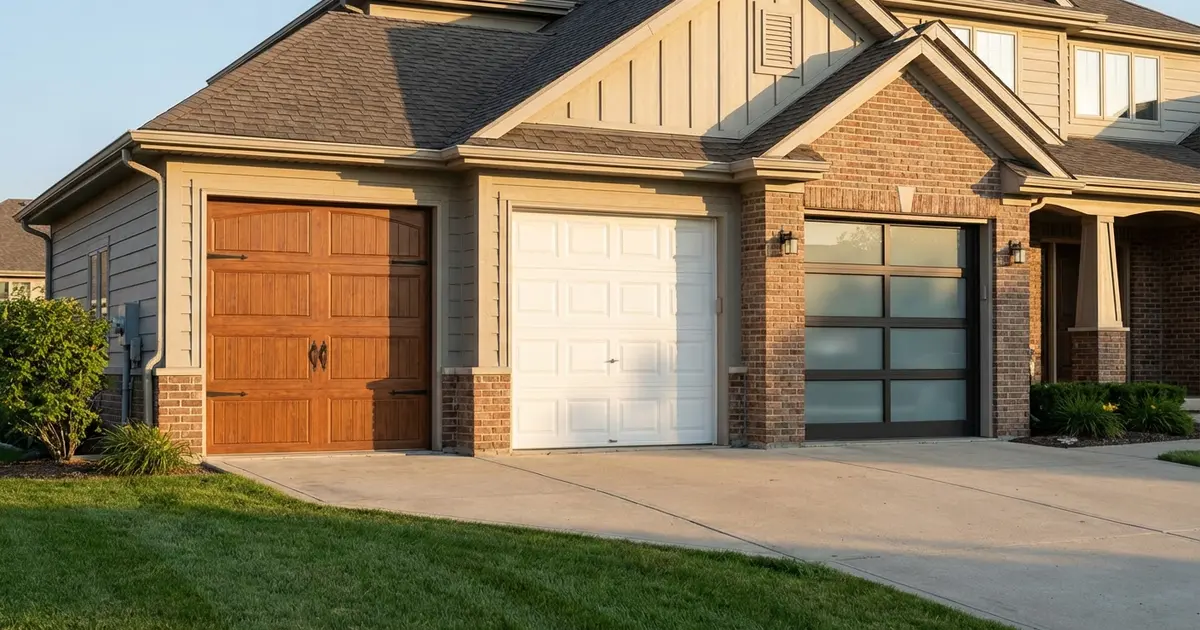
💡 Pro Tip: For most homeowners, steel is the best value. Modern steel with composite overlays closely mimics wood at a fraction of the cost, with zero rot risk and minimal maintenance.
Quick Comparison Overview
| Factor | Steel | Wood | Aluminum |
|---|---|---|---|
| Single-car door cost (installed) | $700–$2,500 | $1,500–$5,000+ | $800–$2,800 |
| Double-car door cost (installed) | $1,000–$4,500 | $2,500–$8,000+ | $1,200–$4,500 |
| Lifespan | 20–30 years | 20–50 years* | 20–30 years |
| Insulation options | Excellent (R-6 to R-32) | Moderate (R-6 to R-16) | Good (R-6 to R-20) |
| Maintenance | Low | High | Very Low |
| Rust resistance | Moderate (treated) | N/A | Excellent |
| Dent resistance | Moderate–Good | Good | Poor |
| Weight | Medium–Heavy | Heavy | Light |
| Design options | Excellent | Excellent | Good (modern styles) |
| Best climate | Most climates | Dry/moderate climates | Coastal/humid climates |
*Wood lifespan is highly dependent on maintenance. Neglected wood doors deteriorate much faster.
Steel Garage Doors
Steel is the dominant garage door material in the US for good reason: it offers the most balanced combination of cost, durability, insulation, and design flexibility of any material available. Walk through any established neighborhood and the majority of garage doors you see are steel.
How Steel Doors Are Made
Steel garage doors consist of multiple panels made from galvanized steel sheet, typically 24–26 gauge. The gauge number is counterintuitive — lower gauge = thicker steel. Common residential specifications:
- 26-gauge steel: Entry-level, thinnest, more prone to denting from impacts (sports equipment, bumper taps, hail)
- 24-gauge steel: The standard for mid-range and better doors — meaningfully thicker and more dent-resistant
- 22-gauge steel: Heavy-duty residential and commercial spec; significantly stiffer and more dent-resistant, higher cost
Insulated steel doors add a layer of polyurethane or polystyrene foam between two steel skins (the "sandwich" construction). Polyurethane provides higher R-values and also structurally bonds the steel skins together, creating a stiffer, quieter panel compared to polystyrene-filled doors.
Steel Door Pros
- Best price-to-performance ratio: Excellent quality available across a wide price range
- Wide design range: Available in dozens of panel styles, hundreds of colors, with realistic wood-grain embossed finishes
- Excellent insulation options: From uninsulated to R-32+, steel accommodates any thermal performance need
- Low maintenance: Factory-painted or powder-coated finish typically lasts 10–15+ years; touch up chips or scratches to prevent rust
- Durable in most climates: Modern galvanized and factory-finished steel resists the elements well in most US regions
- Widely available: Every garage door company stocks and installs steel doors; parts and panels are easy to source for repairs
Steel Door Cons
- Rust risk: Steel can rust, especially at chips, scratches, and bottom edges where moisture collects. Rust ignored for years can cause structural deterioration.
- Denting: 26-gauge steel dents from moderate impacts; hail can leave marks on thinner doors
- Not authentic wood: Even the best embossed steel wood-grain finishes look artificial up close — they fool from 20 feet, not from 5
- Heat conduction: Uninsulated steel doors can significantly affect garage temperature; this is addressed with insulation but adds to cost
Best Applications for Steel
Steel is the right choice for most homes in most climates — particularly homes where the garage door doesn't need to carry the design statement (traditional, transitional, or modern homes where a wood-look door is acceptable), where budget is a real constraint, or where the owner wants a low-maintenance door that holds up for decades with minimal attention.
⚠️ Warning: Wood garage doors require repainting or restaining every 3–5 years in humid climates, or they'll rot, warp, and crack. Factor this ongoing maintenance cost into your decision.
Wood Garage Doors
Wood garage doors represent the premium end of the residential market — both in cost and in authentic appearance. If you've seen a stunning craftsman home with a carriage-house-style garage door and thought "that can't be a steel door," you were probably right.
Types of Wood Used
Not all wood garage doors use the same materials. Common species and their characteristics:
- Cedar: The most popular choice — naturally rot-resistant, dimensionally stable, takes stain beautifully, lighter weight than many alternatives. Widely available from premium door manufacturers.
- Redwood: Similar properties to cedar, excellent natural weather resistance, higher cost and less widely available
- Fir / Douglas Fir: Dense, strong, holds paint and stain well. Common for painted applications. Less rot-resistant than cedar/redwood if finish fails.
- Hemlock / Meranti: More economical wood door options; less rot-resistant, require more diligent finish maintenance
Solid Wood vs Wood Frame with Overlay
True custom wood garage doors are often built as a frame-and-panel construction (similar to interior doors): a structural wood frame with floating wood panels that allow for wood movement. This construction is more stable than solid planks. Less expensive "wood" doors may use a steel or aluminum frame with a wood overlay veneer — these have lower maintenance needs but don't have the weight and feel of solid wood construction.
Wood Door Pros
- Unmatched authentic appearance: The genuine warmth, grain, and character of real wood is impossible to replicate in other materials — particularly important for craftsman, colonial, Tudor, and other traditional styles
- Complete customization: Can be built to any size, style, and finish; no "standard size" constraints
- Natural insulation: Wood has inherent thermal mass; while not as quantifiable as foam-core steel, solid wood doors have reasonable insulating properties
- Repairable: Dents and dings can be filled and refinished; damaged panels can be replaced with new wood matched to the original
- Prestige and resale on appropriate homes: On a high-end home where authenticity matters, real wood is an asset
Wood Door Cons
- High maintenance: Requires repainting or restaining every 2–4 years in most climates — more frequently in wet, humid, or UV-intense environments. Skip a refinishing cycle and the door will show deterioration quickly.
- Warping and swelling: Wood moves with humidity changes — doors may bind in summer humidity or develop gaps in dry winter air, requiring adjustments over time
- Weight: Real wood doors are heavy — often 50–100% heavier than a comparable steel door. This requires heavier-duty springs and hardware, which affects opener choice and maintenance costs.
- High cost: Premium cedar or redwood doors from quality manufacturers start around $1,500–$2,500 for a single-car door (door only, before installation)
- Not ideal for humid or coastal climates: High humidity, frequent rain, and salt air dramatically accelerate wood deterioration unless maintained fastidiously
Best Applications for Wood
Wood is the right choice for homeowners with traditional or craftsman-style homes where the garage door is a significant design element, who live in moderate climates (not coastal, not extremely humid), who are committed to maintenance, and who have the budget for both the premium purchase price and ongoing refinishing costs.
Aluminum Garage Doors
Aluminum garage doors occupy an interesting position in the market: they're the material of choice for modern/contemporary home designs and for coastal environments where corrosion resistance is essential. Outside of those two scenarios, aluminum sees less use — but in its sweet spots, nothing else matches it.
How Aluminum Doors Are Made
Residential aluminum garage doors are typically made from extruded or roll-formed aluminum sections. The aluminum is naturally corrosion-resistant and is usually anodized, powder-coated, or finished in clear-coat to enhance appearance and durability. Many modern aluminum doors incorporate glass panels — frameless tempered glass, frosted glass, or other glazing options — which is one of aluminum's signature design advantages.
Aluminum Door Pros
- Excellent corrosion resistance: Aluminum doesn't rust — period. In coastal environments, this is a decisive advantage over steel.
- Lightweight: Aluminum doors weigh significantly less than steel or wood, reducing stress on springs, hardware, and opener mechanisms
- Modern aesthetic: Aluminum (especially with glass panels) is the preferred material for contemporary, industrial, and minimalist home designs where steel's traditional panel look doesn't fit
- Very low maintenance: No painting required in most cases; periodic cleaning and inspection of any glazing seals
- Glass options: Aluminum frames readily accommodate glass panels in a variety of styles — full-view frosted glass, divided lites, obscure glass for privacy while admitting light
- Recyclable: Aluminum is one of the most recyclable construction materials; a small advantage for sustainability-focused buyers
Aluminum Door Cons
- Dents easily: Aluminum is softer than steel — it dents from relatively minor impacts (sports equipment, backing in slightly too far, hail). Dented aluminum panels are also harder to repair than steel; they typically need replacement.
- More expensive than comparable steel: For equivalent size and insulation levels, aluminum doors typically cost 10–30% more than steel
- Limited insulation in glass-heavy designs: Full-view glass doors (very popular in aluminum) have inherently limited insulation — glass panels have low R-values regardless of framing material
- Can oxidize in coastal environments: While aluminum doesn't rust, it can develop surface oxidation and chalking over time in high-salt air environments if the finish isn't maintained
- Fewer design options for traditional styles: Aluminum's strength lies in contemporary looks; it's less natural for traditional panel-and-rail designs
Best Applications for Aluminum
Aluminum is the clear choice for: (1) coastal homes where salt air corrosion is a real threat to steel, (2) contemporary or modern homes where the aluminum-and-glass aesthetic fits the design language, and (3) buyers who prioritize ultra-low maintenance over everything else.
Wood Composite: The Practical Middle Ground
Worth discussing separately: wood composite garage doors use a combination of wood fiber and polymer resin to create panels that look more like real wood than embossed steel, but require significantly less maintenance than solid wood.
How Wood Composite Differs
Wood composite doors are made from a blend of wood fibers (often recycled wood waste) and thermoplastic resins, pressed or molded into panels. The result looks like painted or stained wood from a normal viewing distance — more convincingly than embossed steel — but doesn't absorb moisture, doesn't warp, and doesn't require the frequent refinishing that solid wood demands.
Wood Composite Pros and Cons
- ✅ Better wood appearance than embossed steel
- ✅ No warping or swelling with humidity changes
- ✅ Less frequent refinishing than solid wood (every 5–8 years vs 2–4)
- ✅ Can be painted or stained in any color
- ✅ Less expensive than solid wood (typically 30–50% less)
- ❌ Doesn't replicate the authentic grain and weight of real wood
- ❌ More expensive than steel
- ❌ Less widely available; fewer manufacturers offer high-quality composite options
Wood composite occupies a niche between steel and solid wood that appeals to homeowners who want more authenticity than embossed steel offers but don't want the maintenance burden of real wood. It's particularly relevant for traditional-style homes in humid climates where solid wood would deteriorate quickly.
Full Cost Comparison
Door-Only Costs (Before Installation)
| Material / Tier | Single-Car (9x7) | Double-Car (16x7) |
|---|---|---|
| Steel — entry level (non-insulated, 26-gauge) | $400–$700 | $600–$1,200 |
| Steel — mid-range (insulated, 24-gauge) | $700–$1,400 | $1,000–$2,200 |
| Steel — premium (insulated, wood-look, 24-gauge) | $1,200–$2,500 | $1,800–$4,000 |
| Aluminum — standard | $600–$1,200 | $900–$2,000 |
| Aluminum — full-view glass (premium) | $1,500–$3,000 | $2,200–$5,000 |
| Wood composite | $900–$2,000 | $1,400–$3,200 |
| Wood — standard (hemlock/fir) | $1,200–$2,500 | $1,800–$4,000 |
| Wood — premium (cedar, custom) | $2,000–$5,000+ | $3,000–$9,000+ |
Installed Costs (Door + Labor)
Professional installation typically adds $250–$500 for a straightforward replacement on a standard-size door. Non-standard sizes, new opener installation, or structural work adds to this. Total installed costs:
| Material / Tier | Single-Car Installed | Double-Car Installed |
|---|---|---|
| Steel — entry level | $650–$1,200 | $850–$1,700 |
| Steel — mid-range insulated | $950–$1,900 | $1,300–$2,700 |
| Steel — premium | $1,450–$3,000 | $2,000–$4,500 |
| Aluminum — standard | $850–$1,700 | $1,150–$2,500 |
| Aluminum — full-view glass | $1,750–$3,500 | $2,500–$5,500 |
| Wood (standard species) | $1,450–$3,000 | $2,100–$4,500 |
| Wood (premium/custom) | $2,300–$5,500+ | $3,300–$9,500+ |
Regional Installation Cost Variations
| Region | Installation Labor Premium/Discount |
|---|---|
| Northeast / Mid-Atlantic (NY, NJ, MA, DC) | +15–30% above national average |
| West Coast (CA, WA, OR) | +10–25% above national average |
| Southeast (FL, GA, NC, SC) | At or slightly below national average |
| South Central (TX, LA, AR, OK) | 5–15% below national average |
| Midwest (IL, OH, MI, IN) | At national average |
| Mountain (CO, UT, AZ, NV) | At or slightly above national average |
Lifetime Cost Comparison
Initial cost is only part of the picture. Here's a rough 20-year cost of ownership comparison for a double-car door:
| Cost Component | Mid-Range Steel | Premium Wood (Cedar) | Standard Aluminum |
|---|---|---|---|
| Initial installed cost | $1,800 | $4,500 | $2,000 |
| Maintenance over 20 years | $200–$400 | $1,500–$3,000 | $100–$200 |
| Typical repairs over 20 years | $300–$600 | $500–$1,000 | $400–$800* |
| Estimated 20-year total | $2,300–$2,800 | $6,500–$8,500 | $2,500–$3,000 |
*Aluminum denting from impacts can require panel replacement that costs more than comparable steel repair.
Insulation and R-Values by Material
The R-value measures resistance to heat flow — higher is better for keeping garages temperate. Here's what each material offers:
Steel Insulation Options
Steel doors offer the widest range of insulation options:
- Non-insulated: R-0 (just the steel skin)
- Single-layer polystyrene: R-4 to R-6
- Polystyrene sandwich (two-layer steel): R-8 to R-14
- Polyurethane foam-core (two-layer steel): R-12 to R-18 (most popular mid-range)
- Premium polyurethane: R-18 to R-32 (highest performance residential)
The key difference between polystyrene and polyurethane: polyurethane bonds to both steel skins, creating a structurally reinforced panel that's stiffer and quieter. Polystyrene fills the space but doesn't bond, making the panel slightly less rigid. For attached garages, polyurethane foam core is worth the modest premium.
Wood Insulation
Solid wood has natural insulating properties — the R-value of wood itself is approximately R-1 per inch. A 2-inch thick solid wood door panel provides roughly R-2 intrinsically. Custom wood doors can be built with foam cores between wood skins to achieve R-8 to R-16, but this is less common and adds significant cost. Most standard wood doors provide R-4 to R-8 depending on construction.
Aluminum Insulation
Aluminum itself has very low insulating properties — it's a metal and an efficient heat conductor. However, insulated aluminum doors (foam-core construction) achieve R-6 to R-20 depending on foam thickness. The challenge: full-view aluminum/glass doors are popular, and glass panels dramatically reduce effective R-value. A door that's 60% glass with an R-20 aluminum frame may have an effective whole-door R-value of only R-4 to R-6. If insulation is a priority, choose a style with more panel area and less glass.
For a deeper dive on garage door insulation, R-values, and whether the investment pays off in energy savings, see our complete garage door insulation guide.
Durability by Climate
| Climate Type | Best Material | Avoid | Notes |
|---|---|---|---|
| Coastal / Salt Air (FL, Gulf Coast, Pacific Coast) | Aluminum | Steel (rusts faster) | Aluminum's corrosion resistance is a decisive advantage |
| High Humidity (SE US, Gulf states) | Steel or Aluminum | Wood | Wood deteriorates rapidly; finish maintenance becomes burdensome |
| Hot / Dry (AZ, NV, NM) | Insulated Steel | Wood (lower concern) | UV fading is the main issue; factory finishes hold well. Insulation matters for comfort |
| Cold / Northern (MN, WI, ND, northern ME) | Insulated Steel (polyurethane) | Non-insulated any material | Thermal performance matters most; R-16+ recommended for attached garages |
| Moderate / Temperate (Pacific NW, mid-Atlantic) | Steel or Wood | No strong exclusion | Wood performs well here with proper maintenance |
| High Wind / Hurricane Zone (FL, TX coast) | Steel (hurricane-rated) | Standard aluminum | Hurricane-rated steel doors available; aluminum dents easily in debris impact |
| Hail-Prone (Midwest, Southern Plains) | 24-gauge+ Steel | Thin aluminum | Thicker steel gauge resists hail dimpling; aluminum dents readily |
Maintenance Requirements by Material
Steel Maintenance
- Annual: Inspect finish for chips and scratches; touch up immediately with matching paint to prevent rust
- Every 6 months: Lubricate hinges, rollers, and springs (all materials share this need)
- Every 5–10 years: Full repaint if finish is deteriorating; check weather seals
- Special watch: Bottom of door panels — water and road salt splash collect here. Keep clean and inspect for rust formation annually.
Wood Maintenance
- Every 6 months: Lubricate hardware, inspect finish for checking or peeling
- Every 2–4 years: Full refinishing — sand, clean, re-stain or repaint. In humid climates or direct sun, every 2 years is realistic. Skip this and wood will check, peel, and begin to absorb moisture.
- Annually: Inspect for soft spots (rot), warping, panel gaps. Treat any soft spots immediately with wood hardener and appropriate filler.
- After wet seasons: Check that the door still operates freely — wood may swell in humid conditions and require spring tension adjustment
Aluminum Maintenance
- Every 6 months: Lubricate hardware, clean glass panels (if applicable)
- Annually: Inspect powder coat or anodized finish for chips; touch up as needed
- In coastal environments: Rinse door with fresh water quarterly to remove salt buildup; inspect for oxidation on unfinished surfaces
- Glass maintenance: Inspect glass panel seals every few years for condensation forming between panes (double-pane glass), which indicates failed seals
Maintenance Cost Summary (20-Year Estimate, Double-Car Door)
| Maintenance Task | Steel | Wood | Aluminum |
|---|---|---|---|
| Lubrication supplies (20 years) | $60–$120 | $60–$120 | $60–$120 |
| Refinishing / repainting | $100–$300 (once) | $800–$2,000 (5x over 20 years) | $0–$100 |
| Panel repairs (weather/impact) | $100–$300 | $200–$600 | $200–$500 |
| Weather seals / hardware | $50–$150 | $50–$200 | $50–$150 |
| Total 20-year maintenance est. | $310–$870 | $1,110–$2,920 | $310–$870 |
Curb Appeal and Resale Value
Garage doors are one of the most visible features of a home's exterior — the garage door can occupy 30–40% of a front facade on a typical suburban home. The choice of material, style, and color has a real impact on curb appeal and, by extension, resale value.
What the Data Shows
According to Remodeling Magazine's annual Cost vs. Value report, garage door replacement consistently ranks as one of the top home improvement projects by return on investment, typically returning 90–100% of project cost in added resale value. This figure applies to mid-range steel door replacements on homes where the existing door is aged or damaged.
For premium wood doors on appropriate high-end homes, the ROI calculation is less straightforward — a $5,000 custom wood door on a $400,000 home doesn't necessarily generate $5,000 in added value, but it contributes to an overall impression of quality that helps at sale time. The conventional wisdom: don't spend more on the garage door than the design and price bracket of the home supports.
Style Matching by Home Type
| Home Architectural Style | Best Material Match | Notes |
|---|---|---|
| Traditional / Colonial | Steel (wood-look) or real wood | Raised-panel or carriage-house style; classic colors |
| Craftsman / Bungalow | Real wood or wood composite | Wood is most authentic; steel wood-look acceptable |
| Contemporary / Modern | Aluminum (with glass) or smooth steel | Full-view glass aluminum is the signature modern choice |
| Ranch / Mid-century | Steel or aluminum | Clean lines; flush or ribbed steel panels work well |
| Mediterranean / Spanish | Steel (stucco-look or wood-tone) or wood | Arched designs available in custom wood; carved-look steel panels |
| Farmhouse | Steel (board-and-batten style) or wood | Horizontal plank or barn-door styles; white or black are classic |
Which Material Is Right for You?
Choose Steel If:
- You want the best value for the money — excellent quality available from $700 to $3,000+ installed
- You live in a climate with significant humidity, hail risk, or temperature extremes
- Low maintenance is important to you — steel requires minimal attention over its life
- You want good insulation options — steel offers the widest R-value range
- Your home is traditional, colonial, craftsman, or contemporary (steel accommodates all styles)
- You need hurricane-rated or high-wind performance (available in heavy-gauge steel)
Choose Wood If:
- Authentic appearance is the top priority and no other material will do for your home's design
- You're willing and able to refinish the door every 2–4 years
- You live in a moderate, relatively dry climate (Pacific Northwest with roof protection, Mountain West, etc.)
- Budget is not a constraint — the premium is significant and justified by your priorities
- You want complete custom sizing, design, and finish options
Choose Aluminum If:
- You live in a coastal environment where steel's rust vulnerability is a real concern
- Your home has a contemporary or modern design that calls for the aluminum-and-glass aesthetic
- Rust-free, ultra-low maintenance is the top priority
- You want full-view glass panels — this is aluminum's design signature
- The door is in a location with low impact risk (low hail, no backing-in mishaps)
Consider Wood Composite If:
- You want better wood appearance than embossed steel but less maintenance than real wood
- You live in a humid climate where real wood would require very frequent refinishing
- Your budget is between steel and premium wood pricing
For related buying guidance, see our smart garage door openers guide and our best garage door brands comparison.
DIY vs Professional Installation
⚠️ Why Garage Door Installation Is Not a Standard DIY Project
Unlike many home improvement tasks, garage door installation carries real safety risk if done incorrectly. The reason: torsion springs (used on most modern doors) are under enormous tension — enough to cause serious injury if released incorrectly or if the spring is improperly sized for the door's weight. A wood door that's 50 lbs heavier than the steel door it's replacing needs different springs; installing the wrong spring tension creates a safety hazard and accelerates wear on every component.
Additionally, the track geometry must be precisely set to match the door's specifications, and the spring tension must be calibrated to the door's exact weight. Both of these tasks require experience and the right tools.
When DIY Replacement Is Feasible
Experienced DIYers with prior garage door experience can install a door in 3–6 hours. The key requirement: you must correctly size and install the springs (or use low-tension extension springs in a safe configuration). If you're not confident in spring sizing and installation, hire a professional for the complete job.
Professional Installation Cost
Labor for a standard replacement installation: $250–$500 for a single-car door, $350–$700 for a double-car door. This typically includes removal of the old door, installation of the new door with springs, and a final balance and safety test. Non-standard sizes, new opener installation, or any structural work adds to the cost.
For complete pricing guidance including regional breakdowns and what to look for when choosing an installer, see our garage door cost guide and our guide on how to choose a garage door company.
Find a Garage Door Installation Pro Near You
Ready to replace your garage door? Local professionals can help you select the right material for your climate and home style, provide accurate quotes, and handle the installation safely.
- Find trusted garage door pros in Miami
- Find trusted garage door pros in Seattle
- Find trusted garage door pros in Dallas
- Find trusted garage door pros in Los Angeles
- Find trusted garage door pros in Minneapolis
Or browse all cities to find installers in your area.
Frequently Asked Questions
Which garage door material is most popular?
Steel is by far the most popular garage door material in the United States, accounting for roughly 80–85% of new residential garage door installations. Steel dominates for several reasons: it offers the best combination of durability, insulation options, low maintenance, design flexibility, and price across the widest range of budgets. Entry-level steel doors start around $400–$600, while premium insulated steel doors with realistic wood-grain embossing can reach $2,500–$4,500 installed — covering the full spectrum from budget to high-end. Aluminum is the second choice, particularly favored in coastal markets and for modern/contemporary home styles. Wood represents a small percentage of new installations but commands a loyal following among homeowners who prioritize authentic appearance and are willing to pay the premium in both purchase price and ongoing maintenance.
How long does each garage door material last?
Steel garage doors typically last 20–30 years with proper maintenance (painting every 5–7 years, prompt rust treatment if needed). Higher-quality steel with factory-applied galvanized coating can exceed 30 years. Aluminum doors last 20–30 years in most climates; they don't rust, but they can oxidize and the finish may require periodic treatment in coastal environments. Wood garage doors have the most variable lifespan: a well-maintained solid wood door can last 30–50 years, but a neglected wood door can deteriorate significantly within 10–15 years. Wood requires the most active maintenance — repainting or restaining every 2–4 years depending on climate and sun exposure. Wood composite (a wood-fiber and resin product) sits between solid wood and steel in terms of maintenance needs, typically lasting 20–30 years. In any material, quality of installation and quality of the specific product matter as much as material choice.
Is a wood garage door worth the extra cost?
For the right homeowner, yes. Wood delivers an authentic, high-end appearance that no other material fully replicates — particularly important if you have a craftsman-style, colonial, or other traditional home where a steel door with wood-grain embossing simply doesn't look right up close. Real wood also allows for complete customization of size, style, and stain/paint color. The counterarguments are real, though: solid wood doors cost 2–4x more than comparable steel, require repainting or restaining every 2–4 years, are more susceptible to warping in humid climates, and cost more to repair when panels are damaged. Wood composite is a practical middle ground — it looks closer to real wood than embossed steel but requires less maintenance than solid wood. Honest assessment: if you're asking whether wood is worth it primarily on resale value grounds, the answer is generally no — the resale premium rarely covers the cost premium. But if you genuinely love the look and are committed to the maintenance, a solid wood door on the right house is a beautiful, durable choice.
What is the best garage door material for a coastal home?
Aluminum is generally the best choice for coastal environments. The primary threat in coastal areas is salt air corrosion: steel, even galvanized steel, can rust significantly faster in high-salt environments, especially if the finish is scratched or chips develop over time. Aluminum is naturally corrosion-resistant because it forms a stable oxide layer that prevents further oxidation. This is why aluminum is the material of choice for coastal construction in Florida, the Gulf Coast, and Pacific coastal markets. Wood is a poor choice for coastal environments: high humidity and salt air accelerate wood deterioration and paint/finish breakdown, dramatically increasing maintenance frequency. If you want a steel door in a coastal area, look specifically for marine-grade or coastal-climate steel doors with thicker galvanizing and high-quality factory finishes, and commit to annual inspection and prompt touch-up of any scratches.
What R-value should I look for in a garage door?
The right R-value depends on how your garage is used and your climate. For an unheated, unattached garage used primarily for storage: R-6 to R-9 is adequate — basic insulation reduces temperature swings and makes the garage more comfortable to work in occasionally. For an attached garage (shares a wall with living space): R-12 to R-18 is the standard recommendation — the garage wall insulation matters more, but a well-insulated door contributes meaningfully. For a conditioned garage (heated and/or cooled): R-16 to R-32 for maximum efficiency — this is where premium insulated steel doors or high-R-value aluminum doors earn their keep. An important note: the door's R-value is just one component of the garage's thermal envelope. An R-18 door in a garage with a poorly insulated ceiling or air gaps around the door frame may perform worse than an R-10 door in an otherwise well-sealed garage. Weatherstripping and proper sealing around the door frame often matters as much as the door's rated R-value.
Can I replace just one panel of my garage door, or do I need to replace the whole door?
Panel replacement is possible and often cost-effective for isolated damage (one dented or cracked panel). However, it's only feasible if: (1) the same manufacturer and model is still available — panel dimensions and profile must match exactly, and older or discontinued models may be impossible to source; (2) the damage is limited to one or two panels — replacing 3+ panels typically costs nearly as much as a new door; (3) the existing door structure and hardware are in good condition. A single-panel replacement typically costs $200–$600 for parts plus $100–$200 labor, compared to $700–$1,500+ for a complete single-car door replacement installed. The color match is also a consideration: a new replacement panel may not perfectly match the weathered color of surrounding panels, especially on older doors. Ask your garage door company to bring a panel sample before committing to a panel-only repair. See our full panel replacement guide for more detail.
How much does garage door installation cost beyond the door itself?
Professional installation typically adds $200–$500 on top of the door cost for a standard residential replacement (removing old door and hardware, installing new door and springs, connecting opener). More complex installations cost more: non-standard sizes or high-lift configurations add $100–$300; new opener installation adds $250–$600; new tracks or structural framing work adds variable costs. When comparing installer quotes, always clarify what's included: some quotes include door removal and haul-away; some don't. The total installed cost for a single-car door ranges from roughly $700 (basic steel, simple installation) to $4,000+ (premium wood or high-end insulated steel, complex installation). For complete pricing details including regional breakdowns, see our garage door cost guide.