How to Measure a Garage Door for Replacement
Ordering the wrong size garage door is an expensive mistake. A door that's 2 inches too wide won't fit in the opening. A door that's too tall needs structural modification. An opener with a long rail won't work in a garage with insufficient backroom. And a non-standard size means a custom order, adding weeks and hundreds of dollars to the project.
The good news: measuring correctly takes about 20 minutes and requires nothing more than a tape measure, a pencil, and this guide. There are six measurements you need — width, height, headroom, side room, backroom, and floor levelness. Get all six right and your replacement door project starts on solid ground.
This guide covers standard residential sectional garage doors (the most common type in US homes). If you have a one-piece tilt-up door, roll-up door, or a custom architectural door, some measurements differ — consult the door manufacturer's specifications directly.
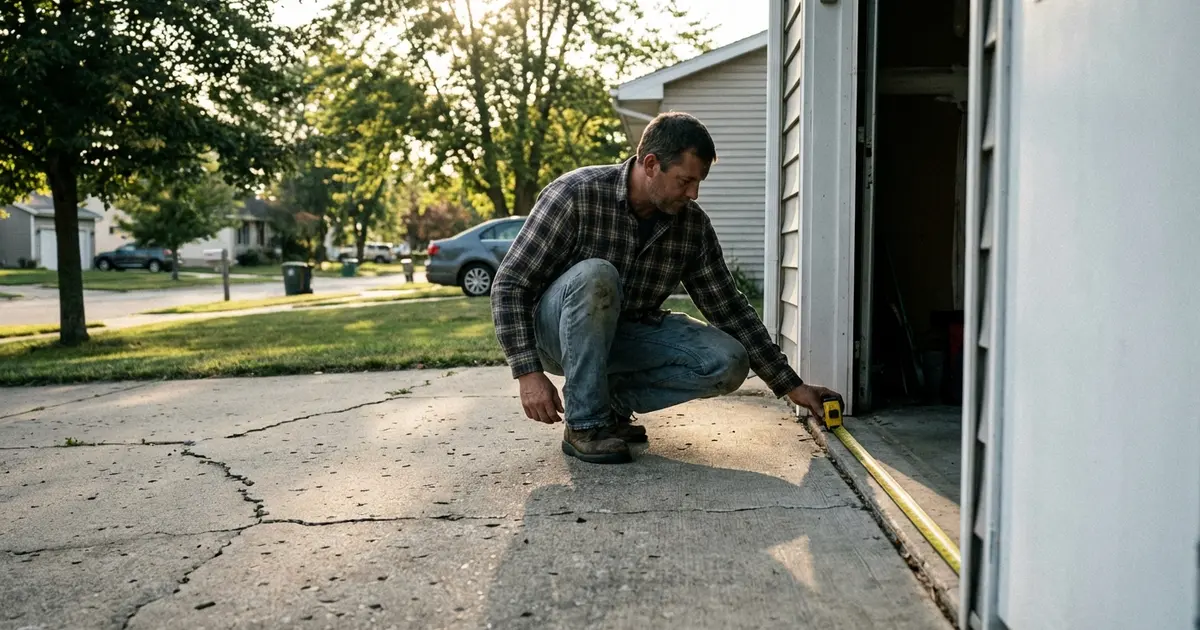
💡 Pro Tip: Always measure the rough opening (the actual hole in the wall), not the existing door. Measure width, height, headroom, and side room three times each — once is never enough for a $1,500+ purchase.
What You'll Need
- A 25-foot tape measure (a 12-foot tape won't reach across a 16-foot opening)
- A pencil and paper or your phone to record measurements
- A level (optional but useful for checking floor levelness)
- A step ladder if your ceiling is high and you need to measure headroom
- A helper for holding the far end of the tape across wide openings (helpful but not strictly required — you can hook the tape end on the door frame)
Measure twice, record once. Take each measurement twice before writing it down. For any measurement where the two attempts differ by more than 1/4 inch, take a third measurement and use the median value. Small errors in measurement translate to ordering problems that cost real money to fix.
✅ Key Takeaway: The six measurements you need: opening width, opening height, headroom, side room (left and right), and backroom (depth). Miss any one of these and the door or opener may not fit.
The Six Critical Measurements
Every garage door replacement project requires these six measurements. Don't skip any of them — each serves a specific purpose in verifying the door will fit and the opener will function correctly.
- Opening Width — determines the door width you'll order
- Opening Height — determines the door height you'll order
- Headroom — determines if a standard opener rail will fit; affects track configuration
- Side Room — determines if standard vertical track sections will fit
- Backroom — determines if the door can fully open horizontally within the garage
- Floor Levelness — affects weatherstripping seal and whether shims are needed
Measurement 1: Opening Width
What to Measure
Measure the width of the garage door opening — the empty space between the two vertical jamb boards (or masonry sides) of the opening. This is the rough opening width.
How to Measure
- Stand inside the garage facing the door opening
- Measure at three heights: near the floor, at mid-height, and near the top of the opening
- Record all three measurements
- The smallest measurement is your effective width (the door must fit through the narrowest point)
What to Look For
Plumb check: If your three measurements differ by more than 1/2 inch, your opening sides aren't perfectly plumb. This is common in older homes where the framing has shifted. Note this — your installer will need to account for it with shims or framing adjustments.
Jamb boards: Some garages have wide jamb boards (2x6 or wider) on the sides of the opening. Measure from the inside edge of one jamb to the inside edge of the other — that's the rough opening. Don't measure the outside of the framing or include the jamb board thickness.
Recording Your Measurement
Write it down to the nearest 1/8 inch. Example: Opening Width = 15' 11-3/4"
In most cases, this will match a standard door size (see the standard sizes table below). A measurement of 15'11-3/4" → order a 16'0" door. The 1/4 inch of clearance on each side is filled by the vertical track and weatherstripping.
Measurement 2: Opening Height
What to Measure
Measure from the floor to the top of the opening — the underside of the horizontal framing member (header) above the door.
How to Measure
- Stand at the center of the opening
- Measure straight up from the finished floor surface to the bottom edge of the header above the opening
- Repeat at the left side and the right side of the opening
- Record the smallest of the three measurements
Floor to Header, Not Ceiling
The header — the structural beam above the door opening — is what limits the door height, not the ceiling. The garage ceiling is typically several inches above the header. The door must fit within the opening framed by the header, not the full ceiling height.
What if the Floor Isn't Level?
If one side of the opening measures 7'1" and the other measures 6'11", you have a 2-inch level difference across the opening. In this case, measure from the lowest floor point. The door is installed level (you'll shim the low side or adjust the threshold), and you need the door to clear the floor at its lowest point. More on floor levelness in measurement 6.
Recording Your Measurement
Write it down to the nearest 1/8 inch. Example: Opening Height = 6'10-1/2"
This would lead you to order a 7'0" door — there's typically 1–2 inches of clearance between the floor and the bottom of the door panel that the bottom weatherseal fills.
Measurement 3: Headroom
Headroom is the distance from the top of the door opening (the underside of the header) to the ceiling above. It's the vertical space in which the garage door's horizontal tracks, the curved transition section, and the opener rail must all fit.
How to Measure
- Stand inside the garage at the center of the opening
- Measure from the underside of the header straight up to the ceiling (or to the lowest overhead obstruction — beams, ductwork, pipes)
- Record this measurement
Minimum Headroom Requirements
| Configuration | Minimum Headroom Required |
|---|---|
| Standard track (no opener) | 10–12 inches |
| Standard track + ceiling-mounted opener | 12–15 inches |
| Low-headroom track kit | 3–4 inches minimum (no opener) |
| Low-headroom track + jackshaft opener | 3–4 inches (opener mounts on wall, not ceiling) |
| High-lift track (for tall vehicles) | Varies by lift height — consult manufacturer |
What If You Don't Have Enough Headroom?
If your headroom is less than 10 inches:
- Low-headroom track kit: Most door manufacturers offer low-headroom track alternatives that use a different cable drum and back-hang bracket system to function with 3–4 inches of clearance. These cost $50–$150 more than standard track. Compatible with ceiling-mounted openers if you have at least 3 inches above the opener rail.
- Jackshaft opener: A wall-mounted jackshaft opener eliminates the ceiling rail entirely. If your opener is the limiting factor (not the track itself), a jackshaft opener solves the headroom problem while actually improving operation quality.
- Structural modification: In rare cases where neither option is practical, the header can be raised — but this is a major construction project ($1,500–$5,000+) and rarely the right call for a residential garage door replacement.
Obstructions
Even if you have adequate raw ceiling height, check for obstructions in the overhead space: ductwork, pipes, electrical conduit, storage shelves, beams. The garage door's horizontal track runs about 12 inches below the ceiling across the full depth of the garage. Any obstructions in this zone need to be relocated before installation.
Measurement 4: Side Room
Side room is the horizontal distance from the edge of the door opening (the door jamb) to the nearest wall or obstruction on each side of the door. The vertical track sections must fit in this space.
How to Measure
- On each side of the opening, measure from the edge of the jamb (or the inside edge of the masonry) horizontally to the nearest wall, column, or obstruction
- Record left side and right side separately — they may differ
Minimum Side Room Requirements
| Configuration | Minimum Side Room (each side) |
|---|---|
| Standard vertical tracks | 3.5 inches |
| Low-headroom track kit | 5–6 inches (wider track bracket) |
| With weather seal on sides | 3.75 inches (seal adds ~1/4 inch) |
Most garages have adequate side room — 3.5 inches is not much space. Problems arise in garages with columns, walls, or utility installations very close to the door opening. If you have less than 3.5 inches on one side, your installer needs to know before purchase.
Service Access
Beyond the minimum for track installation, consider practical service access. The springs, cables, and end brackets on each side of the door require a technician to reach them periodically. If one side of the door is very close to a wall (less than 18 inches of walking clearance), servicing that side of the door becomes difficult. This rarely changes the door choice, but it's worth noting for future maintenance planning.
Measurement 5: Backroom
Backroom is the horizontal depth of your garage from the front wall (where the door is) to the back wall or the first obstruction (water heater, shelves, car, etc.) directly inside the door.
How to Measure
- Stand inside the garage with your back to the closed door
- Measure straight back from the inside face of the closed door to the back wall or to the nearest obstruction that cannot be moved (water heater, built-in shelving, etc.)
- Also measure ceiling clearance along this path for any obstructions that drop below the ceiling
Minimum Backroom Requirements
When a sectional garage door opens, the panels travel along the vertical tracks, curve through the transition radius, and then travel horizontally along the ceiling tracks. The horizontal run of panels equals the height of the door. Add the horizontal track sections and opener rail beyond the panels, and you need:
| Door Height | Minimum Backroom (no opener) | Minimum Backroom (with opener) |
|---|---|---|
| 7 feet | 8 feet 6 inches | 10 feet 6 inches |
| 8 feet | 9 feet 6 inches | 11 feet 6 inches |
| 9 feet | 10 feet 6 inches | 12 feet 6 inches |
| 10 feet | 11 feet 6 inches | 13 feet 6 inches |
Most standard single-car and double-car garages have 20–24 feet of depth, so backroom is not a constraint. It becomes relevant in short garages, converted carports, or when someone wants to add an opener in a space that was originally designed without one.
If You Don't Have Enough Backroom
- Horizontal track sections can be cut shorter in some configurations, but this reduces door clearance at the back and may not be compatible with all openers
- A jackshaft opener uses slightly less backroom than a ceiling-mounted opener since there's no opener rail extending beyond the track end
- Vertical lift or high-lift tracks keep the door more vertical when open, trading backroom for additional headroom — useful in garages with high ceilings but limited depth
- A smaller door height (7 feet instead of 8 feet) reduces the backroom requirement by 1 foot
Measurement 6: Floor Levelness
The floor across the full width of the garage door opening should be level — or close to it. An unlevel floor affects how the bottom weatherseal contacts the floor and whether the door closes evenly.
How to Measure
- Place a long level (4-foot or longer is ideal) or a straight 2x4 with a regular level on top of it across the full width of the door opening on the floor
- Note how much the floor deviates from level across the opening
- Alternatively, measure the floor-to-header height at the left jamb and the right jamb and compare — a difference indicates floor slope
What's Acceptable
- Under 1/2 inch across the full width: No action needed — standard bottom weatherseal handles this variation
- 1/2 to 1 inch: An adjustable bottom seal or threshold seal can compensate; note this for your installer
- Over 1 inch: The door will not seal well on the low side; a concrete threshold or ramp may be needed; some cases require shimming the low side of the door frame
Sloped Driveways
Some garages, particularly in hilly areas or with sloped driveways, have a floor that slopes significantly toward the door (for drainage). This is a different issue than side-to-side unlevel — it means the door's bottom panel, when closed, is contacting the floor at an angle rather than flat. In most cases, the bottom weatherseal is flexible enough to accommodate modest forward slopes. Steep slopes may require a custom threshold or angled bottom seal.
Standard Garage Door Sizes
Compare your measured opening dimensions to these standard sizes. If your measurements fall within 1–2 inches of a standard size, a standard door will fit your opening. If not, you're in custom door territory.
| Width × Height | Door Type | Fits |
|---|---|---|
| 8'0" × 7'0" | Single car – narrow, older homes | Compact cars, sedans |
| 9'0" × 7'0" | Single car – standard | Most cars, small SUVs |
| 9'0" × 8'0" | Single car – tall, modern homes | SUVs, minivans, light trucks |
| 10'0" × 7'0" | Single car – wide | Large SUVs, pickups (width) |
| 10'0" × 8'0" | Single car – wide + tall | Full-size pickups, SUVs |
| 16'0" × 7'0" | Double car – standard, pre-2000 | Two standard cars |
| 16'0" × 8'0" | Double car – modern standard | Two cars or SUVs |
| 18'0" × 7'0" | Double car – wide | Two vehicles with room to spare |
| 18'0" × 8'0" | Double car – wide + tall | Two full-size trucks or SUVs |
Non-Standard Sizes and Custom Doors
If your opening doesn't match a standard size:
- Small variations (under 2 inches): Most manufacturers can produce doors in 1-inch increments between standard sizes for a modest premium ($50–$150 over list price for the closest standard size)
- Larger variations: Custom doors (non-standard width or height) are available from most manufacturers but require a 2–4 week lead time and typically cost $200–$600 more than comparable standard-sized doors
- Matching existing panel style: If you're replacing just some panels (panel replacement, not full door replacement), your panels must match the original door's section height and style. Take photos and note the brand and model of your existing door — custom panel replacements are matched to the original door specs
Measuring With the Old Door Still in Place
You don't need to remove the old door to get your measurements. Here's how to measure each dimension without removing anything:
Width
Measure the width of the existing door panels (not the opening) from the outside edge of the left panel to the outside edge of the right panel. Take this measurement at three heights. This gives you the door size, which should equal the opening width — because the door was sized to fit the opening when it was originally installed.
Height
Measure the existing door panels from the bottom edge (at floor level) to the top of the top panel. This is the door height. Alternatively, measure the opening height by opening the door and measuring the exposed opening (easier than measuring the door panels themselves).
Headroom
With the door closed, measure from the top of the door (top panel's upper edge) to the ceiling. Add the thickness of the top panel (typically 1.5–2 inches) to get the actual headroom from the header to the ceiling. Alternatively, open the door fully and measure from the horizontal track to the ceiling — that space is your available headroom for a new door's track plus opener rail.
Side Room, Backroom, Floor Level
These measurements are taken in the garage space independent of the door itself — measuring them is the same whether the old door is in place or not.
When Old Door Measurements Differ
If you measure the existing door panels and find a width of 15'10" when you expected 16'0" — or any other discrepancy — measure the opening directly (open the door and measure the exposed opening) to get the definitive opening dimensions. Old doors sometimes shrink slightly (wood) or were installed slightly differently than expected. The opening dimensions, not the old door's panel dimensions, determine the new door size.
Track Radius and High-Lift Options
Standard residential garage door track uses a 15-inch radius curve where the vertical track transitions to the horizontal track. This 15-inch radius is the most common and is compatible with most standard residential doors and openers. You don't need to measure this unless you're dealing with a non-standard situation.
When Track Radius Matters
- 12-inch radius track: Available for doors in garages where the ceiling drops sharply just inside the door opening. The tighter radius requires the door to transition more abruptly from vertical to horizontal, which adds stress to the panels. Only use if standard 15-inch radius isn't feasible.
- Low-headroom kits: These use a different cable drum and mounting bracket system rather than modifying the radius. Available from most manufacturers for situations with under 10 inches of headroom.
- High-lift track: For garages where the owner needs extra vehicle clearance (RVs, lifted trucks) before the door goes horizontal. High-lift adds additional vertical track height above the standard curve, keeping the door more vertical for longer during the opening cycle. This requires extra headroom above the door opening and often a jackshaft opener or extended rail.
Matching Your Measurements to an Opener
Once you have all six measurements, you can verify that a new opener will work in your garage. The key opener-related checks:
Rail Length
Standard opener rails come in 7-foot and 8-foot sections to match 7-foot and 8-foot doors. For larger doors, extension sections are available. The rail length must match your door height — a 7-foot door with a 7-foot rail, an 8-foot door with an 8-foot rail. Verify this when purchasing — ordering the wrong rail length is a common mistake when buying openers online.
Headroom for the Opener
The opener rail runs above the horizontal track sections. Specifically: the distance from the top of the door opening (header) to the ceiling must be sufficient to accommodate the door's top panel when fully open (door height, running horizontally) PLUS the opener rail above the track PLUS the track itself. In practice: if you have 12+ inches of headroom, a standard ceiling-mounted opener will fit. If you have 10–12 inches, you may need a specific mounting configuration. Under 10 inches: jackshaft opener or low-headroom kit.
Motor Capacity
Use your door size (width × height) to estimate door weight and verify the opener's HP rating is appropriate:
| Door Material | Approximate Weight (16x7 door) | Recommended Opener HP |
|---|---|---|
| Non-insulated single-skin steel | 130–150 lbs | 1/2 HP adequate |
| Insulated steel (polystyrene) | 160–190 lbs | 1/2 HP (3/4 HP preferred) |
| Insulated steel (polyurethane) | 175–210 lbs | 3/4 HP recommended |
| Carriage-style with overlays | 200–260 lbs | 3/4 HP required |
| Real wood doors | 250–400 lbs | 3/4–1 HP required |
| Aluminum/glass modern doors | 200–300 lbs | 3/4 HP recommended |
For a deeper comparison of opener types, see our complete garage door opener types guide.
Replacement Cost by Door Size and Material
Once you have your measurements and know your door size, here's what to expect for total installed costs (door + installation, excluding opener):
Single-Car Doors (8'–10' wide, 7'–8' tall)
| Material | Door Cost | Installation Labor | Total Range |
|---|---|---|---|
| Non-insulated steel (basic) | $300–$600 | $200–$400 | $500–$1,000 |
| Insulated steel (polystyrene) | $500–$900 | $200–$400 | $700–$1,300 |
| Insulated steel (polyurethane) | $700–$1,200 | $250–$450 | $950–$1,650 |
| Carriage style (steel overlays) | $800–$1,600 | $300–$500 | $1,100–$2,100 |
| Wood composite or real wood | $1,200–$3,500 | $350–$600 | $1,550–$4,100 |
| Aluminum / contemporary | $1,000–$2,500 | $300–$550 | $1,300–$3,050 |
Double-Car Doors (16'–18' wide, 7'–8' tall)
| Material | Door Cost | Installation Labor | Total Range |
|---|---|---|---|
| Non-insulated steel (basic) | $550–$900 | $300–$500 | $850–$1,400 |
| Insulated steel (polystyrene) | $800–$1,400 | $300–$500 | $1,100–$1,900 |
| Insulated steel (polyurethane) | $1,100–$1,900 | $350–$550 | $1,450–$2,450 |
| Carriage style (steel overlays) | $1,400–$2,800 | $400–$650 | $1,800–$3,450 |
| Wood composite or real wood | $2,000–$6,000 | $500–$850 | $2,500–$6,850 |
| Aluminum / contemporary | $1,800–$4,500 | $450–$750 | $2,250–$5,250 |
Custom Door Size Premium
If your measured opening requires a custom door size (not matching any standard dimension within 1 inch), add $200–$800 to the door cost and expect 2–4 weeks additional lead time for manufacturing.
Regional Cost Variation
Labor costs for installation vary significantly by region. Expect to pay 20–35% more for installation in high-cost-of-living markets (NYC, San Francisco, Seattle, Boston) than the national average, and 10–20% less in rural areas of the South and Midwest. The door material cost itself is relatively consistent nationally (shipped from regional distribution centers) — it's the labor that varies.
For complete pricing details including repair costs, see our garage door cost guide. For guidance on choosing between repair and replacement, see our opener repair vs replace guide.
DIY vs Professional: Measurement and Installation
Measuring: DIY All the Way
Anyone can measure a garage door opening. The tools are simple, the process is straightforward, and there are no safety concerns involved. The only reason to have a professional measure instead of doing it yourself is if you're ordering through a dealer who requires their own measurement as a condition of their installation warranty (many do — they don't want to install a door that doesn't fit because of a customer's measurement error).
Installation: Depends on Your Skills
Garage door installation is a physically demanding, technically involved project. The panels are heavy (a 16x7 door arrives in sections weighing 30–80 lbs each), the spring tensioning is dangerous (professional task), and proper track alignment is critical to door operation and safety.
DIY installation is feasible if:
- You've done similar mechanical assembly projects and are comfortable reading detailed instructions
- You have a helper (you cannot safely handle full-size panels alone)
- You're comfortable working on a ladder with tools
- The springs are not included in your task (you'll hire a pro for spring installation)
Hire a professional if:
- This is your first time installing a garage door
- You're working alone
- The project involves spring work (torsion or extension springs should always be installed by a professional)
- The existing hardware (tracks, cables, brackets) needs replacement as part of the project
- You're on a timeline — professional crews complete most residential door replacements in 3–5 hours
For a full analysis of what's safe to DIY versus what requires professional help, see our DIY vs professional repair guide.
Find Garage Door Replacement Pros Near You
Ready to replace your garage door? Connect with experienced installers in your area:
- Find trusted garage door pros in Houston
- Find trusted garage door pros in San Antonio
- Find trusted garage door pros in Columbus
- Find trusted garage door pros in Raleigh
- Find trusted garage door pros in Minneapolis
- Find trusted garage door pros in Salt Lake City
Related guides: Garage Door Opener Types Compared, Wood vs Steel vs Aluminum Doors, Garage Door Insulation Guide, and the full garage door guide index.
Frequently Asked Questions
What are the standard garage door sizes?
Standard residential garage door widths are 8 feet (single car, narrow), 9 feet (single car, standard), 10 feet (single car, wide or SUV-friendly), 12 feet (oversize single), 16 feet (double car, most common), and 18 feet (double car, wide). Standard heights are 7 feet (most common in homes built before 2000) and 8 feet (increasingly standard in modern construction). Carriage houses and newer construction may have 9-foot or 10-foot tall doors for truck clearance. If your existing door is not one of these standard sizes — which happens in older homes with custom openings — you'll need to order a custom door, which adds $200–$800 to the cost and extends lead times from a few days to 3–4 weeks. Always measure your actual opening before assuming it's a standard size.
Can I replace my garage door with a different size?
Yes, but it may require structural modification. Widening a garage opening requires cutting through the framing above the door (the header), adding a larger structural beam to support the load, and potentially modifying the foundation slab or floor. This is typically a $500–$3,000 contractor job depending on the extent of work needed. Narrowing an opening (installing a smaller door) is mechanically simpler but requires framing in the difference with lumber and siding — also a contractor job. Changing height is similar: raising a door height usually means raising the header (structural work), while lowering it would require adding framing at the bottom. For most homeowners, the practical path is replacing with the same size door. Changing size should only be pursued when the existing opening is genuinely inconvenient and budget allows for the extra structural work.
How much headroom do I need for a garage door opener?
Standard garage door opener installations require 10–12 inches of headroom (clearance above the top of the door opening to the ceiling). This space accommodates the top panel of the door when it's fully open, plus the horizontal track sections and any opener rail above it. If you have less than 10 inches, you have a low-headroom situation and need either: (1) a low-headroom track kit that allows the door to function with as little as 3–4 inches of clearance (available from most manufacturers), or (2) a jackshaft/wall-mount opener that eliminates the ceiling rail entirely. Measure headroom before purchasing an opener to verify compatibility. Many opener installation problems stem from inadequate headroom that wasn't checked before purchase.
What's the difference between rough opening and actual door size?
The rough opening is the width and height of the framed opening in the garage wall — the actual hole. The door size you order should match the rough opening dimensions. Garage doors install in the opening with a small gap on each side (typically 1/8 to 1/4 inch per side, sealed by weatherstripping) and sit flush on the floor. Unlike windows (which are sized smaller than the rough opening to accommodate framing), garage doors are sized to match the rough opening. A 16x7 door installs in a 16x7 rough opening. If your rough opening measures 15'11" x 6'11", you order a 16x7 door — it's designed to fit with appropriate clearance for weatherstripping. If your opening is genuinely non-standard (15'6" wide, for example), you're in custom territory.
How do I measure for a replacement garage door if the old door is still in place?
With the old door in place, you can still get your measurements. For width: measure the width of the existing door itself (not the opening) at three points — near the top, in the middle, and near the bottom — and use the widest measurement. This tells you the door size, which should match the opening. For height: measure the existing door from the floor to the top of the top panel. For headroom: with the door closed, measure from the top of the door to the ceiling above. For side room: measure the horizontal distance from the edge of the door opening to the nearest wall or obstruction on each side. For backroom: measure from the inside face of the closed door straight back to the wall behind it (or to any obstruction like a water heater or shelf). Compare these measurements to the specs of the new door and opener you're considering to verify compatibility before purchasing.
Do I need to hire a professional to measure for a new garage door?
Measuring for a new garage door is a DIY-friendly task that most homeowners can do themselves with a tape measure and this guide. The measurements are simple and there are no safety concerns involved. The reason professionals often do the measurement is that they also assess the structural components, springs, tracks, and opener compatibility at the same time — a comprehensive assessment that goes beyond just measuring the opening. If you're purchasing through a garage door dealer or installer, they typically offer a free in-home measurement and assessment before providing a quote. This is worth taking advantage of — the dealer verifies your measurements, identifies any issues with the existing hardware, and confirms the door you want will fit and operate correctly. If you're ordering online without a dealer, measure yourself carefully and double-check every dimension before placing the order.
What is "backroom" and why does it matter?
Backroom is the horizontal depth of your garage measured from the front wall (where the door is) straight back. When a garage door opens, the door panels fold horizontally along the ceiling using the curved section of track where the vertical and horizontal tracks meet. The door panels, now horizontal, extend back into the garage ceiling space. The minimum backroom you need equals the height of the door plus 18 inches (for the horizontal track sections and opener rail). For a standard 7-foot door: 7 feet + 18 inches = 8.5 feet minimum backroom. For an 8-foot door: 8 feet + 18 inches = 9.5 feet minimum. Most single-car garages have 20+ feet of depth, so backroom is rarely a constraint. However, if you're installing in a very shallow space (carport conversion, narrow outbuilding) or considering a taller door replacement, verify you have adequate backroom before purchasing.